
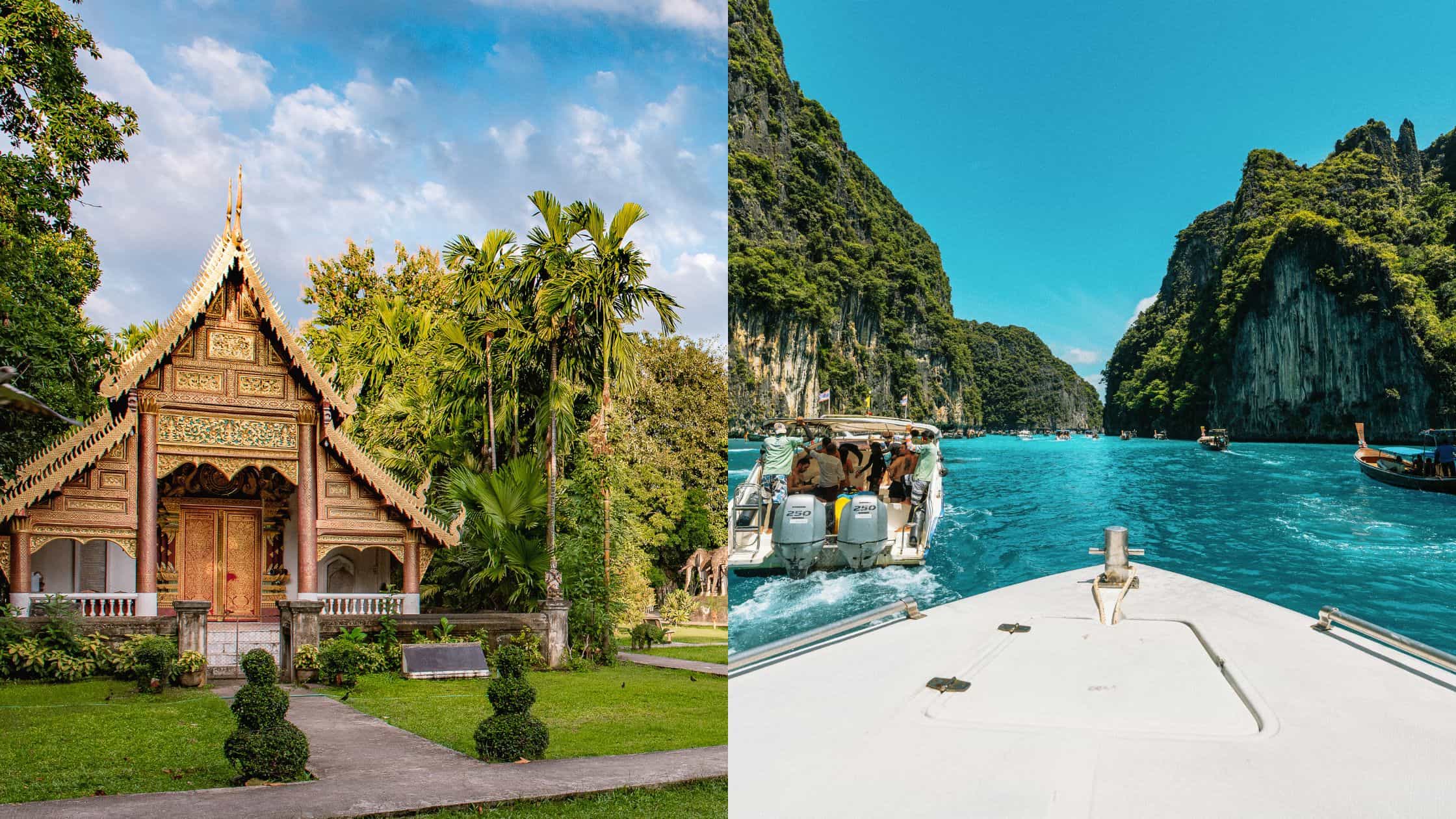
The Chiang Mai vs Phuket question comes up constantly, and for good reason: these are two cities that have almost nothing in common beyond the country they’re in.
The choice isn’t really about which is better. It’s about which version of a trip you actually want.
Both handle a lot of tourist traffic. Both have a well-worn infrastructure for international visitors. What they do with that traffic – and what they feel like from the inside – is where things diverge considerably.
Late spring and the approaching summer season make the comparison even more loaded. Weather starts to matter seriously, and what Phuket becomes in June is not the same city it was in February.
What each city actually feels like day to day
Chiang Mai is a northern city built around a moated old town, and it moves at a pace that reflects that geography. Mornings are cool for most of the year, the streets near Tha Phae Gate smell faintly of incense and grilled things, and the evening market rhythm pulls people out gradually rather than all at once.
It’s not quiet – the weekend walking street gets genuinely packed – but outside those windows, the city has a domestic texture. You hear motorbikes, see locals eating at plastic tables outside shophouses, watch temples being used by people who actually go to them.
Phuket is a different proposition. Patong is the version most people arrive to, and it is loud, lit at night like a stadium, and oriented entirely around the tourist economy. If that’s not what you wanted, it can be a disorienting first evening.
The island has quieter pockets – Rawai and Nai Harn in the south, the old town, parts of the north near Cherngtalay – but even in those areas, the underlying energy is beach-resort energy. People are there to decompress, spend, and move. The rhythm is horizontal rather than exploratory.
Neither of these is a criticism. They’re just different registers, and knowing which one fits your state of mind matters more than the destination’s reputation.
Who each city actually suits
Chiang Mai tends to work well for people who want days with some shape to them: a morning walk, a couple of hours working from a cafe, a slow lunch, an afternoon errand or temple, dinner somewhere that isn’t aimed at tourists.
Remote workers have been here long enough that the infrastructure is genuinely good – co-working spaces in Nimman, fast internet almost everywhere, monthly rental apartments at prices that make European cities feel faintly absurd.
Slow travelers, people recovering from overstimulation, and anyone who wants to feel like they’re living somewhere rather than passing through tend to settle in well.
Phuket suits travelers who want the beach to be the point. If your ideal day involves sun, water, a beach chair by late morning, and a social evening somewhere with a view, Phuket delivers that without friction. It also works well as a staging point for the surrounding islands – Koh Yao Noi, Koh Lanta from the south, the Phi Phi cluster.
The airport is large and well-connected, which makes arrivals and departures cleaner than most Thai island alternatives. Families with young children often find Phuket’s scale manageable; the beach infrastructure is built for ease.
Who should approach each with caution: Chiang Mai can feel slightly underwhelming to travelers who need stimulation from scenery and immediate visual payoff. It takes a few days to understand what the city actually offers. Phuket, particularly around Patong, can feel relentless to anyone with a low tolerance for noise and commercial energy – the kind of place that’s fine for two nights and genuinely wearing for five.
The summer question: how the season changes things
This matters significantly right now. From May through October, Phuket’s southwest coast sits directly in the monsoon. That doesn’t mean constant rain – it means heavy afternoon downpours, grey mornings, rough surf on the main beaches, and a general sense that the island is operating in a lower gear.
Many of the beach clubs and boat operators run reduced schedules. Some close entirely. The prices drop, the crowds thin, and for the right traveler that’s actually appealing – but it’s a different trip.
Chiang Mai’s rainy season is noticeably milder in character. Rain tends to arrive in the late afternoon, clears reasonably fast, and leaves the surrounding hills and gardens looking very green. The city doesn’t shut down.
Markets still run, temples still operate, and the temperature sits in a range that feels more comfortable than the dry season heat. Smoke season, which can make the air genuinely unpleasant, runs February through April – so anyone arriving now has already cleared that window.
If summer is your travel window and beach access is the main goal, the east coast of Phuket and nearby Koh Samui (served by a different regional route) stay more functional during the monsoon. But if you’re open to a city-based trip, Chiang Mai is the lower-risk choice between May and October.
If you want to travel more in Thailand, the article First-time traveler guide to Bangkok is an honest opinion about how the place feels before you get there.
Movement, pacing, and how long each place holds
Chiang Mai is walkable in a meaningful way around the old city, but the areas that many visitors gravitate toward – Nimman, the Sunday Walking Street zone, some of the temples outside the moat – require a short ride. Songthaews (red shared trucks) are cheap and consistent enough that you don’t need to plan carefully. The city rewards staying put.
A week starts to feel like genuine familiarity: you know where you get your coffee, you have a back route to the market, the evening rhythm becomes something you participate in rather than observe.
Phuket moves differently. The island is larger than most people expect, and without a scooter or a willingness to pay for taxis, movement between beaches and areas is slow. Patong to Rawai takes twenty-five minutes on a good day and forty on a bad one.
Most travelers end up anchoring to one area and making occasional sorties. That’s not a problem if you pick the right area to start with, but it does mean the first accommodation choice carries more weight than it would in a compact city.
Three to five days in Phuket is a reasonable envelope for most travelers unless the plan is to island-hop outward. Chiang Mai takes longer to open up – five to seven days starts to feel worth it, and longer stays are where the city genuinely pays off.
If you’re weighing how to balance a longer Thailand trip, the most natural sequence is Chiang Mai first (cooler temperatures, slower acclimatisation to the country) and Phuket as the beach close. The flight between them takes roughly ninety minutes and costs very little booked ahead through any of the domestic carriers.
Cost and practical texture
Chiang Mai is genuinely affordable for mid-range travel. A good guesthouse or small hotel in the old city or Nimman area sits well below what comparable comfort costs in most Southeast Asian capitals, and the food scene – particularly at the covered markets and local restaurants around the Sunday and Saturday walking streets – runs on very small amounts.
A day eating locally, working from cafes, and moving around by songthaew costs less than most people budget for it.
Phuket has a wider price spread. The beach clubs and restaurants in Patong and Surin are genuinely expensive by regional standards. Rawai and the Old Town run cheaper, and the local market food is still reasonable.
But the overall cost of a Phuket trip scales upward quickly if you’re eating and drinking in the tourist-facing areas, which is easy to drift into.
Neither city requires careful budget management for most travelers – but Chiang Mai is the more forgiving environment if that matters.
The practical question of combining both
Many travelers do both, and it works well. The flight between Chiang Mai and Phuket runs multiple times daily with AirAsia and Bangkok Airways, among others, and takes about ninety minutes. Road or train connections exist but are long enough that flying is the obvious choice for most itineraries.
A workable two-week structure: five to six days in Chiang Mai, one night in Bangkok if the connection requires it, then a week anchored in Phuket with optional day trips or a short island extension. Some travelers flip this, ending in the north, but the momentum tends to work better with beaches at the close of a trip rather than the middle.
For travelers also building out a broader Southeast Asia loop, Chiang Mai sits naturally near the border of Laos and connects toward Chiang Rai and the Golden Triangle area. Phuket connects outward toward the Andaman coast and the southern islands. They serve different parts of the same map.
Chiang Mai vs Phuket: questions travelers actually ask
Is Chiang Mai or Phuket better for first-time visitors to Thailand?
It depends on what you want the trip to feel like. Chiang Mai suits travelers who want slower days, walkable neighborhoods, and a city that doesn’t feel organized entirely around tourism. Phuket delivers faster, easier access to beaches and nightlife, with more infrastructure for visitors who want everything within reach. First-timers who find their feet better in a calmer environment usually prefer Chiang Mai; those who want sun, water, and social energy from day one tend to land better in Phuket.
Which is better for remote workers, Chiang Mai or Phuket?
Chiang Mai has a longer-established remote work infrastructure: co-working spaces in the Nimman and old city areas, reliable internet in most cafes, and a cost of living that makes extended stays genuinely sustainable. Phuket has caught up considerably, especially in areas like Rawai and Cherngtalay, but the rhythm there tends toward shorter stays and holiday mode rather than productive weeks.
Is Phuket worth visiting in summer, or should I go to Chiang Mai instead?
Phuket’s southwest coast takes the full force of the monsoon from May through October, with rough surf and grey skies that make many beach days impractical. The east coast and some nearby islands stay more accessible, but the experience shifts considerably. Chiang Mai’s rainy season is milder: afternoon rain, lush surroundings, and a city that functions normally. For a summer trip, Chiang Mai is the more reliable choice if weather consistency matters to you.
How long do you need in Chiang Mai versus Phuket?
Chiang Mai opens up slowly. Three days gives you the surface; a week starts to feel like something real. The city rewards staying rather than rushing. Phuket tends to work on a shorter timeline for most travelers: three to five days covers the main areas without much repetition, though longer stays make sense if you’re island-hopping from there as a base.
Can you combine Chiang Mai and Phuket in one trip?
Yes, and the combination is common. The two cities are far apart by road, so most travelers fly between them – roughly ninety minutes and very affordable when booked in advance. A logical sequence is Chiang Mai first for a slower, cooler start, then Phuket as the beach end of the trip. Reversing that order works but tends to feel slightly anticlimactic once you’re back in a city after the water.