
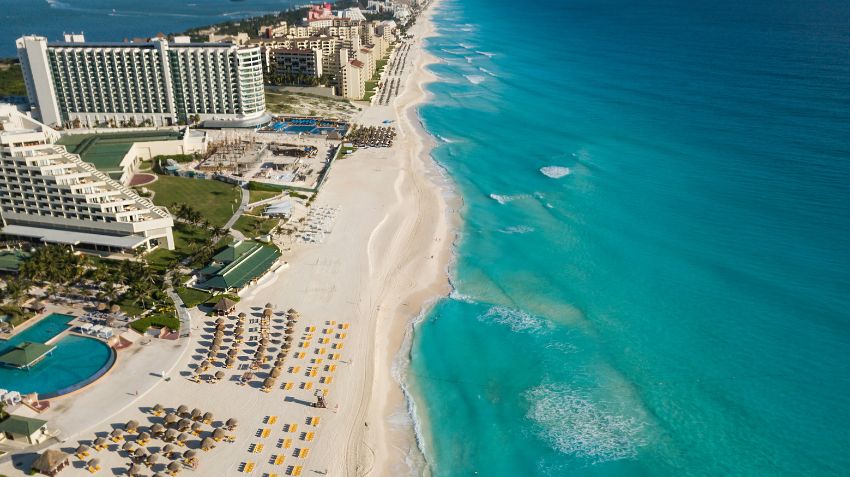
The Caribbean introduces Cancún before you even land: turquoise lagoon on one side, open sea on the other and a narrow coastline built around the water. This first-time guide reveals how Cancún actually feels, moves and fits into the trip you imagine.
Cancún offers two distinct experiences. The Hotel Zone brings beachfront resorts, late evenings and effortless access to the Caribbean, while downtown adds local markets, street food and the energy of a working Mexican city. Understanding both makes choosing where to stay much easier.
July brings warm water, tropical greenery and quieter resort days. Mornings invite exploration, brief afternoon showers cool the air, and lower prices create an appealing window for experiencing Cancún at a more relaxed pace.
What Cancún feels like for first-time visitors
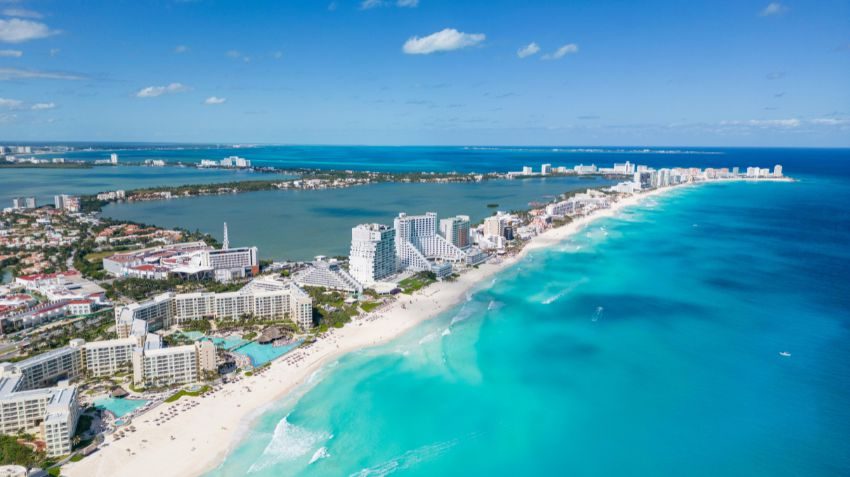
The Hotel Zone is long – roughly twenty-five kilometres of boulevard with resorts, malls and beach clubs on one side and the lagoon visible through the gaps on the other. Walking the whole strip is not how people move here; the R-1 bus runs the length of it continuously, fares are low, and the stops are frequent enough that the corridor becomes easy to navigate once you’ve done it once.
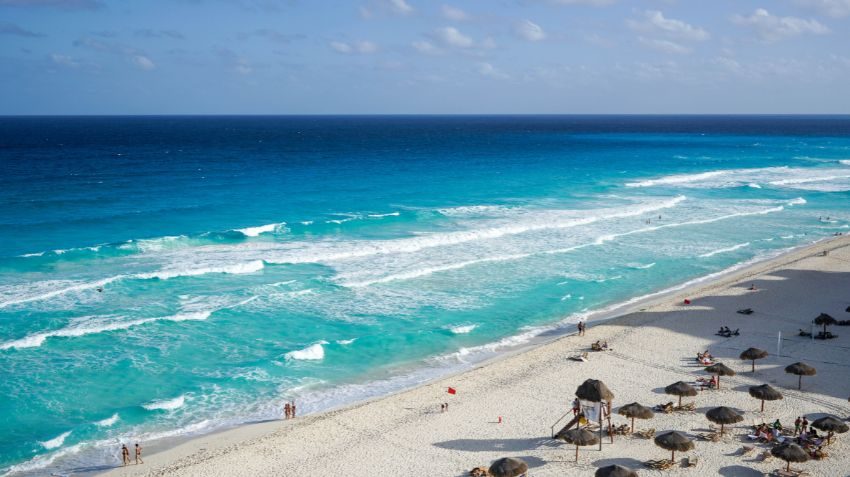
The beach itself is what the zone is built around: fine white sand, shallow turquoise water that stays warm through July, and a consistent shoreline that changes character across the day rather than within it.
Mornings along the beach have a particular quality that afternoon visitors miss. The light is lower, the sand is cooler underfoot, and the water reflects something closer to green than blue before the sun climbs. By late morning the beach fills, and by midday it’s at its most active – families and groups spread across the sand, vendors moving along the edge, music from the nearest beach clubs carrying along the shore.
Late afternoon brings the rain most days, and after it passes the evening opens up: the water is calmer, the air is several degrees cooler, and the restaurants around the Hotel Zone come alive in a way that makes the evening the part of the day many visitors remember most clearly.
Downtown is a different pace entirely. The Mercado 28 area has a local market density that the Hotel Zone doesn’t attempt, and the streets around Avenida Tulum feel like a city rather than a resort. It’s worth an afternoon, particularly for anyone who wants to eat Mexican food that hasn’t been calibrated for international menus. The taxi and bus connections between downtown and the Hotel Zone are straightforward; the distance feels more conceptual than physical once you’ve made the trip.
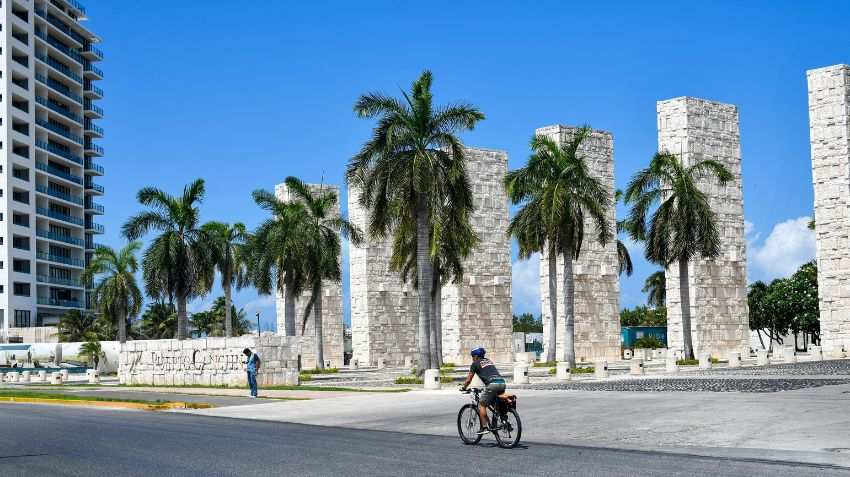
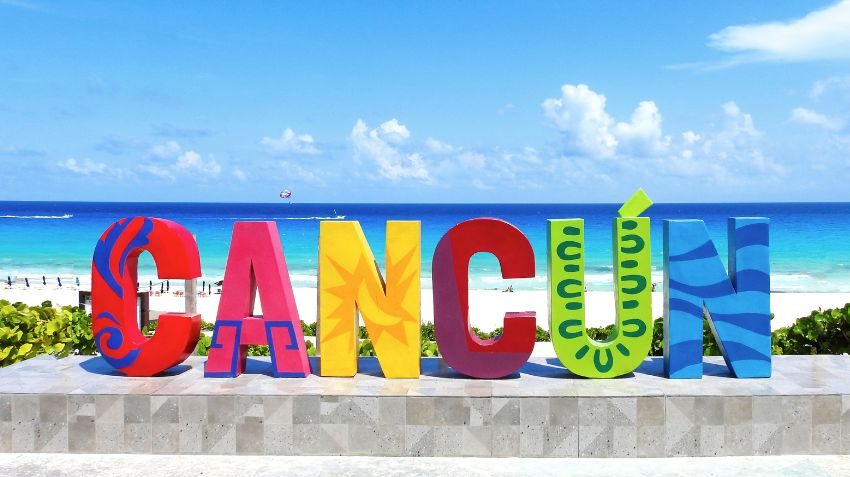
Cancún in photos

Is Cancún right for your travel style?
Cancún works reliably well for a specific kind of first visit: one where the goal is warm water, a comfortable base and low planning overhead. The infrastructure is tourist-facing and intentionally so – transport from the airport is clearly signed, hotels range from budget to large all-inclusive resorts, and the beach is the organizing principle of the day. For travelers who want to arrive and immediately be in the Caribbean without navigating a city, the Hotel Zone delivers that without much effort required.
It fits less naturally for travelers who want cultural immersion, walking exploration across varied neighborhoods, or a local rhythm underneath the tourist layer. Those things exist in downtown Cancún, but they require more deliberate effort to reach, and the Hotel Zone itself is not built around them. Travelers doing the Yucatán Peninsula with Cancún as an entry or exit point – using it as a base for Isla Mujeres, Playa del Carmen or further south – tend to find the arrangement works well: the Hotel Zone gives them a comfortable anchor, and the surrounding region provides everything else.
How to get around Cancún as a first-time visitor
The R-1 bus is the most practical way to move along the Hotel Zone for travelers who aren’t on an all-inclusive plan. It runs the full length of the boulevard and operates frequently enough that waiting is rarely an issue. Fares are low and the route is direct, so even on a first day it feels manageable. For trips downtown or to the ferry terminal for Isla Mujeres, taxis from hotel ranks or ride-hailing apps are the standard options; the distances aren’t large and the cost is predictable.
Cancún’s airport sits at the southern end of the Hotel Zone, which makes the arrival journey unusually simple. ADO buses connect Terminals 2 and 3 directly to the Hotel Zone and downtown at a fixed price displayed at the terminal exit. Authorized taxi ranks operate at the same exits. The journey into the heart of the Hotel Zone takes under thirty minutes in normal traffic, and the clear airport signage makes the arrival logistics among the simplest of any major Caribbean destination.
For Isla Mujeres, the ferry from Puerto Juárez – north of downtown – runs frequently throughout the day and the crossing takes roughly twenty minutes. The island has its own internal movement logic: golf carts for rent, short walking distances between the main pier and the northern beaches, and a pace that shifts noticeably when you leave the ferry terminal and walk into the village.
Playa Langosta and El Pueblo on the northern tip have the shallow water that gives Isla Mujeres its particular reputation, and the light at either end of the day on that stretch of coastline is worth timing a trip around.
Day trips and nearby stops worth adding to a Cancún trip
Isla Mujeres is the most natural continuation from the Hotel Zone and the one that consistently delivers a different register without requiring much effort to reach. The thirty-minute ferry from Puerto Juárez deposits you into a village of coloured buildings and narrow streets where the pace is visibly slower and the water on the western side is some of the calmest swimming anywhere in the area.
Most day-trippers return for dinner, but those who stay overnight find the island after the day-trip crowd leaves has a distinct quality: quieter streets, the sound carrying further, the Caribbean keeping its own hours.
Playa del Carmen sits about an hour south along the coast highway, accessible by ADO bus from downtown Cancún, and introduces a different urban beach energy – a walking street, more café culture and a more varied neighbourhood feel. Tulum is further still, and better suited as an extension of a longer Yucatán trip than as a day trip from Cancún.
For travelers interested in Mayan ruins, Chichén Itzá is the most visited option from Cancún and sits roughly two and a half hours inland; early departures are the standard advice because the ruins receive the full heat of midday and the crowds arrive with it.
Explore Cancún by season to find the window that fits your pacing and budget.
Is Cancún worth visiting for a first trip to Mexico’s Caribbean coast?
For what it is, Cancún is very good. The beach is genuinely beautiful in the way that Caribbean beaches earn the description through specificity rather than superlative – fine sand, warm shallow water, a colour range in the sea that changes through the day and rewards early mornings and late afternoons in particular.
The Hotel Zone makes access to that beach easy and the surrounding infrastructure – transport, food, onward connections – works smoothly enough that a first trip here rarely involves the kind of logistical texture that a more complex destination would bring.
Cancún first-time visitor FAQ: days needed, best time, Hotel Zone, airport and what to expect
1. How many days do you need in Cancún as a first-time visitor?
Most first-time visitors find four to five days enough to move through the Hotel Zone, spend a full day on Isla Mujeres and have time to settle into a slower pace. Three days works if the trip is focused on the beach; more days open up Isla Contoy, Playa del Carmen or the Tulum corridor.
2. Is July a good time to visit Cancún?
July sits inside Cancún’s high-heat, early-hurricane-season window, with warm water, full beach activity and the occasional afternoon storm that clears quickly. Prices are lower than the December-to-March peak, and the Caribbean stays swimmable throughout.
3. Is the Hotel Zone worth staying in for a first trip?
For a first visit, yes. The Hotel Zone puts the beach directly outside the door and keeps movement simple, which suits travelers who want Caribbean water without planning overhead. Downtown Cancún trades that convenience for a quieter, more local rhythm and lower accommodation costs.
4. How do you get from Cancún airport to the Hotel Zone?
ADO buses connect both terminals to the Hotel Zone and downtown at a fixed price clearly displayed at the terminal; authorized taxi ranks operate at the same exits. The journey into the Hotel Zone takes under thirty minutes in normal traffic.
5. What is Cancún actually like beyond the beach?
The Hotel Zone is primarily a beach-and-resort corridor, but the Caribbean backdrop genuinely delivers what it promises, and the ferry crossing to Isla Mujeres introduces a quieter register entirely: narrow streets, coloured facades, shallow water in shades that are difficult to overstate.