
Tokyo is where most first trips to Japan begin, and it sets an unusual standard. Not because it is the most photogenic entry point, but because it makes the country legible faster than anywhere else. The infrastructure is precise, the neighborhoods are distinct, and the daily rhythm of the city, once you locate it, feels surprisingly navigable.
The first two days tend to involve recalibration. Jet lag plus sensory density plus a transit system that runs 13 overlapping lines through the same stations is a genuine cognitive load, and most people underestimate it.
By day three, it clicks, but by day five, it starts to feel like somewhere you could actually live, which is when Japan begins to make a different kind of sense entirely.
What Tokyo is like for first-time visitors
The scale is the first thing. Maps do not communicate it, and photos do not either. Shinjuku Station alone processes around 3.5 million passengers daily, and walking from one end of the complex to another takes fifteen minutes if you know where you are going. You will not know where you are going for the first day. That is entirely normal.
Street-level Tokyo is quieter than the station infrastructure suggests. Residential neighborhoods between the tourist corridors are calm, often startlingly so, with narrow lanes, small parks, and almost no ambient noise beyond the occasional vending machine hum. The contrast between a major interchange and the block behind it is one of the defining textures of the city.
Late spring and early summer bring long evenings and outdoor movement until well past 21:00. Convenience stores (open twenty-four hours, genuinely good for fast meals) become reference points and informal navigation anchors.
The city runs on precision: trains are rarely late, staff interactions are handled with practiced efficiency, and queues form and dissolve without friction. For travelers who find urban chaos draining, this quality is significant.
Is Tokyo right for your travel style?
Tokyo works well for travelers who can function independently, move at their own pace, and enjoy discovering the logic of a place incrementally. It is particularly well-suited to solo travelers, remote workers looking for a longer base, and people drawn to extreme urban competence without social performance requirements.
Solo dining is not just accepted here; it is infrastructurally accommodated, with counter seats and single-portion ordering at every price point.
The city is harder for travelers who need spontaneous social warmth or easy verbal exchange with locals as part of their daily energy. It is not unfriendly, but social interaction tends to be transactional rather than casual, and language overlap is limited outside the main tourist corridors.
High-stimulation sensitive travelers will also find the transit peak hours, which run from approximately 08:00 to 09:30 and again from 18:00 to 20:00, genuinely overwhelming inside major stations. Those hours are worth routing around for the first few days.
Families with young children do manage Tokyo well, but the walking load is real: a typical sightseeing day covers 15,000 to 20,000 steps across uneven distances. Strollers work on most flat surfaces but become complicated in older station corridors and on some shopping street stairs.
How to spend your first week in Tokyo
One neighborhood per half-day is about the right tempo for a first visit. Trying to cross the city more than once a day adds transit time that feels invisible on the map but costs forty to sixty minutes each way, which is significant across a week.
The general pattern that works: anchor your accommodation in a central but not peak-chaos neighborhood (Asakusa, Ueno, and Shinjuku’s western side all offer good access without the worst of the evening noise), then radiate outward. Shibuya and Harajuku to the southwest, Yanaka and Ueno to the north, Shimokitazawa for an afternoon when you want the city to feel quieter.
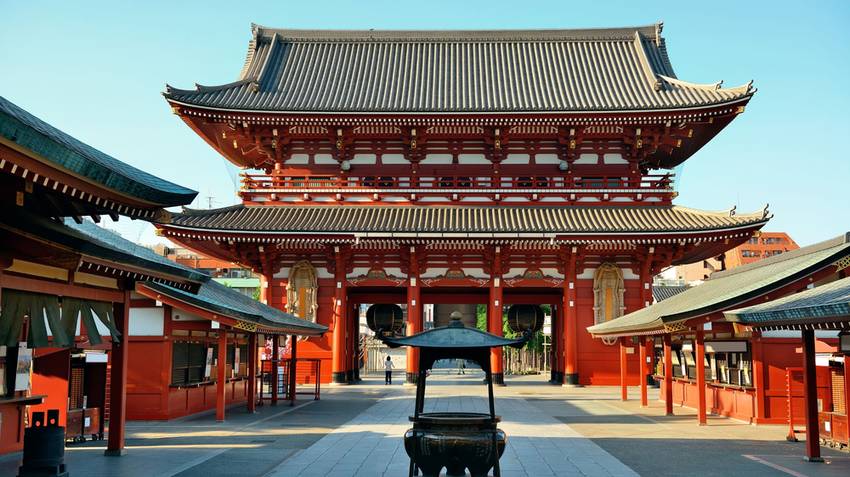
Mornings are calmer and worth protecting for neighborhoods that get loud by midday. Senso-ji Temple in Asakusa, for example, is a different experience at 07:30 than at 11:00, when tour groups compress the main approach into a slow shuffle. The same logic applies to the Tsukiji outer market, where the best movement happens before 10:00.
Evenings in Tokyo reward slowing down. Dinner rarely needs to be before 19:00, many ramen and izakaya spots run until midnight, and the city’s night texture is different enough from the day version to be worth staying out for. The metro runs until around midnight on most lines, after which taxis are available but meaningfully more expensive.
How to get around Tokyo as a first-time visitor
Tokyo’s transit network is run by multiple operators, which is the source of most newcomer confusion. The Tokyo Metro and Toei Subway are two separate systems; JR East runs the above-ground rail including the Yamanote Line loop; private operators (Tokyu, Odakyu, Keio) run additional suburban lines.
IC cards (Suica or Pasmo) work across all of them and remove the need to buy individual tickets, which is the single most useful thing to know before arriving.
Google Maps handles transit routing accurately and includes real-time delays. Once you trust it, navigation becomes manageable even without reading Japanese. Station names are always in Roman script on platform signage and inside carriages.
Haneda Airport is about 30 to 40 minutes from central Tokyo by direct rail and is significantly easier to arrive at than Narita, which sits further out and runs 60 to 90 minutes by train depending on the service. If you have a choice between the two airports on arrival, Haneda is the easier first-day experience.
Tokyo’s rail density changes how accommodation decisions work compared to many other large Asian cities. In Bangkok, for example, where BTS and MRT coverage leaves more gaps between neighborhoods, staying in the right area has a much stronger effect on daily movement and transit fatigue.
The Bangkok neighborhood guide breaks down that contrast in more detail for travelers building a broader first Asia itinerary.
Best Tokyo neighborhoods for first-time visitors
Shinjuku is convenient and never boring, but it is also loud, saturated with competing stimuli, and draws crowds that make its best streets feel narrow after 18:00. It suits travelers who want maximum access and can tolerate the noise level as background.
Asakusa has an older texture: low buildings, a preserved shopping street, proximity to the Sumida River. It is the closest Tokyo comes to a slower urban register, and it works particularly well for first-timers who want to ease in before committing to the full density of Shinjuku or Shibuya.
Shimokitazawa and Yanaka are the neighborhoods travelers discover on day four or five when they start looking for something quieter. Shimokitazawa has vintage shops, small live music venues, and a residential calm that feels like a different city. Yanaka has temple alleys, small craft shops, and a street pace that invites wandering without a plan.
Staying in any of these requires commuting to the larger attractions, but Tokyo’s transit makes that largely frictionless once the IC card system becomes second nature.
Best day trips from Tokyo
Tokyo positions itself well for onward movement within Japan. Kyoto is 2h15m by Shinkansen, Hakone is 85 minutes from Shinjuku, and Nikko is under two hours by rail. These are realistic half-day or overnight additions rather than separate trip decisions, and they change the character of a Japan visit considerably.
Spring (late March to early April) compresses crowd volumes at certain parks and temples to a degree that makes some areas difficult to move through comfortably. The experience is worth it for many travelers, but the density is real, and accommodation books out months in advance.
Late spring through early June, the period the city is moving through now, offers better availability, long evenings, and lower competition at most sites without the summer heat that sets in properly by July.
July and August are hot in a specific way: high humidity and low wind in the urban canyon streets means the temperature differential between a shaded interior and a sunlit pavement can span eight to ten degrees. Moving between air-conditioned buildings with brief outdoor transitions is the natural pace the city adopts, and most travelers follow it without needing to be told.
For travelers curious whether a longer-stay rhythm might suit them better than a conventional itinerary, Tokyo functions well as a slow-travel base, a quality it shares with cities like Lisbon. The Lisbon first-time guide covers a city that sits at the opposite end of the density spectrum, which is worth reading if the scale of Tokyo gives you pause before committing.
Best time to visit Tokyo
Tokyo is not a gentle introduction to travel. It is an advanced city in terms of cognitive demand, physical load, and navigational complexity. The payoff is that it is also extraordinarily efficient and, once you have spent a few days inside it, surprisingly easy to be alone in without feeling lonely.
The cost, in practical terms, is mostly temporal. You will spend more time than expected in transit. You will walk further than your feet anticipated. You will arrive at a temple or market that you planned to spend two hours in and find that the surrounding streets absorbed three.
That is not a problem; it is the texture of the city, but it does mean aggressive itineraries tend to fall apart by day three, and people who build in space for drift tend to come away feeling they understood Tokyo better than those who did not.
Budget travelers can keep costs reasonable by eating at convenience stores and lunch sets and staying in well-located capsule hotels or guesthouses, but accommodation in Tokyo is priced at a level that surprises many European and Southeast Asian travelers. The food cost ceiling is lower than most expect; the accommodation cost ceiling is higher.
Is Tokyo a good starting point for Japan?
Tokyo as a first Japan experience suits travelers who are comfortable with urban density, capable of navigating without language support, and willing to pace themselves through a city that rewards patience over ambition.
It works well for solo travelers, for couples who share a tolerance for high-stimulation environments, and for anyone drawn to the specific pleasure of a city that functions without visible effort.
It asks for a few days of trust before it gives back. The first afternoon, particularly arriving by Narita and clearing customs into the Narita Express, is long and fatiguing, and the city does not make a warm first impression at the station exit.
By the time you have had one morning walk in a quiet neighborhood, one bowl of ramen at a counter seat, and one evening where the metro takes you exactly where you intended, Japan as a travel experience becomes something distinct and coherent. That usually takes about 72 hours.
The travelers for whom it does not fit well tend to be those seeking easy social warmth, those with limited tolerance for walking, or those who need narrative coherence in a destination to feel anchored.
Tokyo is made of layers that take time to read, and not everyone has the patience for that kind of city. Those who do tend to find it one of the more rewarding first encounters with the country.
First-time Tokyo questions
1. How many days do you need in Tokyo for a first visit?
Most first-time visitors find five to seven days enough to settle into the rhythm and cover a few neighborhoods properly. Less than four days means spending most of the trip in transit and adjustment mode rather than actually experiencing the city.
2. Is Tokyo easy to navigate without speaking Japanese?
Practically speaking, yes. Major station signage is bilingual, Google Maps handles transit routing reliably, and convenience store staff are accustomed to non-verbal transactions. The main friction is in smaller local restaurants where menus are picture-only or handwritten in Japanese.
3. When is the best time to visit Tokyo for first-timers?
Spring and autumn are the most comfortable in terms of temperature and crowd energy. Summer is hot and humid from late June onward, which is manageable but physically demanding. Winter is dry, mild by European standards, and quieter, though some outdoor experiences lose their appeal.
4. Which Tokyo neighborhood is best for a first-time visitor to stay in?
Shinjuku and Shibuya are the most common starting points for first-timers because of central transit access, though both are loud and high-stimulation environments. Asakusa offers slightly lower density with better walking texture for those who prefer a slower base. Shimokitazawa and Yanaka suit travelers who want a more residential feel from the beginning.
5. How difficult is it to plan a first trip to Japan around Tokyo?
The main planning load is accommodation booking (Tokyo fills fast for peak seasons), understanding the rail pass tradeoffs if you plan side trips, and deciding whether to anchor in one neighborhood or move. Day-to-day navigation is significantly easier than the planning phase suggests.