
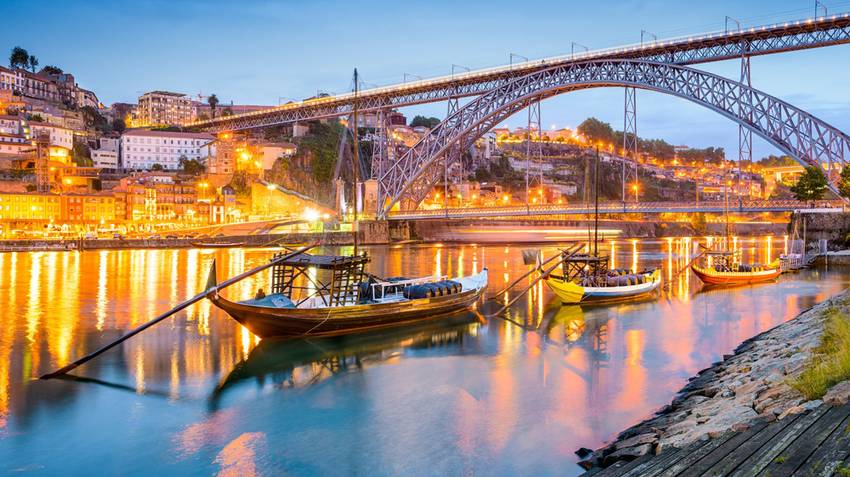
Porto arrives on you quickly. The river, the tiled facades catching the afternoon light, the smell of river air mixing with espresso from a counter somewhere just inside a doorway – the city rarely feels staged, which is part of its appeal.
Within a few hours, you can find yourself crossing viewpoints above the Douro, wandering steep streets that seem unchanged for generations, and understanding why so many travelers leave wanting more time than they planned. As a first-time traveler guide to Porto, what follows is less a list of things to tick off and more an explanation of what the place actually feels like once you’re moving through it.
It’s a city built on hills descending toward the Douro, which means almost every walk involves either a climb or a long, satisfying descent with a view opening in front of you. The scale is human. You can be genuinely lost and genuinely oriented at the same time, which is an unusual quality in a European city of this size.
Spring suits it particularly well. The days are warm without forcing you indoors by noon, the light on the azulejo tiles is generous, and the city is beginning to shift toward its summer rhythm without having fully committed to it yet. If you’re reading this in May or June, you’re looking at one of the better windows in the calendar.
What Porto actually feels like on the ground
The tempo here is slower than Lisbon and considerably slower than any northern European capital you might be carrying in your head for comparison. Mornings are unhurried. The first coffee of the day tends to become a longer thing than you planned. Breakfast drifts, conversations happen at counters, and there’s no particular pressure to be somewhere by a specific hour.
The Douro is a constant presence and a genuine organising principle. The Ribeira waterfront pulls people naturally toward it, and the line of port wine lodges across the river in Vila Nova de Gaia gives the view a kind of weight that most riverfronts don’t have. You end up spending more time near water than you expected.
Two streets back from the river, the city changes considerably. The tourist volume drops, the streets narrow, and you start encountering Porto as a place people actually live in – laundry above, a cat on a windowsill, a woman carrying groceries past a doorway that hasn’t changed in forty years. That transition happens fast, and it’s one of the better things about the city’s density.
Who Porto fits, and who should think twice
Porto works particularly well for travelers who don’t need constant programming. The city rewards wandering, slow meals, and afternoons without a fixed plan. If your natural pace involves sitting with a second coffee and watching a square for twenty minutes, you’ll feel at home here in a way that a more agenda-driven traveler might not.
It also suits people who want a European city with genuine texture but without the management overhead of somewhere like Rome or Barcelona in high summer. Porto is busy in July and August, but “busy” here means you’ll share a viewpoint with fifty people, not five hundred. The city’s geography keeps crowds from pooling in the same way a flat city would.
Travelers who need a dense schedule of ticketed attractions or who find pleasure primarily in nightlife volume may find Porto underwhelming. The evening scene is present but low-key by southern European standards – terraces, wine bars, some live music in specific corners of the city. It ends earlier than Lisbon. If late nights and high social energy are the priority, that’s a tradeoff worth naming before you book.
Porto’s neighborhoods and where to anchor a first visit
Ribeira is the obvious starting point and the obvious tourist centre. It’s where the postcard views are, where most of the restaurants aimed at visitors cluster, and where cobblestones meet the riverbank in the way that ends up on everyone’s camera. It’s worth being there, but it’s not where Porto’s character lives most fully anymore.
Bonfim, directly east of the historic core, is where a lot of that character has settled. It’s residential in feel, with local restaurants and cafés alongside newer independent spots, and the streets there in the evening feel genuinely inhabited rather than performed. Staying here adds a short walk to the main sights but subtracts the persistent tourist density of the waterfront area.
Cedofeita and Lordelo do Ouro sit further west and northwest, quieter still, and suited to travelers on a second or longer visit rather than a first one. Foz do Douro, where the river meets the Atlantic, is worth a half-day but works better as an excursion than a base.
The metro covers the city’s major points efficiently. Six lines, clear signage, and a direct connection from the airport mean that most first-timers find their bearings quickly. The physical terrain is a different calculation: Ribeira and the cathedral district involve real gradient, and a suitcase on cobbles is exactly as difficult as it sounds. Arriving with lighter luggage or choosing accommodation with step-free access isn’t overthinking it.
How days unfold here, and how to pace them
Porto resists an early start. Most of the best experiences – a proper breakfast, the light on the river, a café where the same person has been making coffee since 7am – are available early, but the city doesn’t really open socially until mid-morning. By 10 or 11, the rhythm is established.
Afternoons tend to organise themselves around the miradouros – the hilltop viewpoints that give you the whole city at once. Serra do Pilar across the river in Gaia is the one most visitors reach, usually via the lower level of the Luís I Bridge. The ascent from Ribeira to the upper bridge level is steep, and by early afternoon the exposed sections accumulate warmth. Early morning or late afternoon are the more comfortable windows for that particular walk.
Evenings extend naturally toward dinner, which happens later than visitors from northern Europe expect – 20:00 is not early here, and most local restaurants are still filling at 21:00. The port lodges in Gaia offer tastings through late afternoon and into the evening, and the cable car back down gives you the river lit differently than you saw it at noon.
Three days is the honest minimum for a first visit. Four days allows the place to settle into something more familiar. Travelers who arrive for a long weekend and leave before the second evening has properly started often report that they left just as the rhythm clicked.
Where Porto sits relative to nearby alternatives
The comparison that comes up most often is Lisbon, and it’s a genuinely useful one. Lisbon is larger, faster, and more cosmopolitan in the way a capital city tends to be. Porto is more contained, more immediately legible, and in some ways more forgiving for a first visit precisely because the scale doesn’t overwhelm. Travelers who haven’t decided between the two will find the Lisbon vs Porto first-timer comparison a cleaner way to work through the tradeoff than trying to hold both cities in mind at once.
Beyond Portugal, travelers who respond well to Porto’s combination of hillside terrain, waterfront orientation, and a city that rewards slow movement sometimes find themselves drawn toward similarly-scaled cities elsewhere – Naples has the same quality of texture and intensity in a different key, and the Naples neighbourhood fit read covers much of the same compatibility logic for travelers already thinking in those terms.
Braga and Guimarães are both within an hour of Porto and work well as day trips. Vinho Verde country sits immediately north. The Douro Valley is reachable by train or boat in a few hours, and for travelers with four or five days it represents a natural extension of what Porto has already started.
A practical note on timing and the summer shift
The city you encounter in May or June is noticeably different from the one that arrives in late July. Summer brings a significant increase in visitor volume, particularly in Ribeira and along the main miradouros. The city handles it reasonably well, but the quieter version of Porto – the one where you can sit on the bridge for ten minutes without sharing it with a crowd – is a spring or early autumn experience rather than a high-summer one.
June’s Santo António festival (around the 13th) brings the city to a different kind of life: neighbourhood parties, sardines grilling in the streets, music from doorways that weren’t open the night before. It’s worth knowing about if you’re passing through in that window. The atmosphere that week is genuinely different from the rest of the calendar.
What Porto suits, and when it works best
Porto works for people who want a city that feels earned rather than managed. It has genuine scale, genuine character, and a pace that rewards travelers willing to slow down enough to notice it. The terrain is real – you will walk uphill, your feet will register the cobblestones by day two – and that physical texture is part of what makes the city feel different from somewhere built for easy movement.
A first-time traveler guide to Porto can only do so much before the city takes over and explains itself. Three or four days in late spring, a base in Bonfim or the quieter edges of Ribeira, an afternoon without a plan along the river – that’s the framework most visitors land on, and it tends to hold.
The city suits travelers in a particular kind of state: curious, unhurried, open to a day that drifts pleasantly sideways. It suits them less when they arrive with a tight schedule, a long list, or the expectation that the best version of Porto will be legible immediately. It takes a day to understand, and that day is worth giving it.
If you’re planning a first trip and still weighing the Portugal question more broadly, the first-time guide to Lisbon covers the same territory from a different city’s angle – useful for understanding what you’d be choosing between rather than what you’d be missing.
First-time visitors to Porto: common questions
1. When is the best time to visit Porto for a first trip?
Late spring and early autumn sit comfortably at the top of most first-timers’ calendars. May and June offer warm days, longer light, and fewer people than July and August, when visitor volumes are at their highest. September holds similar warmth with a noticeably calmer pace across the city.
2. How many days do you need in Porto for a first visit?
Three full days gives you enough time to absorb Porto’s rhythm without rushing. The city rewards slow movement more than itinerary density, and most first-timers find a fourth day useful simply because the neighbourhood dynamics take some time to settle into. Porto is one of those places where the second half of the stay tends to feel significantly better than the first.
3. Is Porto easy to get around without a car?
Yes, and for most first visits a car would be more inconvenience than help. The metro runs directly from the airport to the centre in around 35 minutes, and most of what first-timers want to see is walkable from Ribeira, Baixa, or Bonfim. Foz do Douro and the Douro Valley require more planning, but the city itself is genuinely accessible on foot and by transit.
4. How does Porto compare to Lisbon for a first visit?
Porto is smaller and more immediately legible than Lisbon – most visitors have a working mental map within the first day. The pace is slower, the scale is more human, and the city’s character comes through faster. Lisbon has more range and more cosmopolitan energy, but Porto tends to feel more like a place and less like a destination, which some travelers strongly prefer.
5. Which neighbourhood should first-time visitors stay in?
Ribeira is closest to the river and the historic core, with the constant background of tourist activity that comes with that position. Bonfim, just east, sits within easy walking distance of everything while offering a quieter and more residential feel – in the evenings especially, it’s where Porto sounds most like itself.