
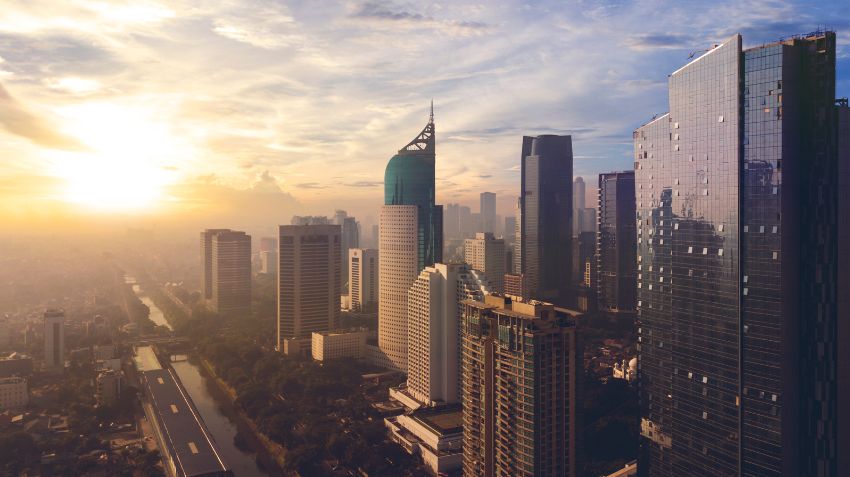
Jakarta doesn’t announce itself the way some capitals do. The first impression is usually scale – a long arrival road from Soekarno-Hatta, towers stacking up along the skyline, the city spreading in every direction without an obvious center to anchor to.
That openness is part of what makes it worth understanding before arriving, and this first-time traveler guide to Jakarta is built around exactly that: not a tour of highlights, but a working sense of how the city actually feels to move through.
Southeast Asia’s largest city carries about 34 million people across its greater metropolitan area, and it holds them in a layered, neighborhood-based logic rather than a compact tourist zone. There are places where the colonial Dutch-era grid still reads clearly, places where glass towers face warung stalls across a single lane, and places where the evening slows into something almost village-like. The city rewards travelers who stop trying to orient it like a European capital and start reading it on its own terms.
Movement here runs on ride-apps. Food is the primary organizing principle of most evenings. The heat is consistent, the humidity is genuine, and the city keeps going well past midnight in most neighborhoods. Once those rhythms click, Jakarta becomes considerably easier than its reputation suggests.
What Jakarta, Indonesia feels like for visitors
The heat is the first thing. Jakarta sits close to the equator, and temperatures hold steady between 30 and 33°C year-round with humidity that makes the air feel thicker than the thermometer suggests. By early afternoon, most outdoor activity naturally compresses into shaded corridors, air-conditioned interiors, or the slower pace of a long lunch. That’s not a warning so much as a description of how the city already operates – Jakartans have structured daily life around it for generations.
The street-level texture shifts dramatically by district. Kota Tua, the old colonial core near the north port, has wide plazas, peeling Dutch facades, and a tourist register that runs at a different tempo from the rest of the city. Ten minutes south by ride-app and you’re in Glodok, Jakarta’s Chinatown, where temple alleyways run beside electronics markets and the smell of incense and frying shallots arrives before the street does. Further south again, Menteng feels almost residential – tree-lined roads, embassies behind walls, a mid-century civic architecture that most visitors miss entirely.
The MRT cuts a clean north-south line through the city’s main corridor, and for first-time visitors it’s the easiest way to understand Jakarta’s structure without getting lost in traffic. Riding it from Lebak Bulus in the south to Bundaran HI near the old commercial center gives a compressed version of the city’s economic geography in about 45 minutes – modern malls at the southern end, older commercial density as you move north, the city loosening slightly into colonial-era horizontality near the upper stations.
Is Jakarta right for your travel style?
Jakarta works well for travelers who are comfortable building days around food, movement, and atmosphere rather than a fixed sequence of sights. The city’s real appeal is experiential: a long breakfast in a warung with no English menu, a detour through a market that wasn’t on any list, an evening that starts with street-side sate and ends somewhere unexpected. Travelers who need a clear sightseeing circuit and measurable daily outputs tend to find Jakarta’s scale harder to navigate. The city is vast, its monuments are spread wide, and the satisfaction often comes from the in-between rather than the destination.
Solo travelers and small groups tend to find it more immediate than families with young children, mainly because of the movement logic – most enjoyable segments of the city require flexible transit and some comfort with spontaneity. Travelers on tight timelines who are using Jakarta as a gateway to Yogyakarta, Bali, or the rest of Java will find two days enough to get a real feel for it without needing to decode the whole metropolitan system.
Those who thrive here usually share one trait: curiosity about how a megacity actually functions, not just how its tourist layer presents itself. Jakarta doesn’t perform for visitors in the way Bali or Bangkok sometimes do. It runs its own life at full speed, and the experience of watching and joining that is what the city offers.
How to plan your first days in Jakarta
Mornings are the most productive window. The heat is lower before 10:00, the city’s commute has peaked and settled, and food stalls that run from early morning often wind down by mid-morning. The time between 08:30 and 12:00 is consistently the best window for outdoor movement, market visits, and the kind of wandering that makes a city legible.
Afternoons shift indoors. Jakarta’s mall culture isn’t just commercial – it’s thermal and social. Grand Indonesia, Plaza Indonesia, Pacific Place, and Senayan City are all genuinely interesting as spaces, and the food halls inside them carry local food variety that matches or exceeds most street corridors in scope. Spending an afternoon in one of them isn’t capitulating to convenience; it’s participating in how the city actually uses those spaces.
Evenings are when the city opens back up. After 18:00, warungs and street food corridors fill steadily, the noise level rises across most districts, and the city settles into a social rhythm that runs late. Jalan Sabang near Menteng has a long strip of late-night food options. Kemang, further south, runs a different register – bars, cafes, a slightly younger creative crowd, traffic that slows rather than stops. Blok M draws a mix that spans generations, and the basement food hall there has a kind of organized informality that feels very Jakarta.
Ride-apps are the connective tissue. Gojek and Grab both function reliably across the city, prices are low by international standards, and the waiting time in most central areas is under five minutes. Walking between districts is not the city’s logic – the distances and sidewalk continuity don’t support it the way they do in Hanoi or Kuala Lumpur. Building days around two or three neighborhood anchors connected by ride-app is both more efficient and more pleasurable than trying to cover ground on foot.
Best Jakarta neighborhoods for visitors
Kota Tua anchors the northern end of the visitor circuit. The main square (Taman Fatahillah) reads differently at different hours – midday is warm and relatively quiet on weekdays, weekend afternoons bring school groups and families cycling the plaza on brightly colored rental bikes, and the museums along the square’s edge (including the Jakarta History Museum and the Wayang Museum) give the area historical depth without long queuing. The surrounding streets carry a mix of renovation and decay that feels more honest than a fully restored heritage district.
Menteng is the colonial residential grid south of the city center – quiet, leafy, with some of Jakarta’s better independent cafes and older warungs in the surrounding streets. It sits directly on the MRT and works well as a base or as an afternoon slow-walk between the heat and dinner. The Taman Suropati park at its center holds local social life at almost any hour of the day.
Kemang and the southern corridor (SCBD, Senayan, Blok M) run a more contemporary city rhythm – restaurants that stay open late, parks that fill on weekend mornings, and a walkability that’s higher than most of Jakarta because the planning is more recent. The Sudirman-Thamrin axis between these southern districts and the old commercial center is the city’s main business spine, and evening on the elevated pedestrian walkway connecting some of its stations carries a different kind of view than any viewpoint in the city.
Glodok remains one of the most atmospheric neighborhoods for a morning visit. The alleys branching off the main street hold small temples, dried-goods shops, and a food culture that runs at a different tempo from the rest of the city. It’s denser and less curated than Kota Tua, which makes it the more interesting of the two for travelers who want to understand the city rather than photograph it.
Best time to visit Jakarta
Jakarta’s year divides roughly into dry (April through October) and wet (November through March), but the practical difference for a first visit is mainly about afternoon rain rather than a fundamental shift in the city’s character. The wet season brings heavy downpours, usually in the late afternoon, that clear within an hour and lower the temperature briefly. The city keeps functioning – the malls fill, the warungs stay open under their awnings, the ride-apps keep running.
The dry months offer lower humidity and cleaner air, which matters more in Jakarta than in many cities because the pollution baseline is higher. July and August coincide with the Indonesian school holiday period, which means domestic tourism spikes, Kota Tua gets significantly busier on weekends, and the better restaurants in Kemang and SCBD book out further in advance. Visiting mid-week in the dry season gives the best combination of weather and space.
Ramadan changes the city’s rhythm noticeably. Daytime food availability contracts (though by no means disappears), and the evening iftar period from around 18:00 produces some of the most atmospheric street scenes in the city – long communal tables appearing on pavements near mosques, food corridors running at full intensity, a social warmth that makes it one of the more memorable times to be in Jakarta if the timing aligns. Travelers planning a first visit during Ramadan will find it a different city from what the guides describe – slower in the day, more intensely alive after dark.
What to know before visiting Jakarta for the first time
The most common mismatch is trying to cover too much ground in too little time. Jakarta is not a city where day three feels like day one – it takes a while to understand how the pieces connect, and rushing produces a blurry impression of traffic and glass towers rather than a real sense of the place. Two focused neighborhoods per day, connected by ride-app, with genuine time in each, produces a more complete picture than five districts treated as checkboxes.
A second common mistake is avoiding the malls entirely. Jakarta’s covered commercial spaces are genuinely part of the city’s social texture, not just retail infrastructure. The food halls inside them carry regional Indonesian food at accessible prices, the air conditioning is a legitimate midday resource, and the social mix is more representative of the city than most tourist itineraries acknowledge.
A third is underestimating the airport-to-city segment. The Damri airport bus is cheap and reliable but runs on road time, which in Jakarta’s traffic means anywhere between 60 and 120 minutes depending on the hour. The Airport Railink from Soekarno-Hatta connects to Manggarai station with a fixed 40-minute journey independent of traffic, making it the more predictable option on arrival. Planning the first afternoon with buffer time rather than a tight agenda removes the pressure from that first segment entirely.
What to expect from a first trip to Jakarta
This first-time traveler guide to Jakarta is ultimately about fit. Jakarta rewards travelers who arrive curious rather than skeptical, who are willing to follow local rhythms rather than impose a tourist itinerary on a city that doesn’t particularly run on one.
The food is one of the strongest arguments for the city – Indonesian cuisine in its full regional spread, available at every price point, from the street-side to the serious restaurant, in a way that few cities in the world match. The neighborhoods hold genuine character once you get below the main commercial surface. The city’s social energy, especially in the evenings, has a warmth and density that travelers from smaller cities often find surprising.
It is not an easy first destination if ease means legibility, compact sightseeing, and smooth pedestrian transitions. It is a rewarding first destination if the reward is understanding something real about how one of the world’s largest cities actually operates, and finding your own thread through it. Travelers who accept that contract tend to leave with something specific – a neighborhood they know, a dish they want again, a sense of scale that reframes the rest of Southeast Asia for them.
The fit is clearest for independent travelers with at least two full days, flexibility in how they structure time, and a genuine appetite for Indonesian food culture. That combination produces a Jakarta stay that works on its own terms.
Jakarta first-time visitor FAQ: best time, days needed, safety, areas and Southeast Asia comparison
1. What is the best time of year to visit Jakarta?
Jakarta has two seasons: dry (roughly April to October) and wet (November to March). The dry months are generally the more comfortable window for first-time visitors, with lower humidity and fewer heavy afternoon downpours. That said, the city’s indoor culture means rainy-season visits are entirely workable – malls, restaurants, and cultural spaces absorb the rhythm without much disruption.
2. How many days do first-time visitors need in Jakarta?
Two to three full days is a realistic first visit. That covers Kota Tua and the old port area, one or two museum stops, a feel for the southern neighborhoods, and at least one proper evening in a local food corridor. Jakarta rewards a slightly slower pace than its size might suggest – four days lets the city open up at a more comfortable rhythm.
3. Is Jakarta safe for solo travelers?
Central Jakarta and the main visitor districts are broadly safe for solo travelers, including solo women. The main practical adjustment is relying on Gojek or Grab rather than walking between areas, and being cautious at night in unfamiliar outer districts. Jakarta’s street food culture and indoor dining scene make evenings easy to navigate.
4. What neighborhoods should a first-time traveler base themselves in?
Menteng and Gondangdia sit centrally and connect easily by MRT to both the old town and the southern commercial districts. SCBD and Senayan suit travelers who want a quieter, more modern-feeling base with easy access to parks and restaurants. Kota Tua itself is atmospheric in the evening, though the surrounding area is less convenient for longer stays.
5. How does Jakarta compare to other Southeast Asian capitals for a first visit?
Jakarta is larger, hotter, and less compact than Bangkok or Kuala Lumpur, with a street rhythm that requires more intentional movement. It rewards travelers who are genuinely curious about Indonesian urban culture rather than those looking for a clean sightseeing circuit – the real texture of the city is in its food, its neighborhoods, and the slow sprawl of an evening in a place that runs on its own logic.