
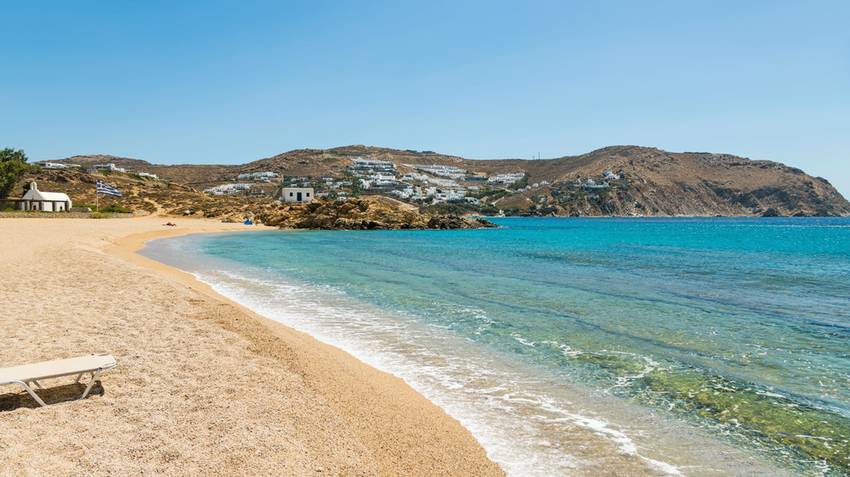
There is a moment mid-morning at Agrari when the water is still calm, the sunbeds on the far end of the cove are only half-occupied, and the loudest thing in earshot is the small taverna setting up tables. That moment is exactly why people find their way here. Mykonos’ Agrari Beach for a calmer pace is not a contradiction – it is a specific choice within an island that has more registers than its reputation suggests.
Agrari sits in a southeast-facing cove just past Elia, tucked far enough from the main beach circuit that it doesn’t feature on the standard day-trip rotation. No resident DJ sets, no poolside bottle service, no speaker towers. The beach runs to a modest length of fine sand backed by low dunes, with the water staying sheltered enough on most summer days that the meltemi – which hammers the north and west coasts – barely registers here.
The island’s party identity is real, and the peak season is genuinely dense. But Agrari operates on its own cadence, and understanding that cadence is the difference between a day that works and a morning spent hunting for a clear patch of sand.
What Agrari actually feels like on the ground
The beach has a small taverna, sunbed rental, and not much else in the way of infrastructure. That simplicity is the main character note. You arrive, you settle, the morning moves slowly. By late morning the cove has filled enough to feel social without feeling dense, and by early afternoon the atmosphere shifts toward the kind of drowsy horizontal time that most Mykonos beaches don’t allow.
The water in the cove stays calmer than nearby Elia on most days, partly due to the orientation and partly because there’s less boat traffic passing close in. The sandy bottom shelves gradually – useful for anyone who finds Mykonos’ rockier southern beaches less comfortable for swimming.
Late afternoon is its own distinct register. Around 17:00, when the direct sun has moved past its peak angle and the cove enters partial shade on the western side, a smaller crowd tends to reassemble after the midday lull. The light on the water at that hour is low and direct, the taverna starts to feel like an actual meal option rather than a sunbed checkpoint, and the beach does something that most of Mykonos doesn’t manage – it slows down instead of accelerating toward evening.
Who Agrari suits and who it doesn’t
Agrari fits travelers who want a Mykonos beach day without the social performance that the island’s larger beaches can require. Couples, solo travelers looking for a quiet afternoon read, people on a longer Aegean itinerary who need one genuinely low-key day – all of these find the tempo here easier to inhabit. It also works for anyone who finds the sunbed-to-sunbed proximity at beaches like Psarou or Paradise slightly too close for comfort.
It is not, however, the right answer for everyone. If you came to Mykonos specifically for the beach club experience – the music, the crowd energy, the social density that is part of the island’s identity – Agrari will read as too quiet, even slightly underpopulated. The taverna is fine but not a dining destination. There is no nightlife continuation from the beach into the evening. The beach ends, you get in your ATV or call a taxi, and the night picks up elsewhere. Travelers who want their beach to connect directly into an evening out should base themselves closer to Paraga or use one of the club beaches as their afternoon anchor instead.
Pacing a day around Agrari
The clearest approach is also the simplest: arrive early, before 10:00 if you can manage it. The first hour or two at Agrari in summer are genuinely calm – the cove fills steadily through the morning, but the rhythm in those early hours is unhurried in a way that feels distinct from the rest of the island.
Midday, from roughly 12:30 to 15:30, is when beach compression peaks. The sand is well occupied, the taverna is busy, and the heat is at its most direct. This is the time most well-paced visitors use for a long lunch, a slow swim, and horizontal non-movement rather than attempting to find a new position on the beach. The cove’s southeast orientation means afternoon sun stays strong until mid-afternoon.
There is no need to be there for a full eight-hour stretch. Three to five hours, centered on the morning window or the late-afternoon one, tends to produce the kind of day the beach actually rewards. The walk along the coastal path from Elia takes around ten minutes and is worth doing at least one way – the path runs along low scrubby hillside with the cove appearing below as you round the last turn, the water a specific shade of greenish-blue that reads differently from above than at sand level.
Getting there independently means renting an ATV or scooter from Mykonos Town – the road is standard island fare, winding and narrow in places, and the KTEL bus network covers Elia but not the cove itself. Taxis are available but availability tightens in the peak window; booking a return pick-up time rather than hoping to flag one down from the beach is the more reliable move in July and August.
Agrari in context: how it sits alongside other Mykonos beaches
Mykonos beach geography runs roughly from north to south on the southwest coast, and the beaches toward the southern end – Elia, Agrari, Kalo Livadi – share a generally calmer character than the central corridor around Paradise and Super Paradise. Agrari is the quietest of the three without being remote or under-resourced.
Elia, directly adjacent, is larger and has more infrastructure, including a beach bar with music. It runs busier and slightly louder than Agrari for most of the day, but also offers more options if you want a proper lunch or a drink at the water’s edge. The two beaches are close enough to split a day between them – morning at Agrari, afternoon at Elia’s taverna – without any real logistical effort.
Kalo Livadi, a little further east, has a similar calm register to Agrari but sits on a longer, more open stretch of sand and tends to attract a slightly more local crowd in the shoulder season. Worth considering if you are spending multiple days on the island and want to vary the setting.
For travelers who find even Agrari busier than they expected in peak summer – both July and August on Mykonos are genuinely high-tempo – the question often shifts away from beach selection entirely and toward island selection. If your interest is in a quieter Aegean beach rhythm with fewer visitors at the island level, the Greek island beaches digital detox read covers that trade-off more fully, with alternatives calibrated to different pacing preferences.
Timing Agrari across the season
The beach is at its most comfortable in late June and the first weeks of September. Late June still carries the energy of a season beginning – the water has warmed enough for long swims, visitor numbers haven’t yet peaked, and the island hasn’t fully shifted into its highest-tempo mode. The cove in this window has a loose, unhurried character that feels genuinely distinct from the August version.
Travelers deciding whether Mykonos matches the kind of beach experience they want may also find the Mykonos versus Paros beaches comparison useful when comparing different island beach rhythms across the Cyclades.
July and August are real. The beach fills earlier, the taverna is busier, and the window for a calm morning shrinks to roughly 08:30 to 10:30. That window is still there and still worth using – it just requires a slightly earlier start than most visitors plan for. The water in August is as warm as it gets, and the late-afternoon period from 17:00 onward often recovers some of the morning’s quieter quality.
Early September is arguably the best single month. The meltemi eases, the water stays warm from the summer, and the crowd level drops noticeably from the August peak without the beach losing any of its essential character. Some tavernas begin reducing hours from mid-September, but the cove itself keeps working well into the shoulder season – the light at that time of year is lower and more angled, and the cove in early evening has a warmth to it that the harsh midday sun doesn’t allow.
Agrari as a base decision, not just a day trip
Staying near Agrari rather than in Mykonos Town or near the party beaches is a legitimate option for travelers whose main interest is the calmer southern coast. There are small hotels and rental properties in the Elia-Agrari corridor, and the quieter road in the evenings is a meaningful contrast to the noise level near Fabrika or the harbor area.
The trade-off is access to Mykonos Town’s evening atmosphere, which requires either a scooter, an ATV, or a taxi journey rather than a walk. For a week-long stay built around beach days and slower dinners, the distance works in your favor. For two or three nights where you want the harbor, the windmills at dusk, and the late-night energy easily at hand, staying in town and day-tripping to Agrari makes more structural sense.
The fit, plainly stated
Mykonos’ Agrari Beach for a calmer pace is a real proposition, not a wishful one – the beach delivers a consistently lower tempo than the island’s central corridor, in a sheltered cove with decent infrastructure and water that swims well across the whole summer season. It suits travelers who want one version of Mykonos without needing the whole of it: a morning on calm sand, a long lunch, a slow swim in warm water, and an afternoon that ends when it naturally ends rather than when a DJ decides.
The fit shifts if the peak August window is unavoidable, if the lack of evening connection from the beach matters to you, or if you need more infrastructure than a single taverna can offer. In those cases, Elia is the natural step up – same southern coast character, slightly more going on. But for a day, or even several days, built around a quieter Aegean rhythm, Agrari holds its ground more reliably than most beaches on an island that isn’t particularly known for holding it.
Travelers drawn to quieter Aegean beach rhythms beyond Mykonos will find the Greek island beaches digital detox read a useful next step – it covers islands and beach corridors calibrated specifically to lower-tempo stays.
Travelers comparing different Greek island styles may find the Mykonos versus Paros beaches comparison useful for understanding how beach rhythm changes between islands.
Agrari Beach Mykonos – frequently asked questions
1. Is Agrari Beach in Mykonos actually quieter than other beaches?
Relative to Psarou, Super Paradise, or Paradise Beach, yes – Agrari runs at a noticeably lower tempo. It has no resident beach club playing music at full volume, the sand fills more slowly, and the social register skews toward couples and smaller groups rather than large parties. It is still a Mykonos beach in July, so ‘quiet’ is relative, but the difference is real and consistent.
2. What time should I arrive at Agrari Beach to get a good spot?
Arriving before 10:00 gives you easy choice of position and a genuinely calm first hour. By noon the beach has filled considerably, though it never reaches the compressed density of the island’s party beaches. Late afternoon, roughly from 17:00, the light on the water shifts and the crowd begins to thin again – the last hour before sunset is one of the better stretches of the day.
3. How do I get to Agrari Beach from Mykonos Town?
The road connection from Mykonos Town takes around 15-20 minutes by ATV, scooter or taxi. There is no dedicated public bus line that drops you at the cove itself – the main KTEL network covers nearby Elia, from which Agrari is a short walk along the coastal path. Most visitors rent transport for the day, which gives flexibility to leave before the midday heat peaks.
4. Is Agrari Beach suitable for families or solo travelers?
It works well for both, partly because neither dominates the atmosphere. Families appreciate the sheltered cove and calmer water; solo travelers find the lower social density easier to read. The beach has a small taverna and sunbed rental, so basic comfort is there without the full resort infrastructure that shapes larger Mykonos beaches.
5. When is the best time of year to visit Agrari Beach?
Late June and early September hit a particularly good window – long days, warm water, and visitor numbers that haven’t yet peaked or have already begun to ease. The beach faces southeast, so morning light is direct and the water is calm before the afternoon meltemi builds. By mid-September, some tavernas reduce hours, but the cove itself keeps its character well into the shoulder season.