
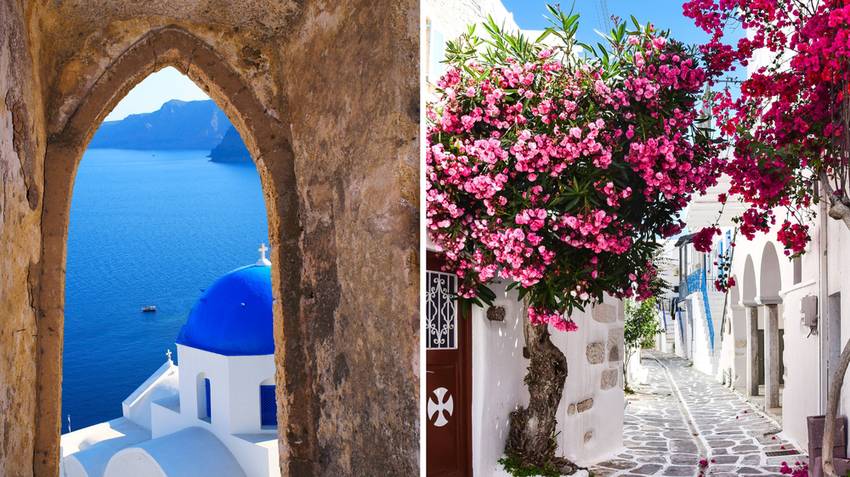
The question of Mykonos beaches for high-energy nights versus Paros beaches for longer, slower days is not really about which island has better sand.
The sand is fine on both. What differs is the contract each island offers: what you are implicitly agreeing to do with your time, your money, and your energy levels by the third day.
Both are Cycladic islands, both have clear water, both get genuinely busy in summer. But the rhythm, the social architecture, and what a typical afternoon actually feels like are quite different, in ways that matter more than most comparison articles suggest.
With summer approaching fast and ferries filling up, the decision between them is worth making clearly rather than defaulting to the one you have heard of more often.
What Mykonos beaches actually deliver
The beaches on Mykonos are, to a large extent, organised around beach clubs. Not loosely – structurally. Paradise Beach and Super Paradise are the two most prominent examples, and at both, the day begins with sun loungers arranged in tight rows, each connected to a tab you run at the club.
Music starts around midday at moderate volume and climbs steadily through the afternoon. By 16:00 it is genuinely loud. By 18:00 it is a party.
This is not incidental to the experience – it is the experience. The beach and the nightlife are not separate phases of the day; they are a single continuous arc.
People arrive for the beach and stay for the club, or arrive already dressed for the club and treat the beach as a warm-up. The two things blur into each other in a way that makes Mykonos feel more like a resort event than a Greek island afternoon.
For the traveler who wants that, Mykonos delivers it consistently. The infrastructure is professional, the music selection is taken seriously, and the social energy peaks in a way that some islands attempt and few actually achieve. If you arrive expecting that arc, you will find it well-executed.
The tradeoff is that the beach experience outside that arc is harder to find. There are quieter beaches on the southern coast and a few coves accessible mainly by water taxi or car rental, and these stay calmer even in peak season.
But Mykonos does not make the quiet option easy to find. The island’s layout, accommodation pricing, and general social atmosphere are oriented around density and activity, not retreat.
How Paros beaches behave differently
Paros has beach bars. It has music, and Naoussa in particular has a real nightlife scene that runs late in summer. But the default mode of a Paros beach is not a club. It is a beach.
Kolympithres, on the northern coast near Naoussa, has distinctive rock formations that break the shoreline into several smaller coves. The water is shallow enough that you can walk out a long way before it gets deep, which makes it easier to spend a full morning without any particular agenda.
Santa Maria, a few kilometers east, is wider and catches a sea breeze in the afternoon that makes the heat manageable even in late July. Neither beach is empty – Paros gets plenty of visitors in summer – but there is generally more sand per person, fewer tabs to run, and less pressure to keep ordering.
The practical difference shows up most clearly in how afternoon energy feels. On Mykonos, an afternoon at the beach accumulates a kind of social obligation, a sense that you are participating in something that has a direction and a tempo.
On Paros, an afternoon at the beach tends to drift. Coffee becomes a swim, the swim becomes lying in the shade, the shade becomes a late walk back toward town along a waterfront path. Days stretch without much effort.
For travelers who find the Mykonos model appealing in theory but exhausting by day three, Paros is the natural recalibration. The island suits people who want a few evenings out – Naoussa’s bar strip along the old port genuinely comes alive after 22:00, but who want those evenings to punctuate slower days rather than anchor every single one.
Travelers weighing a beach-focused trip against the Santorini alternative will find the Santorini beach crowd-avoidance read useful for understanding how a third Cycladic option handles the same peak-season pressure differently.
The meltemi wind and which beaches actually stay usable
Both islands sit in the path of the meltemi, the dry northerly wind that moves through the Cyclades from July through early September. It is not a disaster, locals consider it a feature, because it keeps temperatures from becoming oppressive, but it changes which beaches are pleasant on any given day and which are effectively unusable due to wind and chop.
On Mykonos, the northern beaches take the meltemi directly. Agios Stefanos and some of the beaches close to the town get rough and sandy in the wind. The southern and southeastern beaches, Elia, Agrari, and the beach-club strip around Paradise – are more sheltered and stay calmer. This is worth knowing before booking accommodation based on beach proximity alone.
On Paros, the pattern is similar. The eastern coast faces the wind more directly; the western side of the island and the beaches along the north near Naoussa benefit from the island’s own mass providing partial shelter. Santa Maria, despite being on the eastern side, sits in a bay that dampens the worst of it. Aliki in the south stays reliably calm.
The practical implication for a week-long stay: on both islands, having access to a vehicle or being willing to take taxis gives you flexibility that staying near one fixed beach does not. On Mykonos, the distances are shorter. On Paros, the island is larger and the journey to the calmer beach on a windy day might be 20 minutes by car from Parikia.
Who each island actually fits
Mykonos fits travelers who want the social intensity as an end in itself. Not just tolerable but actually desired: the noise, the cost, the density, the performative aspect of beach clubs, the sense that the night could go anywhere.
It fits couples who want a few days of pure hedonism without pretending to be doing anything else. It fits groups traveling together who want a shared energy to sink into. It also fits people who visit for two or three nights rather than a week, because the model is sustainable for a short burst in a way it is not for longer stays.
Paros fits more configurations. Solo travelers who want a relaxed base with enough social infrastructure to have evenings out without being committed to them. Couples who want to genuinely decompress rather than stimulate further.
Remote workers who need a few days of actual slowness after a long stretch of urban noise. Families who need shallower water and calmer afternoons. People on a second or third Greek islands trip who have already done the high-energy version and want to find out what the slower register feels like.
There is a specific category of traveler that Mykonos misleads: the person who books it expecting a Greek island and arrives to find an international club circuit that happens to have sea views. If the word “island” is doing most of the work in your mental image of the trip, Paros is probably the better match. If the word “nightlife” is doing most of the work, Mykonos is built for you.
The same decision framework comes up in other beach-focused comparisons across the Mediterranean, the Phuket active beach fit read maps a very similar energy-versus-pace tension to a different coastline, which is useful context if you are deciding between destination types rather than specific islands.
Cost, logistics, and the shape of a combined trip
Mykonos is more expensive, consistently, across accommodation, food, beach clubs, and taxis. This is not a recent development or a matter of finding the right neighborhood – the island prices at a premium across the board in summer. Budget travelers can visit, but the gap between what things cost and what a comparable day on Paros costs is real and compounds over several days.
Paros has accommodation at a wider range of price points, and the general cost of eating and drinking in Parikia or Naoussa is closer to what most people expect from a Greek island rather than what Mykonos has become.
This affects the experience in a specific way: on Paros, people tend to stay longer because staying longer is financially sustainable. Five or six nights is common. On Mykonos, three nights is a more natural fit both financially and energetically.
The two islands sit close enough together that combining them on a single trip is genuinely easy. The ferry connection is direct and takes under an hour on the faster services.
Logistically, there is a question of ordering. Starting on Paros and moving to Mykonos keeps the more intense island as a finale, which suits people who want to ease into the trip. Starting on Mykonos and moving to Paros works better for people who get the social high out of their system early and want to land somewhere quieter to actually recover before flying home.
High-speed ferries from Piraeus to either island take roughly 3 to 5 hours depending on the service and intermediate stops. In peak season, morning departures sell out early – booking them two to three weeks ahead is sensible rather than cautious.
Reading the two islands at the right season
June is arguably the best month for Mykonos if the goal is to experience the club beach atmosphere without the absolute density of late July. The clubs are operating, the weather is good, but the island has not yet reached the state where finding a taxi after midnight becomes a genuine logistical problem. Late August and early September see the crowds thin slightly and prices drop, but by then the meltemi is at its most consistent.
Paros in June is genuinely pleasant – the island feels inhabited rather than overwhelmed, Naoussa is lively in the evenings without being impassable, and the beaches have real space. July and August bring more people, but Paros absorbs them more evenly than Mykonos because the visitor flow distributes across multiple beaches and two main towns rather than concentrating at a few well-known spots.
Both islands quieten substantially after September. For travelers whose priority is calm water, fewer people, and significantly lower prices, the trade is lower temperatures for swimming and a few shuttered venues. Paros handles this transition better than Mykonos, because the island’s economy is more locally rooted and more stays open into October. Mykonos in October is largely closed.
Which beach experience you are actually choosing
The choice between Mykonos beaches for high-energy nights versus Paros beaches for longer, slower days is ultimately a question of what you want a day to look like when it has no particular obligations attached to it.
On Mykonos, a free day tends to fill itself through the island’s social infrastructure, music, movement, the collective energy of people doing the same thing. On Paros, a free day tends to drift, which feels like freedom to some travelers and like emptiness to others.
Neither is a superior version of a Greek island summer. They are two coherent and deliberately different answers to what beach time is for. Mykonos is for the traveler who wants the day to have a climax. Paros is for the traveler who wants the day to have room.
The combination trip remains the most practical answer for anyone uncertain which they are: three nights on one, four on the other, and the ferry between them as a built-in gear change. What usually happens is that people arrive on whichever island they booked first, adjust their expectations on the ground, and leave with a clearer sense of which register actually fits the way they travel.
Mykonos vs Paros beaches: common questions
1. Which island has better beaches for parties and nightlife?
Mykonos organises much of its beach experience around beach clubs that transition directly into evening events. Paradise and Super Paradise are the primary venues, with music volumes and social energy that stay high from midday until well past midnight. Paros has a lively bar scene in Naoussa and Parikia but the beach experience stays quieter throughout the day.
2. Are Paros beaches good for families or quieter travelers?
Paros suits families and slower-paced travelers considerably better than Mykonos. Beaches like Kolympithres and Santa Maria have shallow water, less noise, and more space. The overall atmosphere on Paros runs calmer, and accommodation costs less, which changes how freely people move and how long they stay.
3. How do ferry connections compare between Mykonos and Paros?
Both islands are well-connected from Piraeus and Rafina via high-speed ferries, with crossing times of roughly 2.5 to 4.5 hours depending on the service. Paros is also a natural stop between the two ports, so combining the islands on one trip works logistically. In July and August, morning departures and popular routes fill early and booking ahead matters.
4. What is the meltemi wind like on Mykonos and Paros in summer?
The meltemi is a strong, dry northerly wind that affects both islands from July into early September. On Mykonos, the northern and eastern beaches can be significantly windier; the beaches along the southern coast stay calmer. Paros has similar patterns, with the western side of the island generally more sheltered during active meltemi days.
5. Should I visit Mykonos and Paros on the same trip?
They sit close enough to combine naturally, and the contrast is part of what makes the combination work. A few days on Paros before or after Mykonos tends to provide a genuine reset in pace rather than more of the same. Traveling from Paros to Mykonos toward the end of a trip keeps the higher-energy island as a closer, which suits many people better than starting with it.