
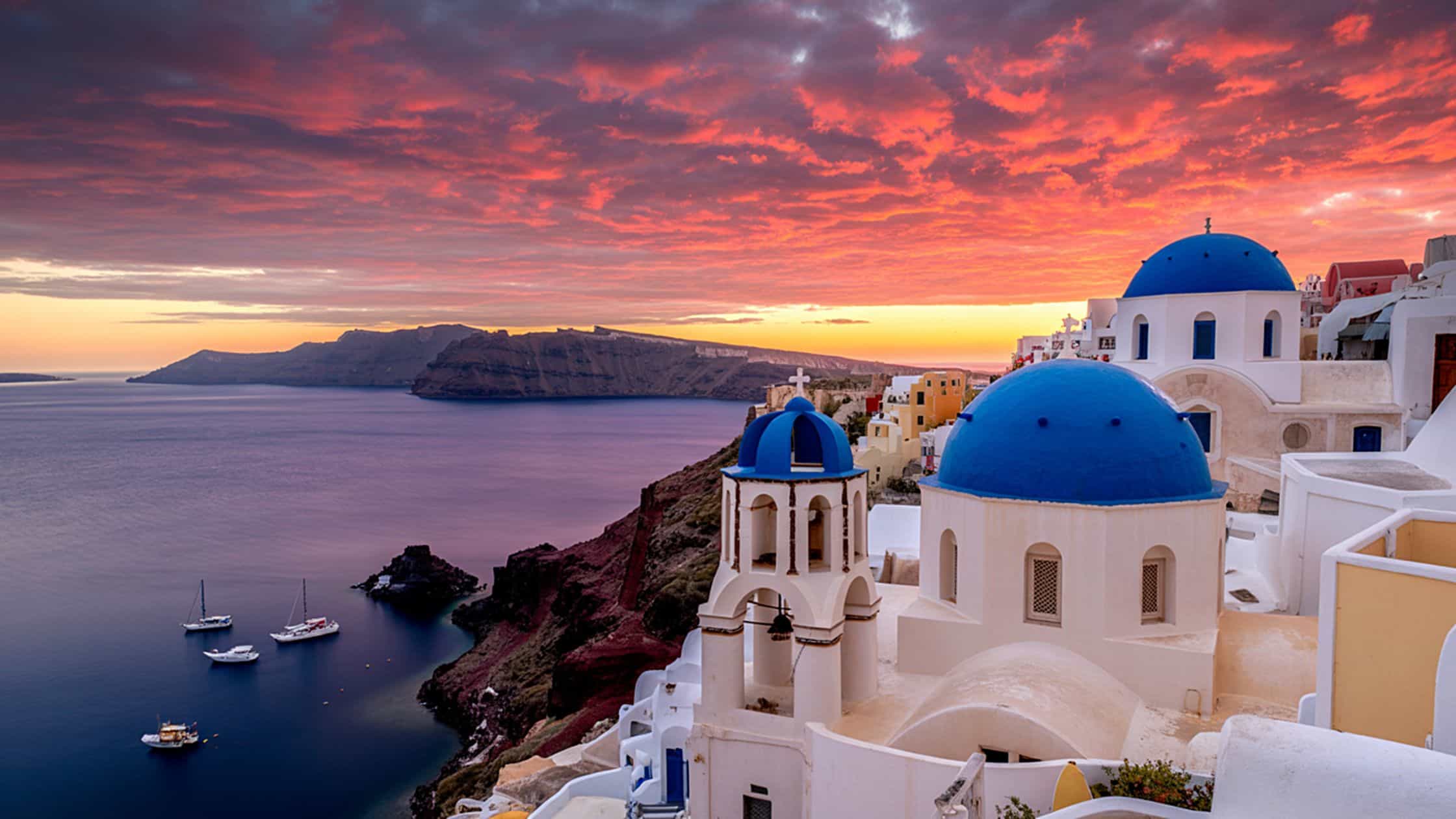
The beaches of Santorini are not the island’s main argument for existing. The caldera view is, but that does not mean the beaches are an afterthought, it means they work differently here, and understanding that difference is the starting point for a short visit that actually delivers.
If you are trying to find Santorini beaches for a short, impactful visit that avoids the island’s notorious crowds, the answer has more to do with timing and beach selection than with any secret location nobody else knows about.
Santorini in late May and through June operates at a different frequency than August. The light is sharp, the sea temperature is already reasonable, and the main beaches are busy rather than packed.
That distinction matters more here than on most Greek islands because the crowd pressure on Santorini concentrates in very specific physical spaces, the caldera path between Fira and Oia, the main black sand beach stretch at Perissa and Kamari, and the narrow lane near Red Beach – which means that choosing slightly differently pays off fast.
The island is small and the geography is strange: a caldera rim with most of the accommodation perched on it, and a long southeastern coastal shelf where the actual beaches sit. They are not visible from the well-known views.
You drive down toward them and the landscape shifts entirely – from whitewashed cliff-edge architecture to a flat volcanic coast with black sand that holds heat long past midday.
What Santorini beaches are like for travelers
Perissa and Kamari are the two long beach towns on the east coast, separated by the rocky Mesa Vouno headland. Both have black volcanic sand, a line of sunbed-and-umbrella operations, and a string of tavernas and beach bars running their full length.
Perissa is slightly larger and more oriented toward younger travelers; Kamari draws a broader mix and has a pedestrianised seafront road that makes evening walking easy. Neither is a quiet beach by any objective measure in July or August.
What they are, at the right hour, is genuinely enjoyable. Before 09:30, the sand is cooler, the sunbed staff are still setting up, and the only people already in the water are the ones who drove down specifically to beat the heat.
The black sand radiates absorbed warmth quickly as the day progresses – by noon, bare feet need sandals. The sea itself is clear and calm in the morning; the meltemi wind usually builds from the early afternoon, which creates chop and makes the water feel livelier, not rougher.
Cruise ships dock at Athinios port and their passengers reach the beaches by bus or taxi, usually hitting Perissa and Kamari between 10:30 and 14:00. Staying at the beach through 17:30 and beyond shifts the atmosphere back toward the more relaxed end, families leaving, the light softening, a few people still swimming in calmer afternoon water.
What Santorini beaches are really like
Vlychada sits on the southern coast, past the port, and requires either a rental car or a deliberate taxi trip. It is worth the effort if avoiding the main beach corridor is a priority.
The cliff backdrop is white and heavily eroded, a different visual register entirely from the black sand beaches further north. The beach itself is narrower and the facilities are minimal compared to Perissa.
It stays quieter because it sits outside the obvious bus route and requires a specific decision to go there rather than defaulting to the main corridor.
Red Beach, near Akrotiri, is photogenic in the way that a small cove with red and black volcanic cliffs behind it tends to be. It is also very small.
In the morning, before 10:00, it can feel almost private. By late morning it changes entirely, the path from the small car park fills and the beach itself, perhaps 80 meters of usable sand, can have fifty or sixty people on it.
The visual payoff is real; the swimming space is not generous. Most people who go for a short visit find that twenty minutes there is satisfying and that staying for a full beach afternoon is not what it’s optimized for.
White Beach, reachable only by boat taxi from Red Beach or from Akrotiri, is more isolated by necessity than by reputation. The boat taxis run when conditions allow, which in summer usually means mornings are reliable and afternoons are less so depending on wind.
It is a small operation and the beach is genuinely limited in size, but the effort of getting there filters the crowd meaningfully.
Is Santorini suitable for a short beach trip?
A short, beach-focused visit to Santorini works well for travelers who approach it as a two or three-day stop rather than a full week. The island rewards brevity.
Three days gives you one caldera morning walk, one properly timed beach day (with an early start at Vlychada or Perissa before 09:30), one evening at Oia without necessarily staying for the famous sunset scrum, and enough time to understand what the island is and is not.
Travelers who arrive expecting a low-key beach destination similar to Milos or Folegandros will feel friction. The infrastructure of Santorini, the accommodation pricing, the density along the caldera path, the number of organized tours, is built around the island’s status as one of the most photographed places in the world.
That coexists with the beaches rather than disappearing at them. People who find large groups, cruise ship day-trippers, and premium pricing genuinely wearing should probably center their Greek island time elsewhere.
Travelers who want the specific drama of the caldera alongside functional beach access will find the combination works, especially if they are willing to shape their days around timing rather than convenience.
The meltemi wind is worth factoring honestly. It typically begins earlier in the day on the exposed east coast beaches than in sheltered coves elsewhere in the Aegean. Morning swims are reliably calm; early afternoon swimming becomes windier.
This is not necessarily unpleasant, some people find the wind exactly what makes a hot volcanic beach tolerable, but it changes the rhythm of a beach day away from the long, flat-calm afternoon that slower coastal destinations offer.
Travelers considering the southern Aegean more broadly often find themselves weighing Santorini against islands with more beach variety and lower entry friction.
The Phuket active beach read covers a completely different register of beach intensity, which can clarify thinking for travelers unsure whether they want a high-atmosphere, low-sprawl beach destination or something more expansive.
Travelers deciding between a Santorini stop and a less infrastructure-heavy alternative sometimes find the Spain city beach access read useful as a contrast point, particularly for understanding how coastal beach access operates when integrated into a denser urban fabric rather than an island context.
How to combine Santorini beaches with the caldera
The logistical rhythm of a two to three day Santorini stay rewards a specific kind of sequencing. Caldera walking and Oia are best handled early in the morning, before 08:30, when the path between Fira and Oia is largely empty and the light is still angled rather than flat. By 10:00 the path fills, and by noon the section approaching Oia becomes a slow procession in both directions.
Beaches work in the inverse window, morning beach time is the high-value slot, and the afternoon caldera area (especially restaurants with views) is actually more comfortable in the late afternoon, once the cruise crowds have started moving back toward the port.
Structuring a day around that inversion, caldera path before 09:00, beach from 09:30 to 13:00, afternoon rest away from the sun, caldera-side dinner from 19:30 – makes a short visit feel complete rather than rushed.
Taxis from the beach towns back up to Fira or Oia become harder to find between 16:30 and 18:30, which corresponds to the port departure window.
The KTEL bus runs reliably between Fira, Perissa, and Kamari, and the frequency is adequate during the day.
For Vlychada or the Akrotiri area beaches, a rental car or scooter for one day is the practical solution, the road down from the main town takes about fifteen minutes and the parking situation at Vlychada is manageable outside of full August weekends.
What to know before visiting Santorini beaches
The sunset at Oia is the island’s most replicated image. It is also genuinely worth experiencing once, the light on the caldera wall, the specific quality of the color as the sun drops behind the western edge of the island, is what made Santorini’s reputation.
What it is not is a quiet, contemplative moment. The path near the main windmill viewpoint can have several hundred people on it by 20:00 in peak season. Accepting this and staying toward the edge of the crowd rather than fighting for the front row makes it work; treating it as something to experience rather than own.
Accommodation on the caldera rim prices at a premium specifically for the view and the proximity to the caldera path. For a beach-oriented visit, staying in Perissa or Kamari is significantly cheaper, puts you within walking distance of the beach, and makes early morning beach access easy.
The trade-off is that reaching Fira and the caldera area requires a bus or car rather than a ten-minute walk. For a short trip where the beach is the anchor and the caldera is one day, that trade-off is usually favorable.
Akrotiri, the Bronze Age archaeological site, sits near the southern beaches and is worth a morning visit if the timing aligns.
It is covered and walkable even in summer heat, takes about ninety minutes without rushing, and is rarely as packed as the caldera viewpoints. Pairing it with a morning at Vlychada or Red Beach keeps the day coherent without requiring excessive driving.
How to plan a short Santorini beach itinerary
Santorini beaches for a short, impactful visit that avoids the island’s notorious crowds is not about finding a version of the island that does not exist. The crowds are real and they concentrate in predictable places at predictable hours.
The approach that works is built around that rather than despite it: arrive at the beaches before the cruise rhythm kicks in, choose Vlychada or the southern coast over the main black sand corridor when flexibility allows, and use the caldera area in the windows when it breathes rather than when it compresses.
For travelers who want two or three days of specific visual drama, functional beach mornings, and the atmosphere of a place that feels genuinely unlike the rest of the Aegean, Santorini delivers best as a short stay rather than a full-week island base.
Travelers treating Santorini as one stop within a wider Greece circuit often end up noticing how sharply the country’s pacing, transport rhythm, crowd density, and energy shift from place to place rather than blending into one continuous island experience.
The Greece circuit read breaks down how those transitions actually feel across a multi-stop route.
The volcanic geography, the black sand, the caldera wall, the low scrubby terrain, is not interchangeable with anywhere else in Greece. That specificity is the reason to go and the beaches are part of that landscape rather than the reason for it.
Santorini beaches FAQ
1. Which Santorini beaches are the least crowded?
Vlychada and White Beach tend to draw far fewer visitors than Perissa or Kamari. Vlychada in particular has an unusual landscape of eroded white cliffs and stays quieter even in July, partly because it requires more deliberate effort to reach. Red Beach is visually distinctive but very small and can fill within an hour of the cruise boats docking.
2. What time should I arrive at Santorini beaches to avoid peak crowds?
Arriving before 09:30 makes a significant difference on the main black sand beaches. Cruise passengers typically arrive mid-morning, and by 11:00 the popular stretches are at full activity. Going early also means cooler sand and manageable heat before the meltemi wind picks up in the early afternoon.
3. Is Santorini worth visiting for beaches if you are not a beach person?
Probably not as a primary reason to go. The beaches are distinctive – black and red volcanic sand, dramatic cliff backdrops – but the swimming experience itself is fairly straightforward. Santorini rewards travelers who want atmosphere, the caldera view, and the specific quality of light more than those whose trip is entirely beach-anchored. If beaches are the main draw, Milos or Paros offer more variety with considerably less crowd pressure.
4. When is the best time to visit Santorini to avoid crowds at the beaches?
Late May and early June give you warm enough water and air temperatures without the July-August peak. September is also a good window, with slightly quieter beaches and still-warm sea. The meltemi wind is less consistent in late spring, which makes afternoon beach time more comfortable. August is the most congested month across every beach and the caldera path.
5. Can you reach Santorini’s quieter beaches without a car?
The KTEL bus network covers Perissa and Kamari reliably from Fira. Vlychada and the southern cape beaches are harder without a rental car or scooter. Taxis exist but become unreliable during cruise arrivals and the late afternoon rush toward the port. For a short visit focused on quieter spots, renting a car or ATV for one day is the practical solution.