
Lisbon’s neighborhoods don’t announce themselves the way some cities do. You move from one to the next without a clear border, and the atmosphere shifts gradually – a different incline, a different tile pattern on the walls, a different hour when the street actually wakes up. Understanding the neighborhoods of Lisbon is less about memorising a map and more about understanding which version of the city you want to live in for a few days.
The city is built across seven hills, which sounds poetic until you’re pulling a suitcase up a 15% gradient at noon in June. But that same topography is also what makes each district feel genuinely distinct – Alfama’s dense historic fabric, the wide pedestrian grid of Baixa, the quieter residential plane of Príncipe Real, the late-night energy that radiates from Bairro Alto. The fit between traveler and neighborhood here matters more than in flatter, more uniform cities.
What follows is a neighborhood-by-neighborhood read on pacing, atmosphere, and traveler fit – not a ranked list, but a working orientation for someone deciding where to base themselves.
Is Alfama or Mouraria better for staying in Lisbon, Portugal?
Alfama is the neighborhood most people picture when they think of Lisbon: steep lanes, azulejo-covered walls, fado drifting from a doorway around 21:30. That image is accurate, but it represents about two hours of the day. The rest of it involves a lot of stairs, tourist groups moving slowly uphill toward the viewpoints, and a streetscape that works better on foot and without a timeline.
The miradouros – Portas do Sol, Santa Luzia – fill up by 11:00 in summer and stay busy until mid-afternoon, then empty again after dinner. That second window, after 21:00, is when the neighborhood shifts into a different register: quieter, more local in character, the light low and orange on the river below. Travelers who arrive expecting the daytime version and stay into the evening tend to revise their opinion upward.
Mouraria sits just to the west and runs at a slower tempo – less visited, more residential, with a morning market at Intendente square and a street character that reflects the neighborhood’s longer history as one of Lisbon’s most ethnically mixed districts. It’s a better base for slow travelers and those staying more than three or four nights.
Is Baixa or Chiado better for first-time visitors in Lisbon, Portugal?
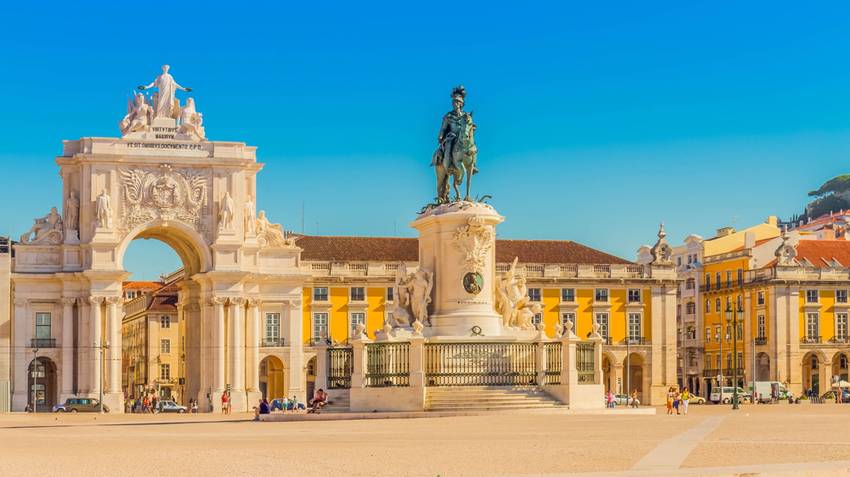
Baixa is Lisbon’s flat center – a Pombaline grid of wide streets rebuilt after the 1755 earthquake, walkable in every direction, and the easiest district to navigate without thinking about it. The trade-off is that it’s also the most visitor-facing part of the city, and the streets around Rossio and Rua Augusta move at a high-tempo pedestrian rhythm through most of the day.
Chiado, just uphill to the west, has a different character: bookshops, coffee that costs more than elsewhere but stays good, and a cluster of squares where the pace slows in the evening. The Praça Luís de Camões fills with people around 19:00 who aren’t going anywhere in particular, which is one of the more pleasant things about the neighborhood.
For first-time visitors with, the Baixa-Chiado axis offers the most efficient base: close to everything, metro-connected, and flat enough that the walking profile doesn’t accumulate tempo the way Alfama does. It’s the area that works regardless of rhythm or traveler type, which also means it’s rarely the most interesting place to stay.
Travelers still deciding whether Lisbon is the right Portuguese starting point may find the Lisbon first-time guide useful for understanding how the city feels beyond the neighborhood decision itself.
Is Bairro Alto or Cais do Sodré better for nightlife in Lisbon, Portugal?
Bairro Alto functions like two different neighborhoods depending on the hour. Until about 20:00, it’s a quiet residential grid of narrow streets, small restaurants, and independent shops. After that, the bars open, the streets fill, and by midnight the acoustic register is entirely different – conversations from windows, music from below, the general sound of a city that hasn’t decided to stop yet.
This works well for travelers who want to be inside that energy rather than commuting to it. It works less well for anyone who needs to be asleep before 01:00 or who finds late-night street noise intrusive.
Cais do Sodré sits downhill toward the river and runs a slightly different version of the same late schedule. The bar scene here concentrates on Rua Nova do Carvalho – a short pedestrianised street that gets dense on weekends – but the surrounding area has enough depth that staying one or two streets away means access without direct exposure. It also has the best access to the Tagus waterfront, which in June carries a particular quality of light around 21:00 that is hard to find elsewhere in the city.
Is Príncipe Real or Estrela better for a quieter stay in Lisbon, Portugal?
Príncipe Real sits just north of Chiado and operates at a noticeably calmer pace – boutique hotels and guesthouses, a Saturday antiques market in the garden square, restaurants that close at a reasonable hour and don’t play music loud enough to hear from the street. The neighborhood attracts a different kind of traveler: people on longer stays, couples who want proximity to the center without being inside it, remote workers who prefer a calmer daily rhythm.
Estrela is further west and more purely residential – local cafés, the large Estrela gardens, a quieter spatial scale. It requires more walking or a bus to reach the main sights, but the neighborhood itself has a slow, neighborhood-of-Lisbon quality that rewards travelers who are comfortable with a slightly longer transit chain.
Both districts suit travelers who have already spent time in the city and know what they want, or those arriving with enough days to settle in rather than move fast.
Is Campo de Ourique or Santos good for staying in Lisbon, Portugal?
Campo de Ourique sits further out to the west, connected by tram 28 but requiring more travel time to the historic center. Its character is almost entirely residential – a covered market, a grid of quiet streets, the kind of neighborhood where the same people sit in the same café at the same hour every morning. Visitor activity is minimal.
Santos lies between Cais do Sodré and Belém and has been developing slowly as a gallery and design district over the past decade. The streets are calmer than Bairro Alto, the evenings quieter, and the proximity to the waterfront means the late afternoon walk toward the Tagus is a reasonable daily ritual rather than an excursion. For travelers who want access to Belém – the monastery, the tower, the custard tart queue at Pastéis de Belém that forms by 10:00 on weekend mornings – Santos cuts the journey significantly.
Where to stay in Lisbon, Portugal by traveler type
First-time visitors with three to four days generally orient best from Chiado or Baixa: maximum coverage, minimum transit complexity, easy metro access. The atmosphere is less distinctive than the historic districts, but the positioning removes most sequencing decisions.
Travelers staying five days or more often find that Mouraria or Príncipe Real repays the slightly longer journey to the main sights. The daily rhythm in both neighborhoods has more texture – a local café that knows your order by day two, a morning street that operates on its own schedule rather than a tourist one.
Late-night travelers and those who want to be inside the social energy of the city at 23:00 belong in Bairro Alto or Cais do Sodré. Anyone who needs quiet evenings for work or sleep belongs in Príncipe Real, Estrela, or further west.
Alfama is its own category. It rewards travelers who move slowly, who enjoy the physical density of the historic fabric, and who are prepared for the walking profile – not because the area is difficult, but because the experience of it is inseparable from the terrain. Arriving with a large wheeled suitcase and tight scheduling is the version that doesn’t work; arriving with a light bag and two or three days of unhurried time is the version that does.
Travelers who find themselves weighing Lisbon’s neighborhood rhythm against another Portuguese city’s approach to the same question will find the Porto neighborhood stays read a useful parallel – Porto’s districts solve similar questions differently, and the contrast is often clarifying. If the broader choice between the two cities is still open, the Lisbon vs Porto first-timer comparison covers the trade-offs at the same traveler stage.
Best Lisbon neighborhoods in Portugal for summer
June through September is when the city operates at its fullest pace. The viewpoints in Alfama are busiest between 10:00 and 16:00; the beaches at Cascais and Estoril (accessible by train from Cais do Sodré in around 40 minutes) become a daily escape pattern for people staying in the city for more than a week. The evenings stay warm and long, which shifts a lot of activity outdoors and toward the waterfront.
The practical effect on accommodation is that Baixa and Chiado see the highest visitor density in this window, and the gap between a well-positioned Príncipe Real guesthouse and a central Alfama rental narrows considerably in terms of daily experience. The walking time between them is under 20 minutes, and the difference in morning atmosphere is significant.
Shoulder season – October and early November, or April into early May – compresses the visitor presence noticeably without closing anything important. The light is lower and more lateral, the terraces still open, the streets easier to move through. Some travelers who visit Lisbon for the first time in summer and return in autumn describe a feeling of finally seeing the city as it actually is, which is probably less a statement about authenticity and more a statement about pace.
How to choose the best neighborhood in Lisbon, Portugal
The neighborhoods of Lisbon reward travelers who match their base to how they actually want to move through the city – not just geographically, but temporally. A traveler who wakes early, wants a quiet coffee and a morning walk before the city fills, and plans to be somewhere by 10:00 will have a different experience in Príncipe Real than in Bairro Alto, even though both are technically central and both are walkable to the same landmarks.
The city is small enough that no choice is wrong in a logistical sense. But the atmosphere of where you sleep shapes the atmosphere of the whole trip more in Lisbon than in larger, more uniform capitals. That’s partly the topography, partly the small scale of the districts, and partly the fact that each neighborhood has a genuinely distinct social character rather than just a different set of prices. Understanding that before booking is the part most city guides skip over, which is also why the neighborhood decision in Lisbon tends to matter more than people expect it to.
Neighborhoods of Lisbon: frequently asked questions
1. Which Lisbon neighborhood is best for first-time visitors?
Chiado and Príncipe Real suit most first-time visitors well. Both sit close to the main sights, have reliable dining options at varied price points, and stay walkable without committing to the steeper gradients of Alfama. Chiado in particular puts you within fifteen minutes of almost everything on foot or by metro.
2. Is Alfama a good place to stay in Lisbon?
Alfama works well for travelers who want to be inside the historic atmosphere rather than near it. The streets are steep and uneven, and the tourist activity is highest around the viewpoints during the day, but by late evening the neighborhood quiets to a different register entirely. It suits people who move slowly and don’t mind carrying luggage uphill.
3. Which Lisbon neighborhood is quietest for sleeping?
Príncipe Real and Estrela tend to offer the quietest nights. Both sit away from the main late-night corridors, have a more residential character, and still connect easily to the rest of the city. Bairro Alto, by contrast, stays acoustically active until 02:00 or later on weekends.
4. How do the different neighborhoods of Lisbon compare for longer stays?
For stays of a week or more, Mouraria and Campo de Ourique often make more sense than the tourist-facing districts. Both have a daily rhythm built around local commerce, morning markets, and neighborhood cafés rather than sightseeing, which gives longer stays a different quality. Mouraria sits closer to the historic center; Campo de Ourique is slightly further west but calmer.
5. What is the best Lisbon neighborhood to stay in during summer?
In June and July the long evenings are the defining feature of Lisbon, and Cais do Sodré and Santos give you the easiest access to the waterfront and the outdoor bar terraces that run until late. The nights stay warm, the light on the Tagus fades slowly around 21:00, and both neighborhoods have enough residential depth that you are not sleeping inside the loudest block of the city.