
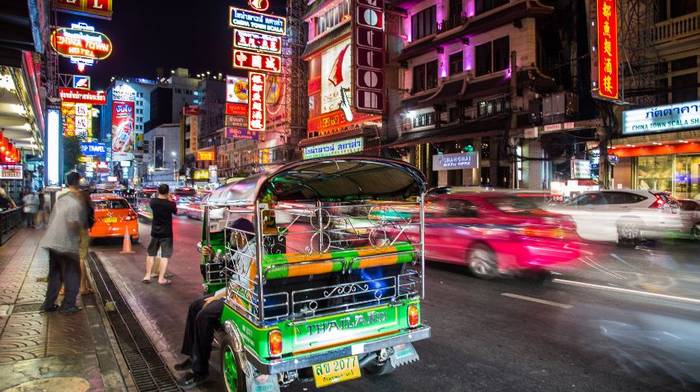
Bangkok offers excellent value when you know where to focus your budget. Street food remains remarkably affordable, while accommodation, comfortable transport, and major attractions shape the wider daily cost.
A useful budget travel guide to Bangkok is therefore about two things: making the most of the city’s best-value experiences and knowing how to combine it with destinations where your budget stretches even further.
That flexibility is one of Thailand’s greatest advantages. Chiang Mai, Pai, Kanchanaburi, and Hua Hin are all easy to reach and offer their own mix of food, culture, scenery, and slower-paced days. The real question is not whether Bangkok fits your budget, but how long to stay before continuing into another rewarding part of Thailand.
Travelers arriving in Thailand for the first time may also find the Bangkok travel guide useful for understanding how the city’s neighborhoods, transport system, and daily rhythm fit together.
What Bangkok really costs per day
Street food stays cheap across the city, and that part of the budget mythology holds. A bowl of noodles on Yaowarat Road runs 50 to 70 baht. Som tam from a cart near the Victory Monument costs about the same. The problem is that Bangkok is not a street-food-only city once you start moving around it.
The BTS Skytrain and MRT are reliable and fast, but fares are distance-based and accumulate across a day of sightseeing. A round trip from Sukhumvit to the Grand Palace area on the express boat and then back via Skytrain runs close to 100 baht each way once transfers are included. Add a couple of temple entry fees at 200 to 500 baht each, a lunch that moves indoors because of the June heat, and an evening Grab to avoid a long walk back from dinner, and the day is already at 800 to 1,000 baht before accommodation.
The accommodation corridor that keeps costs genuinely low is Banglamphu – the Khao San Road area and the streets south toward the river. Fan rooms start around 300 to 400 baht, small air-conditioned guesthouses from 500 to 700 baht, and the neighborhood has enough cheap restaurants and fruit stalls to eat well for under 150 baht per meal. It is not the quietest part of the city at night, and the visitor activity on the main street is its own kind of experience, but the savings versus Sukhumvit are real.
Travelers comparing accommodation costs across the city may also find the Bangkok neighborhood guide useful for understanding where value and convenience overlap.
The travelers who do Bangkok cheapest tend to stay in Banglamphu, use the river express boats rather than Grab, eat from carts and shophouses rather than air-conditioned restaurants, and limit themselves to one or two paid attractions per day. At that pace, 700 to 900 baht a day is achievable. Push the accommodation upward or add a rooftop bar evening and the number climbs fast.
How long should you stay in Bangkok?
Bangkok rewards three to four days more than it rewards seven. The city’s density and pace are part of its character – the night markets, the elevated rail corridors, the river light in the early morning near the Chao Phraya Express pier – but after the first few days the cost-to-pace ratio starts to shift. Staying longer to “do more” often just means spending more on transit and meals without adding proportionally to the experience.
The overnight train north to Chiang Mai costs a fraction of a week’s Bangkok accommodation and gets you somewhere that runs slower, costs less and stays cooler in the evenings. For travelers who are weighing how long to anchor in Bangkok versus spreading those days across the country, the Bangkok or Chiang Mai comparison covers that decision in detail – including which city fits which travel rhythm and when one works better as a base than the other.
The argument for a shorter Bangkok stay and an earlier move north or west becomes more compelling in June and July specifically. The city in early summer is hot, occasionally wet in the afternoon, and quieter than peak season in ways that make it easier to navigate but harder to justify a long stay. Shoulder-season pricing on guesthouses is genuine, but so is the incentive to use the lower flight and bus prices to spread across more of the country.
Chiang Mai as a budget alternative to Bangkok
Chiang Mai is the most direct budget-friendly alternative to Bangkok for travelers who want a city rather than a beach or a village. It has the same kind of infrastructure – reliable guesthouses, good street food, a functional transit system of songthaews and red trucks, a range of cafés and coworking spaces – at a noticeably lower daily cost.
A fan room in the old town or near Nimman Road runs 300 to 500 baht. A bowl of khao soi at a shophouse near Warorot Market costs 50 to 60 baht. An evening on the Saturday or Sunday walking street does not cost anything unless you choose to spend. The cumulative daily total for a careful traveler sits closer to 500 to 800 baht, a meaningful drop from Bangkok’s 800 to 1,100 baht range.
For travelers considering a longer northern Thailand stay, the Chiang Mai budget guide explores accommodation, food, and day-to-day costs in greater detail.
The trade-off is pace and scale. Chiang Mai does not have Bangkok’s energy and it does not try to. Evenings wind down earlier in most neighborhoods, the walking streets empty by 23:00, and the city’s social rhythm is quieter and more internal. That is precisely what makes it work for remote workers, slow travelers and anyone who arrived in Bangkok and found the density a bit much after a few days. The Chiang Mai neighborhoods read covers the district-level differences in detail, including which areas suit budget stays versus longer remote-work anchors.
Kanchanaburi for budget travelers
Kanchanaburi sits about two to three hours west of Bangkok by train or minivan and is one of the most underused destinations on the budget Thailand circuit. Accommodation along the River Kwai runs from 250 baht for a fan room in town to 500 to 700 baht for a floating raft house on the river – an experience that costs about the same as a dorm bed in a Bangkok tourist hostel.
The town itself is quieter than it sounds in most descriptions. The bridge and the war museum draw visitors, but the river stretches north of town are calm, the evening light on the water around 18:30 has a particular quality that travels in the memory, and the pace over two or three days is restorative in a way that Bangkok simply cannot offer. Eating is cheap – river fish, noodle shops, the night market near the central road – and the absence of a BTS to pay for makes the daily total drop significantly.
The train from Bangkok Thonburi station to Kanchanaburi costs under 100 baht and runs twice daily. It is slow and has no air conditioning, which is either part of the point or a reason to take the minivan, depending on the traveler. The walk through the countryside north of Nakhon Pathom is worth the two extra hours it adds over the minivan.
Hua Hin for affordable beach travel
Hua Hin is not the cheapest destination in Thailand, but it becomes one of the most cost-effective when visited in the right window. June and July are technically the shoulder season on the Gulf side – the west-facing beaches of Koh Samui and Koh Phangan get most of the rain in this period, while Hua Hin tends to stay drier and quieter than its reputation suggests. Hotel prices drop noticeably and the beach has space.
The town has a walkable night market, fresh seafood at prices that would not survive in Bangkok, and a three-hour train connection from Hua Lamphong at under 200 baht in third class. It is not a backpacker town – the social scene leans older and more domestic Thai – which makes it calmer and in some ways more pleasant to navigate on a tight daily budget without the service-industry pressure of a full tourist resort.
For travelers who want a beach phase without flying to the islands, Hua Hin in June or July is the most accessible and cost-controlled option within reach of Bangkok.
Travelers considering a beach destination instead often compare the Gulf coast with the Andaman side, making the Phuket travel guide a useful next read.
Bangkok vs Chiang Mai, Hua Hin, and Kanchanaburi
A useful way to frame the decision is not “is Bangkok too expensive?” but “what does the same daily spend buy me somewhere else?”
At 800 baht a day in Bangkok, you are in a basic air-conditioned room in Banglamphu, eating street food for two meals, using public transit, and visiting one paid attraction. At 800 baht a day in Chiang Mai, the same budget gets a cleaner room with more space, slower mornings, and evenings that do not require transit to navigate. At 800 baht a day in Kanchanaburi, it gets a raft house on the river, three full meals, and nothing in particular to pay for entry to.
Bangkok earns its place as a base – for arrivals, for onward logistics, for the specific energy and food culture that genuinely cannot be replicated elsewhere in Thailand. But it earns it best in doses of three to four days, not as a week-long anchor when the budget is a primary constraint. The alternatives above are not compromises. They are just different settings for a different phase of the same trip.
Travelers who are specifically weighing Pattaya as a coastal alternative from Bangkok – cheaper on accommodation in certain pockets, busier in others – will find the Pattaya guide covers its distinct character and what type of traveler it actually suits, separate from the beach-and-budget assumptions most people carry into it.
Is Bangkok worth it on a budget?
Bangkok is worth the money it costs, for the right length of stay and with the right base neighborhood. The city’s density, food culture and infrastructure make it one of the most compelling arrivals in Southeast Asia. But it is not the cheapest city in Thailand, and it is not designed to be. The budget travel guide to Bangkok is ultimately a guide to spending three or four days well in Banglamphu and then moving.
The travelers who get the most out of this circuit are the ones who treat Bangkok as an accelerator – fast, stimulating, full of things to eat and watch and navigate – and the alternatives as the actual texture of the trip. Chiang Mai for the slower pace and lower daily cost. Kanchanaburi for the quiet and the river. Hua Hin for a beach week that does not require a flight. The city earns its place at the start of that sequence, or at the end of it, but rarely in the middle for a full week.
Budget travel in Bangkok: common questions
1. What is the cheapest time of year to visit Bangkok?
June through August sits in the low season, with hotel rates noticeably lower and flight prices softer. The heat is more intense and afternoon rain is frequent, but the city still functions fully and street food prices stay the same year-round. Evenings are lively regardless of season.
2. Is Chiang Mai significantly cheaper than Bangkok?
Day-to-day spending in Chiang Mai tends to run lower, especially on accommodation and sit-down meals. The difference is most visible in the mid-range: a guesthouse that costs 600 baht in Bangkok often runs 350 to 450 baht in Chiang Mai. Street food prices are comparable across both cities.
3. Which Bangkok neighborhoods are best for budget travelers?
Banglamphu and the Khao San Road area remain the most established budget corridor, with hostels, cheap local restaurants and easy river access. Ari and On Nut offer cheaper daily costs than the Sukhumvit tourist strip while staying on the Skytrain line, which reduces taxi spend significantly.
4. How easy is it to travel cheaply between Bangkok and Chiang Mai?
The overnight train between Bangkok Hua Lamphong and Chiang Mai runs around 700 to 1,200 baht for a second-class sleeper, and covers the journey while you sleep – a genuine budget win. Budget flights on Thai Lion Air or Nok Air occasionally drop below 500 baht with advance booking, though fees add up quickly.
5. What does a realistic daily budget look like in Bangkok?
Traveling lean but comfortably – dorm or fan room, street food for two meals, BTS or MRT for transit, one paid attraction – typically runs 700 to 1,100 baht per day. The city rewards travelers who eat where locals eat and use public transit rather than Grab for every trip; the difference in daily spend across a week is significant.