
Phuket’s western coastline catches the afternoon light in a way that explains, fairly quickly, why so many people arrive planning four days and leave having booked another trip. The sea shifts between greens and blues depending on the cloud cover, the sand holds heat long into the evening, and the pace of a beach town – slow mornings, long lunches, nights that stretch further than planned – takes hold faster than most travelers expect.
This first-time traveler guide to Phuket exists because the island is genuinely easy to get wrong. Not in a way that ruins a trip, but in a way that leaves you wondering why you spent three nights in the wrong part of it. Phuket is Thailand’s largest island and its most visited, which means the range of experiences on offer is wide enough to make two first-timers describe completely different places – one a neon beach-road strip running past midnight, the other a quiet café in a colonial-era shophouse with no one else inside.
Understanding what the island actually contains – how its different zones feel, who they suit, and how the days naturally unfold – is the clearest preparation a first visit can have.
What the island actually feels like
Phuket doesn’t feel like a single place. The west coast is where most first-timers land their expectations: a sequence of beaches running roughly north to south, each with its own energy and crowd composition. Patong is the loudest and most commercially dense, with a beach road that stays busy from late afternoon through well past midnight. Kata and Karon sit ten to fifteen minutes south and carry a significantly quieter register, still with restaurants and bars but with more space between them. Rawai and Nai Harn at the southern tip have a different quality altogether – less tourist infrastructure, more long-term residents, a slower morning rhythm.
Phuket Old Town, roughly in the center of the island, often surprises first-timers who expect it to be another tourist zone. The Sino-Portuguese architecture on Thalang and Dibuk roads is genuinely distinctive, the coffee is good, and on a weekday morning the streets are quiet enough to walk without being herded. It functions as a useful counterweight to the beach areas and rewards an afternoon or a half day rather than a dedicated day trip.
The island’s interior, covered in rubber and palm plantations with hills cutting through the middle, connects these zones by road. Distances look short on a map. In practice, moving between beaches by scooter or taxi takes twenty to forty minutes depending on traffic, which means committing to a base zone matters more than the map suggests.
Who Phuket suits and who it doesn’t
Phuket works well for travelers who want a beach holiday with options nearby – day trips to the Phi Phi Islands or Phang Nga Bay, a mix of beach time and street food, evenings that can be as quiet or as social as the mood demands. Couples doing a first Southeast Asia trip, groups covering a broad range of preferences, and travelers who want reliable infrastructure (consistent accommodation quality, easy airport transfers, established food options at most price points) tend to find the island straightforward.
It suits people less well when the expectation is quietness, isolation, or an “untouched” Thai island experience. Phuket has been a major destination long enough that the infrastructure is thoroughly established, and the main beach zones reflect that. Solo travelers who want high social energy will find it in Patong; those seeking a slower rhythm often find Kata or the south more comfortable after the first few days. Travelers arriving during high season (December through March) and staying in Patong should expect full hotels, busy beaches, and evenings that leave little quiet until well after midnight.
How days unfold and where to base yourself
Mornings on the west coast are the best part of the day, physically. Temperatures are lower, the beaches are quieter before 09:00, and the water is calmer before the afternoon wind picks up. Most travelers find themselves shifting into a rhythm of early beach time, a long lunch somewhere with shade, an afternoon of slower activity (a market, a temple, a café in Old Town), and then the evening beach road.
Choosing a base is the decision with the most practical weight for a first visit. Staying in Patong gives central access to everything and the most evening activity, but the ambient noise level is high – the street outside runs loud until 02:00 or later, which is fine for the first night and increasingly disruptive by the fourth. Kata is quieter, with a more manageable beach and a shorter strip of restaurants that still covers all the necessary bases. Rawai and Nai Harn in the south suit travelers who actively want to decompress, rent a scooter, and build days around exploration rather than beach infrastructure.
Most first-timers do better picking one base and staying there for the full trip rather than moving hotels between beach zones. The time and energy cost of relocating on a relatively short visit outweighs the gains, especially when most zones are reachable by songthaew or taxi within thirty to forty minutes.
The island’s road network means a scooter changes the experience considerably. The southern roads toward Promthep Cape and the hills above Kata open up with one, and the quieter beaches require it. Phuket’s traffic is genuinely busy, however, and the roads mix trucks, scooters, and tourists with variable levels of comfort behind the wheel. App-based taxis (Grab operates on the island) are a reliable alternative, and songthaews run fixed routes between major zones for a fraction of the metered fare, though schedules are loose.
If the idea of a beach base with less infrastructure starts to appeal after a few days, travelers who realize they want a slower coastal rhythm without committing to another big island often look at the Chiang Mai first visit read as a northern counterpart, where the energy is cooler and the pace genuinely different.
Seasonal conditions and what actually changes
The high season runs from roughly November through March, when the southwest monsoon has cleared and the west coast beaches are calm and consistent. This is peak demand for hotels and the period when Patong runs at full intensity. Prices for accommodation are highest in December and January, and the beach road in Patong has real energy – young travelers, families, groups from across Southeast Asia, evening markets and beach clubs running simultaneously.
April and May bring the transition into the wet season. The weather is hotter and more humid before the rains arrive. June through October is the southwest monsoon period, which means afternoon rain is frequent, west coast seas can be rough enough that some beaches have red-flag warnings, and a few smaller operators close. The island is noticeably quieter, accommodation rates drop significantly, and the atmosphere in beach towns shifts toward the smaller population of longer-term visitors and expats who stay year-round. Phuket in the wet season still has more dry hours than not, and the rain tends to fall in heavy afternoon bursts rather than all-day cloud cover, but the beach experience is less reliable.
For a first visit where the west coast beaches are a primary draw, the clearest window is November through February. March and April work with slightly more heat and the start of shoulder-season pricing. June through August suits travelers with more schedule flexibility, lower budgets, and less weather sensitivity.
Day trips and what sits nearby
Phuket functions well as a base for the surrounding waters. Phang Nga Bay, with its limestone karst formations and the James Bond Island stop that every tour itinerary includes whether you want it or not, is a half-day or full-day trip by speedboat from the east coast piers. The scenery is genuinely distinct from the beaches and worth doing once. The Phi Phi Islands sit roughly 45 minutes by speedboat and are heavily visited, particularly Phi Phi Don’s main bay – the experience is more about the water and the boat journey than about the island itself at this point. Ko Yao Noi, by contrast, sits inside Phang Nga Bay with far less traffic and a noticeably slower rhythm, accessible by ferry from Tha Ratchada pier.
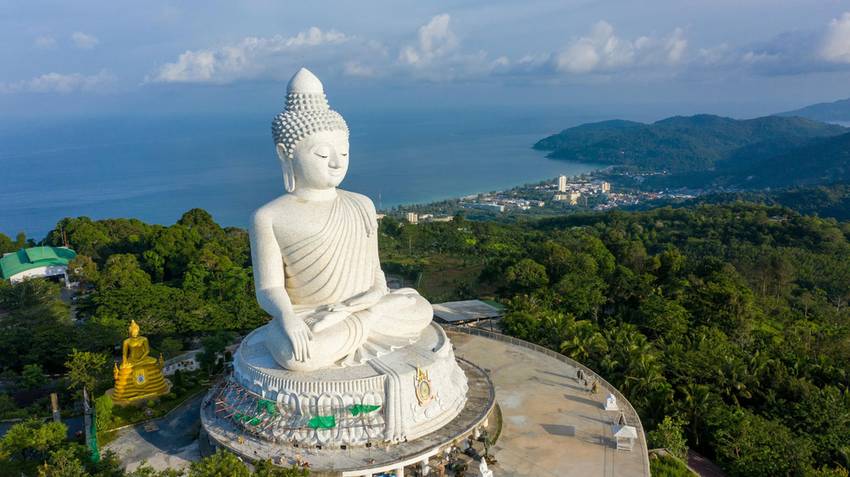
Within the island, the Phuket Big Buddha on Nakkerd Hill is a practical viewpoint stop that also gives a sense of the island’s terrain from above. The approach road is steep, and motorbike taxis cluster at the base for those arriving without transport. For travelers weighing a longer Thailand itinerary, Bangkok remains the dominant comparison node – louder, faster, more infrastructurally complex. The Bangkok neighborhood stays read maps the decision well if the question is where to spend more days versus fewer.
Many travelers end up choosing where to spend their extra days rather than whether to visit both destinations. The Chiang Mai first visit guide explores a version of Thailand built around markets, cafés, mountains, and a noticeably slower pace.
What Phuket suits best as a first trip
Phuket as a first visit to Thailand makes sense when the priority is clear: a beach base with working infrastructure, good food across a range of prices, easy access to day trips, and enough evening life to fill the hours without having to invent your own program. The island handles logistical uncertainty well – there are options at most turns, and the accommodation and transport ecosystem is well-established enough that improvising works.
The first-time traveler guide to Phuket comes down to this: the island rewards travelers who understand which zone fits their rhythm before they arrive, and who build a realistic expectation of what the main beach areas are like at peak hours. It is a place that works easily when matched correctly, and one that can feel noisier or more commercial than expected when the wrong zone gets chosen. The south of the island and the early mornings are where the version of Phuket that most people are imagining actually lives. The trick is knowing to look there.
Continuing your research
Phuket sits inside a wider Thailand ecosystem. Travelers building a longer itinerary often pair it with a few days in Chiang Mai for a contrast in pace and altitude – the Chiang Mai budget living read covers what the north actually costs and how far a daily budget stretches there, which is a useful planning anchor alongside the beach costs on Phuket.
Phuket first visit: common questions
1. When is the best time to visit Phuket for the first time?
November through March is the clearest and driest stretch, with calm seas on the west coast and consistent beach conditions. The island is also at its most visited then, so expect full hotels and lively evenings. April and May bring higher heat before the southwest monsoon arrives, while June through October is quieter and notably cheaper, with more dramatic skies and occasional heavy afternoon rain.
2. How many days do first-time visitors usually need in Phuket?
Five to seven days gives a first-time visitor enough time to settle into one beach area, explore two or three contrasting parts of the island, and take a day trip by boat. Shorter stays of three nights work if the goal is one beach base and a few relaxed evenings, though the island tends to reward a slower pace once the jet lag lifts.
3. Is Phuket good for solo travelers visiting for the first time?
Yes, though the experience shifts considerably depending on where you base yourself. Patong is loud and sociable and easy to navigate alone; Kata or Rawai suit solo travelers who want a quieter rhythm without full isolation. Phuket Old Town has a strong café and street-food culture that works well for people content spending time on their own.
4. Do you need a scooter to get around Phuket?
Not strictly, but without one the island feels considerably smaller. Songthaews run fixed routes between major beach areas, tuk-tuks and app-based taxis fill the gaps, and most beach zones are walkable within themselves. Renting a scooter opens the quieter roads in the south and hills, though Phuket’s traffic is genuinely busy and the roads less forgiving than on many other Thai islands.
5. What does Phuket actually feel like beyond the beach?
Away from the main beach strips, the island has a slower register – rubber plantation roads, hill temple viewpoints, morning markets in local neighborhoods, and Phuket Old Town’s Sino-Portuguese shophouses and good coffee. The contrast between the waterfront energy and the quieter interior is one of the things that makes a longer stay feel more layered than a week of sunbeds alone.