
Chiang Mai is compact enough to understand within a day or two, but unhurried enough that most people end up staying longer than they planned.
This first-time traveler guide to Chiang Mai is built around that gap between what you expect and what the city actually asks of you – because the experience is considerably different from other Southeast Asian city arrivals.
The city sits in a valley in northern Thailand, ringed by mountains on most sides, and divided loosely into the walled Old City, the commercial Nimman area to the west, and a riverside quarter that most first-timers discover later in the stay. There is no metro. Distances are short, the heat, depending on when you arrive, is either tolerable or the dominant fact of your day.
Arriving in late spring or early summer means arriving just as the burning season winds down and before the monsoon rains settle the air. It is not the most comfortable climate window, but the city is less crowded than in peak season, prices are lower, and the afternoons when the sky occasionally breaks open have a particular quality that cooler months do not.
What the city actually feels like on the ground
The Old City is defined by a square moat. Inside it: temples, guesthouses, small restaurants, tour operators, and the kind of slow pedestrian movement that comes from narrow lanes and high temperatures. By 9am, the main moat road already carries a mix of motorbikes, tuk-tuks, and tourists walking toward the nearest coffee. By noon, most people have retreated indoors.
The rhythm the city encourages is a morning-and-evening one. Temples and markets are best before 10am, when the light is lower and the pavement has not yet absorbed a full day of heat.
Evenings shift the energy outward: the Sunday Walking Street on Wualai Road draws a dense, slow-moving crowd from around 17:00 onward, and the Night Bazaar near Chang Klan runs most evenings with similar foot traffic from 18:00. In between, afternoons tend to belong to air-conditioned cafes and co-working spaces, not sightseeing.
Nimman, about 2 kilometers west of the moat, is a different register entirely. It is cleaner, more modern, and quieter during the day, with a cafe-and-shopping-mall density that feels closer to a Thai university town than a heritage district. Many first-time visitors use it as a base and walk or Grab to the Old City for the cultural sights which is a reasonable strategy, though it does mean the Old City becomes a day-trip destination rather than where you wake up.
Who Chiang Mai suits and who it does not
The city works particularly well for people who want structure without rigidity. There is enough to fill a week without a single day feeling forced. Temples, cooking classes, markets, day trips to Doi Inthanon or the elephant sanctuaries north of the city, evenings wandering the Night Bazaar – the days tend to fill themselves once you understand the heat logic and stop trying to operate at midday.
Remote workers and slow travelers have settled here in significant numbers, and the infrastructure reflects it: fast wifi is standard in most guesthouses and cafes, and the cost of staying comfortably is considerably lower than Bangkok or any coastal resort area. For a first visit, the combination of walkable geography, low logistical friction, and genuine depth in both food and cultural sights makes it one of the easier entries into Thailand.
It suits less well if you need constant urban stimulation or a packed nightlife calendar. Bar areas exist around the moat, but Chiang Mai’s nightlife is modest by Thai standards and tends to end earlier than Bangkok or the islands. Travelers coming directly from a beach trip often find the city atmosphere a useful counterbalance; those arriving from Bangkok sometimes take a day to adjust to the slower pace.
Travelers who start feeling restless after a few slower days in Chiang Mai often end up debating whether to continue south toward the islands or stay longer in northern Thailand. Phuket represents almost the opposite register: denser beach infrastructure, more nightlife, heavier tourism flow, and a much more physically active coastal rhythm.
The Chiang Mai vs Phuket comparison breaks down how those two versions of Thailand differ once you are actually living inside the daily pacing of each place.
How days actually unfold: pacing and movement
The city is flat, which makes walking viable in a way that many Southeast Asian cities are not. The inner moat road is a roughly 1.8-kilometer loop; walking it once takes about 25 minutes at a normal pace. In cooler months, this is pleasant. In April or May, the same walk at 14:00 is a different calculation entirely – pavement temperatures are high, shade is inconsistent, and the Old City’s narrow lanes that face south offer almost none.
Grab is the practical solution for midday movement. Fares are short and inexpensive for most cross-city trips. Red songthaews – shared pickup trucks running fixed routes – cover the main corridors for a flat fare and are a reasonable option once you know the direction you need. Renting a motorbike or bicycle extends your range considerably and is common among visitors staying more than three or four days, though the Old City’s one-way streets require some acclimatization.
Day trips outside the city are where the mountains become relevant. The drive up to Doi Suthep, the forested ridge above the city, takes about 40 minutes and changes the temperature noticeably. Most visitors make this trip at least once; going early avoids both the crowd compression on the stairs and the heat on the exposed viewpoints.
For longer excursions – elephant sanctuaries, the craft villages north of the city, Chiang Rai as an overnight – it is worth considering that the roads leaving the valley can be busy in the late afternoon.
Travelers who find Bangkok’s scale and transit load heavy often arrive in Chiang Mai and adjust within a day. The Bangkok neighborhood stays read covers that city’s spatial logic for those doing both in sequence and trying to decide which one to use as a base first.
Seasons and when to come as a first-time visitor
November through February is the standard recommendation, and for good reason. Temperatures sit in the low-to-mid 20s during the day, nights are genuinely cool, and the air quality is at its clearest. This is also peak season, which means the Old City fills up, guesthouse prices rise, and the Sunday and Saturday Walking Streets become genuinely slow-moving by 19:00. The tradeoff is worth it for most first-timers who want the most comfortable version of the city.
March to May is the hot and smoky season. Agricultural burning in the surrounding hills and across the border in Myanmar pushes air quality down – sometimes significantly, sometimes for weeks at a stretch. The AQI can sit in unhealthy ranges for extended periods, which matters if you plan to be active outdoors or if you are sensitive to particulates.
The heat independently peaks in April, reaching 38-40°C on the worst days. First-timers who arrive in this window generally spend more time inside and less time walking between temples.
June to October is rainy season. It does not rain constantly – most days have clear mornings – but afternoon downpours are common and some roads in lower areas of the city flood briefly after heavy rain. The mountains are greener, fewer tourists are around, and prices drop. For travelers with flexibility and some tolerance for weather interruption, it is a reasonable window. The moat fills and the surrounding scenery changes character considerably.
Where to base yourself and how to orient quickly
The Old City is the most self-contained base. Almost everything a first-time visitor wants to see is either inside the moat or within a 15-minute Grab ride. Guesthouses here range from basic to mid-range boutique, and the lanes are quiet enough by midnight that sleeping is not an issue even without heavy soundproofing. The main friction is heat management: the moat area offers less shade than Nimman’s tree-lined side streets, and walking between temples in the afternoon requires planning around the temperature.
Nimman suits people who want more of a neighborhood-café-and-coworking feeling. The walking options are better for evenings – cooler streets, more cafes open late – and the proximity to Maya Mall provides practical fallbacks (supermarket, pharmacy, air conditioning). The Old City from Nimman is a 15-20 minute walk or a short Grab, which most people find acceptable.
The Riverside area and the Nimmanhaemin Road extension further north are worth knowing about for longer stays, but for four to six days, most first-timers do not need to stray far from the Old City-Nimman axis. The city does not reward rushing between zones.
For context on how a first visit to a much larger and more transit-intensive Asian city tends to unfold, the Tokyo first-visit read addresses a very different scale and transit load, which helps clarify what makes Chiang Mai’s low-friction geography distinctive by comparison.
What the city rewards when you slow down
Chiang Mai’s appeal accumulates slowly. The first day often feels like orientation – where is the moat, how does Grab work, what is the actual heat situation. The second day is usually when the rhythm starts to make sense: a temple before 9am, coffee somewhere with wifi until midday, a late lunch somewhere with air conditioning, an errand or a massage, then the market in the evening. It is not complicated. It is also surprisingly easy to sustain for a week without getting restless.
The food is consistently the thing first-time visitors report adjusting to most willingly. Northern Thai food differs from the Bangkok-centric Thai cuisine that most international visitors know before arriving: khao soi, the coconut-curry noodle soup that appears on almost every menu in the Old City, is a reasonable introduction. The Sunday Walking Street food section near Wualai is dense and inexpensive; arriving at 17:30 rather than 19:00 means shorter waits and slightly more space to move.
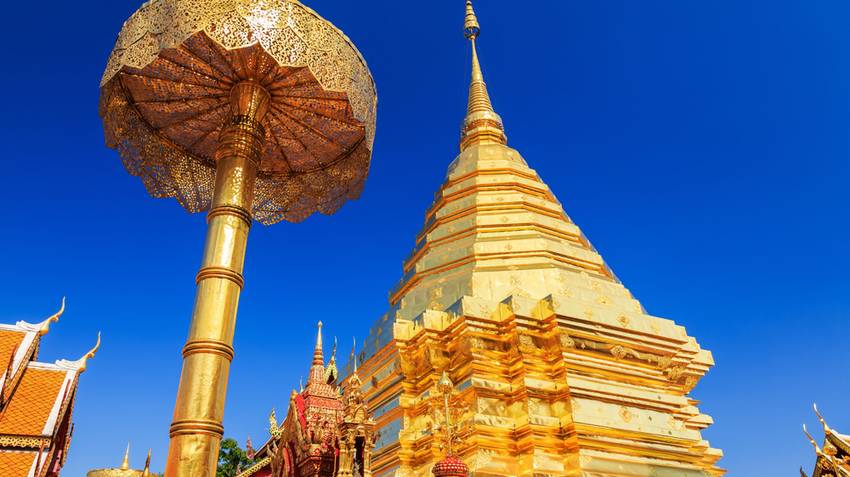
The cultural depth of the city – over 300 temples within the wider metropolitan area – rewards people who are genuinely curious about Theravada Buddhist practice and Lanna history, not just those who want a temple photo. Wat Chedi Luang and Wat Phra Singh are the two most visited within the Old City and are worth the visit in the early morning, when monks are still present and the noise of the street has not yet picked up.
Using Chiang Mai as a first entry point to Thailand
Some travelers arrive in Chiang Mai before Bangkok; others come after a beach stay in the south. Both sequences work, though the city functions differently in each position. As a first stop, it introduces Thailand at a gentler pace, with enough infrastructure for first-timers and enough genuine depth to feel substantive. As a post-beach stay, it offers a counterpoint to coastal heat and resort monotony, and the cultural density of the Old City tends to feel more meaningful when you arrive with some accumulated context about the country.
Chiang Rai, three hours north by road or 45 minutes by domestic flight, is the natural continuation for travelers who want to extend their northern Thailand time. It is quieter, smaller, and has the White Temple and Blue Temple as primary draws. Most visitors do it as a day trip from Chiang Mai, though a one-night stay allows a more relaxed pace and access to early-morning light at the main sites.
The decision between spending more time in the north versus moving south to the Gulf coast or Andaman beaches is one most first-time visitors face mid-trip. For travelers weighing the coastal option, the Phuket active beach fit read covers the atmosphere and physical conditions on the Andaman side for those who want to contrast the two registers before deciding.
What first-time visitors to Chiang Mai should actually expect
As a first-time traveler guide to Chiang Mai, the most honest framing is this: the city is one of Southeast Asia’s most forgiving first entries into a complex region.
The geography is contained, the infrastructure for visitors is well-established, the cost is low, and the pace allows for genuine adjustment rather than constant forward movement. It does not require extensive planning to enjoy. It does reward willingness to slow down.
The season determines a lot. Arriving between November and February means arriving at the city’s most comfortable and most socially active version. Arriving in the shoulder months means adapting to heat and smoke but gaining quieter streets and lower prices. Neither version is wrong – they are just different cities in the same location.
The traveler who leaves Chiang Mai mostly pleased is usually the one who spent at least four days, got up early at least twice, found a cafe or guesthouse where they felt settled, and stopped trying to do the afternoon shift in direct sun. The one who leaves ambivalent usually tried to move too fast through a city that does not reward speed.
Chiang Mai first visit: common questions
1. When is the best time to visit Chiang Mai for a first trip?
November to February is the most comfortable window: cooler temperatures, lower humidity, and the clearest air of the year. March through May is the hot and smoky season, when agricultural burning pushes air quality down significantly, sometimes for weeks. June to October brings rain and greener surroundings but also occasional flooding in lower-lying areas.
2. How many days do first-time visitors need in Chiang Mai?
Four to six days covers the Old City temples, Nimman, a day trip outside the city, and enough slow time to feel the rhythm without rushing. Fewer than three days is possible but leaves little room for the unplanned afternoons that define the experience. Many first-timers extend their stay once they settle in.
3. Is Chiang Mai easy to get around without speaking Thai?
Yes. Grab operates reliably across the city, English signage is widespread in tourist and expat areas, and most guesthouses and restaurants in the Old City or Nimman are comfortable with English. Red songthaew shared trucks run fixed routes and are cheap but require knowing the general direction you want.
4. Is Chiang Mai safe for solo travelers visiting for the first time?
Chiang Mai has a long-established solo travel infrastructure. Hostels, co-working spaces, and walking-friendly neighborhoods make it easy to meet people or stay independent. Standard city precautions apply at night around bar areas, but the overall environment is low-friction for first-time solo visitors.
5. How does Chiang Mai compare to Bangkok for a first visit to Thailand?
Bangkok is larger, faster, and significantly more stimulating; the transit system alone requires a learning curve. Chiang Mai runs at a slower pace with a more contained geography, which makes it easier to orient on a first visit. Some travelers do both in sequence, using Chiang Mai to decompress after Bangkok’s density.