
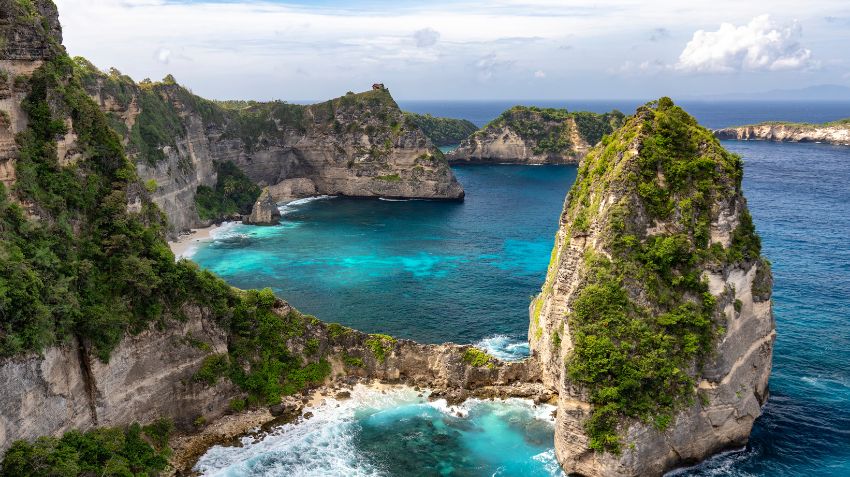
Bali arrives with a specific quality of light and a specific smell: frangipani, incense, and something faintly green from the rice fields, all of it slightly damp. The island moves at its own pace, which tends to be slower and more interior-facing than most first-time visitors expect.
This first-time traveler guide to Bali is built around that pace, because the people who leave feeling like they understood the island are almost always the ones who stopped trying to cover it and started learning how one or two zones actually work. Bali rewards that approach more directly than almost anywhere else in Southeast Asia.
In July, the island is fully alive: dry air, long evenings, and a steady rhythm of activity along the coastal strip and in the Ubud valley. It is also the busiest window of the year, which means the way you sequence your days matters more than it would in, say, October.
What Bali actually feels like before you arrive
The first thing to understand is that “Bali” names a reasonably large island with genuinely different zones, each running on its own social and physical tempo. Seminyak and Kuta are coastal, dense with international visitors, and oriented toward evenings and beach hours. Canggu runs a slightly younger and more dispersed rhythm, with surf, cafés and co-working spaces spread along a flat coastal corridor.
Ubud sits inland, cooler in the evenings, and organized around its market, its temple circuit, and the rice terrace walks that start very early and empty out by 10:00 once the day-tripper busses arrive.
The interior is a different Bali entirely. Quieter roads, morning mist on the hills around Kintamani, a walk to a local warung where the food costs a fraction of anything near the beach. It does not demand special effort to find, but it does require choosing a base that gives you access to it.
Heat and humidity are real in the coastal zones. Stone surfaces stay warm into the evening, and the difference between a 07:30 walk and a 13:00 walk in Seminyak is mostly about whether you want to sweat through your shirt. The morning hours are when the island is at its quietest and most itself: offerings freshly placed on the streets, fewer scooters, the kind of light that makes the rice paddies look three shades greener than they will at noon.
Is Bali right for your travel style on a first visit?
Bali suits a wide range of travelers, but it suits them in different zones. Slow travelers and remote workers tend to settle into Canggu or Ubud, where the infrastructure for longer stays is well developed and the daily rhythm supports mornings that start late and afternoons that dissolve into long lunches. Couples and honeymooners often find Seminyak or the quieter stretches of Sanur work best for them. Solo travelers tend to rotate between Canggu’s café culture and Ubud’s social guesthouse scene.
First-time visitors who arrive expecting a compact island they can cover in a week often find themselves feeling scattered. The distances between zones are not extreme on a map, but traffic on the main roads, particularly the corridor between Kuta and Ubud, means that a 35 km journey can take well over an hour in peak afternoon traffic. This is less a problem once you accept it as part of how the island moves, and more of a mismatch if you are trying to use it as a multi-day island-hopping destination.
Bali is probably not the right first stop for travelers who need high urban density, reliable public transit, or a compact city core they can walk end-to-end. It is a strong fit for travelers who want to settle into a base, let their days organize themselves around meals and movement, and occasionally surface for something specific, a temple, a sunrise on a volcano, an afternoon in the market.
How to structure your first visit to Bali: zones, pacing and base logic
Most first-time itineraries work better as a two-base structure: one coastal stop and one interior stop. The standard version is four to five nights in the south, usually Seminyak or Canggu, followed by four to five nights in Ubud. That sequence allows the island to reveal itself in two quite different registers, and most people find the transition from coast to interior feels like arriving somewhere new rather than just changing hotels.
If you only have a week, pick one zone rather than trying to cross the island multiple times. Ubud with day trips to the coast is one version; a coastal base with a single overnight in the hills is another. The mistake most first-time visitors make is building an itinerary that requires moving every two or three nights, which turns most of the time into logistics.
Day trips from either base are well established. From Ubud, the standard circuit covers Tirta Empul, the Kintamani volcano viewpoint, and the Tegallalang rice terraces, all in a single morning with a driver. The terraces are crowded by 09:30 in July, so arriving before 08:00 changes the experience considerably. From a coastal base, the sea temple at Tanah Lot and the Uluwatu clifftop temple both work as afternoon trips, timed to arrive as the light drops and the Kecak fire dance begins.
Getting between zones is straightforward with a pre-booked driver. Most accommodation will arrange this, and the cost for a full-day driver, including waiting time, runs at a fraction of equivalent car hire in Europe. Within Seminyak or Canggu, Grab handles short trips reliably. Ubud’s compact center is walkable for most things, though the main market area gets genuinely busy from mid-morning onward.
Travelers who wonder how Bali compares to the experience of arriving in a major Southeast Asian city for the first time often find the Jakarta first-time visitor read a useful parallel, particularly for understanding the difference between island-based and urban-based travel in Indonesia.
Bali in photos
Where to base yourself in Bali for a first visit
Seminyak and Legian
The most developed stretch of the south coast, with the highest concentration of restaurants, beach clubs and international-facing infrastructure. It is busy and it knows it is busy, which gives it a certain self-assured energy. The beach here is long and wide, facing west, so the late-afternoon light on the water is genuinely good.
For first-time visitors who want a comfortable landing with everything within easy reach, it works very well. For travelers who find high-density tourist environments wearing over several days, the nearby Jakarta first-time visitor guide offers a useful contrast in how urban-dense and island-diffuse travel in Indonesia compare before you commit.
Canggu
A looser, more spread-out zone running along a flat coastal corridor north of Seminyak. The beach here is surfable and less crowded than Kuta. Cafés, co-working spaces and yoga studios are the dominant social infrastructure, which makes it a natural fit for remote workers and longer-stay travelers. It lacks the polish of Seminyak but has more of a neighborhood character in the pockets between the main roads.
Ubud
The cultural and geographic center of the island for most visitors. The market opens early and the streets around it are at their most alive before 09:00. By mid-morning the central area is busy with day-trippers; by early afternoon it has settled back into its own pace. The evenings are noticeably cooler than the coast, and the terraced landscape around the town produces a quality of late-afternoon light that is hard to describe without sounding promotional.
Ubud rewards slower pacing. Two or three days spent actually walking the village roads, visiting nearby temples and eating at small warungs produces a more layered experience than the same time spent on day trips organized from a coastal base.
Sanur and the quieter south
Sanur runs at a noticeably calmer register than the western strip. The beach is sheltered, the promenade walkable in the morning, and the overall atmosphere is more family-oriented and less night-economy-driven. For travelers who want easy access to the south and the fast boat connections to Nusa Lembongan without the intensity of Seminyak, it sits well.
Bali in July: what the peak season actually means on the ground
July is high season, and the island runs accordingly. Popular temples like Tanah Lot and Uluwatu have significant visitor activity by mid-morning. The terraces at Tegallalang, which are genuinely worth seeing, require either an early start or an acceptance that they will be shared with many other people when you arrive. Neither is a problem if you know it in advance.
The upside is that July also means the island is fully operational: restaurants, tour circuits, surf schools, cooking classes and boat connections to the Nusa islands all run at full capacity. The dry season light is clear and the evenings are long. It is a good time to be here, and the visitor activity largely concentrates in a predictable set of locations, which means that ten minutes off any main tourist road produces a very different version of the island.
Evening hours tend to carry the day’s best energy. In Ubud, the main street after 19:00 has a particular quietness that the midday version does not. On the coast, beach clubs and open-air restaurants come into their own around the same hour when the heat has finally released and the sky over the Indian Ocean turns a specific shade of copper.
Is Bali worth it for a first-time visitor, and who it really suits
For a first-time traveler guide to Bali, the honest answer is that the island suits people who are willing to let it set the pace rather than imposing one on it. Visitors who arrive with a list of fifteen things to see in seven days tend to spend a lot of time in traffic and come away feeling like they skimmed the surface. Visitors who pick two zones, stay four or five nights in each, and leave some days deliberately unstructured tend to find something they did not expect.
It suits slow travelers, couples who want to feel settled rather than constantly moving, remote workers looking for a place where the daily rhythm organizes itself naturally around work and exploration, and anyone who has wanted to understand what rice terrace culture, Hindu temple architecture, and an active surf and café scene coexisting on one small island actually looks like up close. It fits less well if you need constant urban stimulation, a city you can walk end-to-end, or a destination where the distances between things are trivially short.
The island’s character holds across most seasons, but July in particular catches it in full voice. That is both a genuine draw and a reason to arrive with a plan for the early morning hours, when Bali is briefly, unmistakably its own thing.
Continue exploring: If you are building an Indonesia trip around Bali and considering whether to add a city stop, the Jakarta first-time visitor guide covers the urban side of the country and how it sits alongside an island-based itinerary.
Bali first-time visitor FAQ: best time, days needed, base choice, getting around and July atmosphere
1. How many days do you need in Bali for a first visit?
Ten to fourteen days gives you enough time to settle into one base, make a second base shift, and take at least one day trip without rushing. Seven days is workable if you pick one zone and stay there rather than trying to cross the island.
2. What is the best time of year to visit Bali for the first time?
The dry season runs roughly from May through October, with July and August bringing the most visitor activity and the clearest skies. Shoulder windows in May, June and September offer similar conditions with a noticeably calmer atmosphere at popular sites.
3. Should a first-time visitor base themselves in Ubud or Seminyak?
It depends on whether you want to spend more time near the coast or the interior. Seminyak and Canggu suit people drawn to beach life, evenings out and easy café culture; Ubud fits travelers who want rice terraces, temple circuits and a cooler, slower-paced daily rhythm. Many first-time visitors do both.
4. Is Bali easy to get around without a driver?
Within a single zone, yes – Grab works reliably in Seminyak, Canggu and Ubud for short trips. Between zones, a pre-booked driver is the most practical option, and for most day trips from Ubud or a coastal base, that is the standard arrangement rather than an exception.
5. What does Bali feel like for a first-time visitor in July?
July sits inside the island’s peak window: dry, warm, and busy enough that popular spots like Tanah Lot and the Tegallalang terraces draw significant visitor activity by mid-morning. Arriving early at key sites and shifting to quieter villages or less-traveled temple circuits in the afternoon gives the island a completely different texture.