
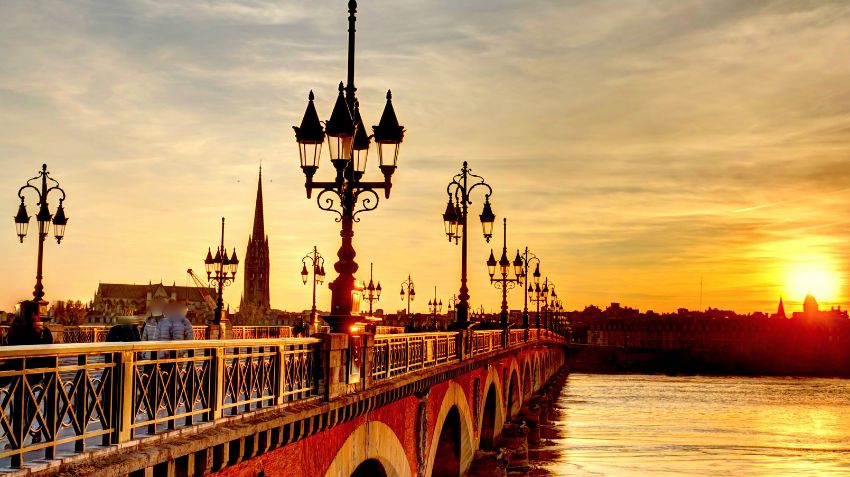
Bordeaux has a particular quality in the evening: the stone facades along the riverfront hold the day’s warmth well past sunset, the terraces fill gradually rather than all at once, and the light on the Garonne turns a specific shade of amber that the city seems designed around. It is a place that rewards slowing down, and it rarely asks you to rush.
For anyone working through a first-time traveler guide to Bordeaux, the useful thing to know early is that the city operates at two distinct tempos depending on the hour. Mornings belong to markets, boulangeries, and the cool stone streets of the old town. Evenings belong to the quais, the wine bars, and the long Bordelais dinner that nobody seems in any hurry to finish.
What Bordeaux feels like for first-time visitors
The historic centre – a UNESCO-listed area locals still just call the old town – is compact in a way that makes the first day unusually easy to navigate. The main landmarks sit within walking distance of each other along the riverfront: the Place de la Bourse with its famous water mirror, the Grand Théâtre, the Saint-André Cathedral, all connected by flat streets that do not require much planning to explore in sequence.
What catches most first-time visitors off guard is how residential it feels. The Chartrons district, a ten-minute walk north of the old town, runs at a noticeably different pace from the tourist corridor. Antique shops, a Sunday morning market, small wine merchants, and a scattering of cafés where the clientele is mostly local. The contrast with the more visited streets around Place du Parlement is immediate and worth building into at least one afternoon.
Wine is everywhere and yet rarely intrusive. The city is not organized around it the way the surrounding countryside is – you can spend two full days in Bordeaux without setting foot in a cave or a tasting room. But the presence of wine shapes the food culture, the evening rhythm, and the way restaurants approach their menus, which tend to be shorter and more considered than in many French cities of this size.
Is Bordeaux right for your travel style?
Bordeaux fits best when the traveler wants a city that is genuinely enjoyable to walk through without an agenda. The architecture is consistent and handsome rather than dramatic – pale limestone rather than grand monuments – and the pleasure of the old town is largely cumulative, built from repeated small moments rather than a single unmissable sight.
It suits slow travelers, couples, and anyone arriving from a denser city who wants to keep cultural activity at a reasonable pitch. Remote workers find the café culture generous: many places in Chartrons and around the Marché des Capucins stay open through the afternoon and do not seem to mind laptops. The evening is too good to waste on early dinners – kitchens here gear up around 19:30, and the lively phase of most restaurants runs between 20:00 and 22:00.
The fit shifts for travelers who need a dense programme of museums, nightlife past midnight, or the kind of constant social energy that Paris or Lyon sustain more easily. Bordeaux has cultural institutions – the CAPC contemporary art museum, the Cité du Vin wine museum outside the centre – but the city’s strongest register is outdoor and convivial rather than institutional. If that sounds like the wrong trip, it probably is.
Bordeaux in photos
How to get around Bordeaux as a first-time visitor
The tram network does most of the heavy lifting. Three lines connect the airport (via Line A), the train station, the riverfront, and the main residential neighborhoods in a layout that is genuinely readable on a first attempt. The historic centre itself is mostly car-free, which means the actual experience of moving through it is almost entirely on foot.
Arriving from Bordeaux-Mérignac airport, the tram A takes roughly 35 minutes to reach the city centre with no transfer. The airport terminal connects directly to the tram stop, so arriving with luggage is straightforward. Most hotels and rentals in the old town or Chartrons sit within a 5-10 minute walk of a tram stop.
For wine country, the train is the sensible choice for a short visit. Saint-Émilion is about 35 minutes from Bordeaux Saint-Jean station, and the village sits mostly uphill from the station along a winding climb through vineyards. Worth knowing: the last train back runs earlier than expected on weekdays, and the walk back down to the station with a warm afternoon behind you covers distance faster than the uphill arrival suggested it would.
Ride apps cover the city well for evening returns from outer neighborhoods or the Cité du Vin, which sits slightly off the main tram corridor. Cycling is genuinely pleasant along the quais and between Chartrons and the old town – rental stations are frequent and the flat terrain means even a slow pace covers ground comfortably.
Best areas and day trips near Bordeaux worth exploring
Within the city, the split that matters most for first-time visitors is between Saint-Pierre and Chartrons. Saint-Pierre is the old town’s social heart – the covered market, the restaurant-dense streets around Place du Parlement, the evening crowds along the quais. Chartrons carries a quieter Sunday morning quality even on weekdays, and its antique dealers and wine merchants extend south toward the old town in a way that rewards aimless walking.
Outside the city, Saint-Émilion is the obvious day trip and earns it. The village is small, the medieval streets compact, and the wine estates visible from almost any angle. Arcachon and the Atlantic coast sit an hour by train and offer a complete change of register – pine trees, seafood, dune walks, and water that is cooler than the Mediterranean equivalent.
The Dune du Pilat, a sand dune of remarkable scale just south of Arcachon, takes about 20 minutes to climb and provides a view across the Bay of Arcachon that no photograph properly accounts for.
Travelers who find themselves wanting more French city texture alongside Bordeaux often end up weighing it against Lyon or working it into a longer loop. The France loop itinerary covering Paris, Nice, Lyon and Bordeaux sits on exactly that question – how the four cities sequence against each other in pacing and atmosphere.
Is Bordeaux worth visiting on a first trip to France?
The honest answer depends on what the trip is actually for. If France means Paris first, Bordeaux works well as a contrast rather than a continuation – slower, more residential in feel, better at being enjoyed over three or four days than rushed through in one. If the goal is southwest France specifically, or wine country, or a city that functions as a genuine base rather than a transit point, Bordeaux earns its place clearly.
First-time visitors to France who arrive expecting the density of Paris or the coastal energy of Nice tend to recalibrate quickly once the old town’s evening rhythm clicks into place. The city is less cinematic than those comparisons suggest, and more liveable. The pleasure of Bordeaux is largely proportional to the time given to it – a single night reveals the architecture and the riverfront; three days reveals the city.
If you are weighing Bordeaux against other French cities with a different energy or a faster urban tempo, the Lyon first-time read covers the river rhythm, neighborhoods and food culture of a city that runs at a noticeably different register.
Summer is the fullest version of Bordeaux: the outdoor life is at its most generous, the wine tourism infrastructure runs at capacity, and the evenings along the quais carry a social ease that feels specific to this city. Those arriving in September will find the crowds thinner, the light softer on the limestone facades, and the harvest season beginning in the vineyards nearby – a version of Bordeaux that different travelers find equally worth wanting.
Bordeaux first-time visitor FAQ: days needed, summer rhythm, transport, neighbourhoods and wine country
1. How many days do you need in Bordeaux as a first-time visitor?
Three days gives you a comfortable first read of the city: the old town, the riverfront quais, a wine country half-day, and enough time to let the evening rhythm settle in. Four days works well if you want to extend into Saint-Émilion or slow down in the Chartrons district without rushing.
2. What is Bordeaux like to visit in summer?
July and August are warm and active, with the quais and outdoor terraces at their liveliest in the evenings. Midday heat shapes the rhythm naturally – mornings and evenings are when the city feels most like itself, and the riverfront stays comfortable even in peak summer thanks to the Garonne breeze.
3. Is Bordeaux easy to get around without a car?
Yes – the historic centre is flat and walkable, and the three-line tram network connects the main neighbourhoods clearly. For wine country day trips, trains reach Saint-Émilion in about 35 minutes, so a car is optional rather than essential for a short stay.
4. Which neighbourhood is best to stay in for a first visit to Bordeaux?
Saint-Pierre and the area around the Place du Parlement put you inside the old town’s evening rhythm – restaurants, covered passages, and the riverfront all within ten minutes on foot. Chartrons is the quieter, slightly cooler alternative, with its antique dealers, Sunday market and a more residential morning feel.
5. Do you need to know French to travel in Bordeaux?
Basic French goes a long way in smaller wine bars and neighbourhood restaurants, where menus and conversation stay local. In the old town and at major wine tourism sites, English is widely understood, but arriving with a few words of French tends to open up a warmer version of the city.