
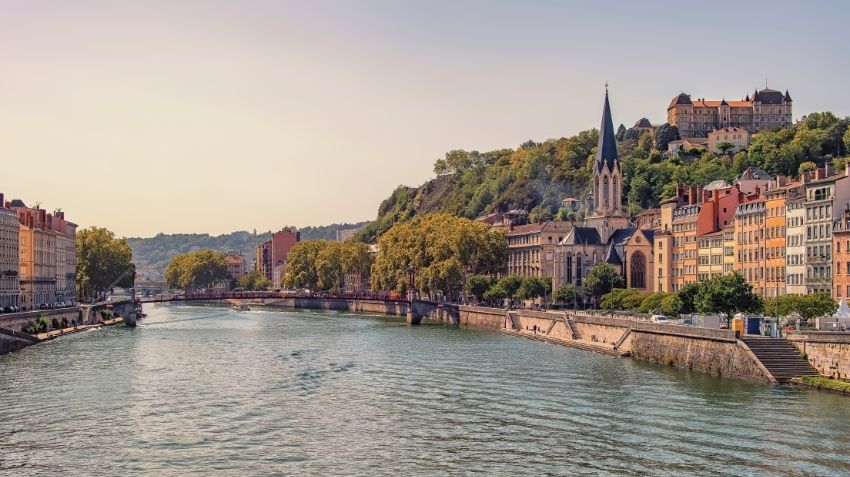
Lyon settles into you gradually. The first morning, you are still reading the city as a collection of surfaces, rivers, and medieval lanes. By the second, you are eating lunch at 13:30 in a bouchon and already thinking about which covered market to revisit before the train. This is a reasonable first-time traveler guide to Lyon precisely because it resists the itinerary format: the city does not work well when you run it hard. It works when you let it set the pace.
The Saône and the Rhône run parallel through the center, with the Presqu’île peninsula between them, and that physical structure turns out to be one of Lyon’s most useful qualities. Everything a first visit covers sits within about four kilometers of walkable, mostly flat ground, with the exception of Croix-Rousse and Fourvière, which require a vertical commitment that rewards the effort.
In July, the city is in full summer mode. Terraces stay open late, the riverbanks carry evening foot traffic until well past 22:00, and the Roman theatre above Vieux-Lyon hosts the Nuits de Fourvière festival through most of the month. The social and culinary life that defines Lyon runs at high tempo during summer, which is both the draw and the reason to pace carefully.
What Lyon feels like for first-time visitors
The Presqu’île is the easiest entry point. Wide boulevards, a covered market hall, and bouchons clustered around Rue Mercière and the streets behind the Opéra give the first day a clear structure without requiring much navigation. The light on the stone facades around Place des Terreaux is best in the hour before dinner, amber and low, when the square shifts from tourists crossing it to people actually sitting in it.
Vieux-Lyon, across the Saône on the west bank, operates at a slightly different register. The traboules, covered passageways cut through Renaissance apartment buildings, link parallel streets in a way that turns a short walk into something more architectural. The main axis along Rue Saint-Jean carries most of the visitor traffic during the day; the lanes branching off it are quieter and where the texture of the quartier is most readable. Many traboule doors are unlocked between 09:00 and 18:00, and the tourist office on Place du Change distributes a free map of accessible entry points.
Croix-Rousse sits on the hill north of the Presqu’île, reached by a metro stop or a 20-minute climb through a sequence of stairs and passages that Lyon natives do without thinking about it. Up here, the city changes register entirely: a morning market on the Boulevard de la Croix-Rousse, smaller restaurants aimed mostly at locals, a consistent breeze from the height that makes July afternoons more comfortable than in the stone streets below. The silk-weaving history is present if you look for it, but it is the neighborhood pace rather than any single site that makes Croix-Rousse worth the climb.
Is Lyon the right first stop in France for your travel style?
Lyon fits travelers who organize their days around meals. Not as an abstraction, but as a structural reality: breakfast, an unhurried walk, lunch at a bouchon or at the counter inside Les Halles de Lyon Paul Bocuse, an afternoon of wandering, and dinner somewhere that requires a reservation. That rhythm fills three or four days comfortably without a single museum feeling obligatory.
It suits those who find Paris dense in July. The visitor volume is real but does not compress the city the same way. You can walk from one end of the Presqu’île to the other in 25 minutes and still feel like you are moving at your own pace. The bouchon culture rewards going slowly, ordering the full menu, and accepting that 14:30 is an appropriate time to still be finishing lunch.
It is a less natural fit for travelers whose primary interest is art, museum density, or a Paris-calibrated range of international cultural institutions. The Musée des Confluences and the Musée des Beaux-Arts de Lyon are both genuinely worth a half day each, but the city’s weight is not there. Travelers coming primarily for architecture, food culture, and the specific French provincial rhythm of a serious regional capital will find Lyon does that consistently well.
First-time visitors to France who are weighing Lyon against an entirely different atmosphere – Mediterranean light and coastal energy rather than inland food culture and river rhythm – often find the Paris vs Nice first-trip read clarifies which register they are actually looking for before committing to the itinerary.
How to move around Lyon as a first-time visitor
The metro runs four lines covering most of the visitor geography, clean and frequent enough that queuing is rarely a factor outside rush hour. The tram extends coverage toward the Confluence district in the south and out toward the Part-Dieu train station hub. A single TCL network ticket covers both, and the app handles loading and validation without requiring the ticket machine queues that characterize arrival at Part-Dieu on busy July afternoons.
The Vaporetto, a small river shuttle, runs along the Saône between Saint-Paul in Vieux-Lyon and the tip of the Presqu’île. It takes under ten minutes and covers a connection that would otherwise require a longer walk around the bridge. In July it operates on regular daytime schedules and tends to be quieter than the streets it replaces.
Getting in from Lyon Saint-Exupéry airport follows a clear sequence. The Rhônexpress tram runs directly to Part-Dieu station in around 30 minutes, with departures every 15 minutes during the morning and evening windows. From Part-Dieu, the metro B line connects to the Presqu’île, and the D line covers Vieux-Lyon at the Vieux-Lyon Saint-Just stop. The connection is clean enough that arriving with luggage does not require a taxi decision.
Walking is the default mode for most of the first-visit geography. The Presqu’île is flat; Vieux-Lyon is flat along its main axis, less so on the lanes rising toward Fourvière. Croix-Rousse is a genuine hill, and while the stairs are manageable at a comfortable pace, arriving with rolling luggage is not a strategy. The funicular from the Vieux-Lyon metro station reaches Fourvière without the climb, which is worth knowing early.
Day trips from Lyon and where to go next
Beaujolais wine country sits about 40 kilometers north by train or car, and the villages around Belleville-en-Beaujolais organize easily into a half-day from Lyon Part-Dieu. The landscape is genuinely beautiful in a quiet agricultural way, without the tourism infrastructure of larger wine routes, and the timing suits those who want one afternoon outside the city without committing to an overnight.
Vienne, 27 kilometers south on the TER regional train, carries a Roman theatre larger than the one in Lyon and a smaller old town that empties of visitors by late afternoon. The journey runs about 20 minutes and the combination of Roman ruins and a riverside lunch makes it one of the more coherent day trips in the region. In July, Vienne also runs the Jazz à Vienne festival, which extends into the evenings and provides a reason to time the return train accordingly.
Travelers who want to use Lyon as the first point in a longer France itinerary often frame Paris as either the arrival or departure city. The TGV between Lyon and Paris runs in under two hours, which makes the connection one of the easiest high-speed rail segments in the country. Those working out how Paris and the Riviera sit together as a first France trip will find the Paris first-visit guide a useful structure for thinking about sequence and pacing before booking.
If the French Riviera is already in the frame, the Nice first-time visitor read covers the coastal register that Lyon does not offer, including the rhythm differences that matter when sequencing both cities in the same trip.
Lyon’s food and architectural character rewards slow travel specifically. A week in Lyon with one day trip to Beaujolais and one to Vienne is not too much; for most first visitors it is roughly the right scale.
Is Lyon worth visiting for a first trip to France?
For a first-time traveler guide to Lyon to be honest, it has to say this clearly: Lyon is not the most immediately legible French city from the outside. It does not sell itself on a single image the way Paris does. What it offers instead is a density of good eating, a coherent and walkable historic core across three distinct neighborhoods, and a French provincial rhythm that is harder to find in the capital at any season.
In July it runs at full social tempo. The Nuits de Fourvière, the evening markets, the full terrace culture on the Presqu’île, and the long slow summer lunches at bouchons all operate simultaneously. For travelers who want France to feel like France, in a city that has been serious about food culture since before anyone was writing travel guides about it, Lyon tends to deliver consistently and without much theatrical effort.
It suits patient travelers and food-focused travelers most naturally. It suits anyone who finds Paris in summer too large and too crowded to actually rest inside. It is a quieter, denser, slower version of urban France, and for the right traveler that is not a consolation prize but the point entirely.
Continue exploring: If your trip to France is still taking shape – weighing where to start, how to split time between cities, or which rhythm matches your travel state – the Lyon read sits alongside the comparison nodes for Paris, Nice, and the broader France itinerary questions in the Nodaliso France cluster.
Lyon first-time visitor FAQ: days needed, bouchons, traboules, airport transfer and comparison with Paris and Nice
1. How many days do you need in Lyon for a first visit?
Three full days cover the essential rhythm without feeling compressed. One day for Vieux-Lyon and the Fourvière hill, one for the Presqu’île and Les Halles de Lyon Paul Bocuse, and a third to slow down in Croix-Rousse and follow wherever the morning takes you. Four days lets you breathe a little more into the food side of the city.
2. What is the best area to stay in Lyon for a first visit?
The Presqu’île is the most practical base for a first visit: central, walkable to both banks, and close to the bouchon clusters around Rue Mercière and the opera quarter. Vieux-Lyon offers more atmosphere but slightly less transport convenience, and suits travelers who want stone streets and a quieter morning pace over easy access to everything.
3. Is Lyon worth visiting in summer?
July and August bring Lyon to full outdoor life: terraces, evening markets, and the long twilight over the Saône. The city absorbs summer well because much of its food and social life happens indoors or under canopies regardless of season, and the hills provide natural cooling in the evenings. Nuits de Fourvière, the summer festival held in the ancient Roman theatre above the city, runs through most of July and into August.
4. How do you get from Lyon Saint-Exupéry airport to the city center?
The Rhônexpress tram runs directly from the airport to Lyon Part-Dieu station in around 30 minutes, with departures every 15 minutes during peak hours. From Part-Dieu, the metro and tram network connects to Vieux-Lyon and the Presqu’île in under ten more minutes. Taxis are available but take longer during morning and evening traffic windows on the A43.
5. What should first-time visitors to Lyon know about eating in bouchons?
A bouchon is a specific Lyonnais format: a small, often family-run restaurant serving traditional dishes like quenelles, andouillette, salade lyonnaise and tête de veau. Portions are generous, the rooms are small, and the service is informal. Most serious bouchons are listed with the Association de Défense des Bouchons Lyonnais, which publishes a verified roster worth cross-referencing before sitting down, since tourist versions multiply near the main Vieux-Lyon streets and the name itself is not legally protected.