
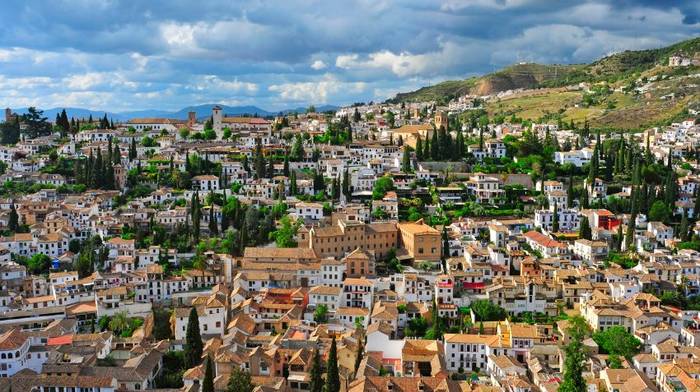
Granada has a specific quality of afternoon light that is worth arriving early enough to catch: the way it settles on the red walls of the Alhambra across the valley from the Albaicín, around 18:00 in summer, when the heat has started to ease and the stone begins to give back some of its warmth.
This first-time traveler guide to Granada begins there, with that view, because it tells you something true about the city before you have walked a single street.
Granada is one of the few Andalusian cities where the monumental weight of what you are visiting – the Nasrid Palaces, the Generalife, the old Moorish quarter climbing the hillside – coexists with a genuinely local city underneath.
The university keeps a younger population in the center year-round. The tapas culture means that a beer at a bar often comes with food, unrequested and included. Evening in the Realejo or around Plaza de la Trinidad has its own unhurried pace, separate from the tourist circuit around the Alhambra.
Summer brings real heat by midday – Granada sits at 690 metres above sea level, which softens the evenings considerably compared to the coast, but July and August afternoons can reach 37°C on the open streets. The city adapts: mornings fill early, afternoons go quiet, and the social life restarts properly after 21:00 when the terraces come back to life and the tapas bars fill with a mix of students, local families, and travelers who have figured out how the day is supposed to work.
What Granada feels like for first-time visitors in summer
The city operates on two registers simultaneously. There is the Alhambra circuit – timed entries, guided groups, a steady flow of visitors moving through the Nasrid Palaces in roughly ninety-minute windows – and then there is everything below it: the grid of streets around Gran Vía, the market at Mercado de San Agustín, the small squares where people stop for coffee without any particular itinerary.
The Albaicín runs up the hillside opposite the Alhambra. The lanes are narrow, often cobbled, occasionally steep enough that you pause to look back and realize how high you have climbed. At the Mirador de San Nicolás, the Alhambra sits across the valley in direct sight, and in the early evening the light on its towers has the particular amber quality that makes people stay longer than they planned. The viewpoint is busy by mid-morning; arriving at 08:00 or after 19:00 gives you a very different experience of the same place.
Sacromonte, the neighborhood carved into the hillside caves above the Albaicín, has its own quieter character during the day – the cave houses whitewashed and cool inside even in July, the streets thin, the sound mostly wind and distant traffic.
Flamenco performances happen here in the evenings, in venues built into the rock. The walk down from Sacromonte back toward the center at night, with the city lit below, is one of those small incidental moments Granada offers without advertising it.
Travelers deciding where to stay before planning daily routes can also explore the Barcelona neighborhood guide for another example of how neighborhood choice shapes a first visit.
Is Granada the right destination for your travel style?
Granada works well for travelers who want a city that has both serious historical weight and a usable daily life around it. The Alhambra is not a supplementary attraction – it takes a half-day minimum to move through properly, and most people find they want more time in the Generalife gardens than they originally planned. If your interest in historic architecture is limited, the Alhambra still dominates the trip in terms of planning and cost, and that asymmetry is worth knowing in advance.
The city also suits travelers who move at an uneven pace – who are happy to spend a slow morning in a café near the cathedral, then walk up to the Albaicín in the early afternoon, then decide what to do next based on how they feel. Granada does not demand a tight itinerary. Travelers who need a very compressed schedule, fitting seven destinations into five days, tend to find the city slightly resistant to that logic: the Alhambra requires advance booking and a fixed time slot, which structures the day around it whether you want it to or not.
Solo travelers and couples tend to settle into Granada easily. Families with young children manage well in the central flat areas and the Realejo neighborhood, though the Albaicín’s hills and cobbles make pushchairs impractical above the first few streets.
Travelers weighing this against a coastal alternative – whether to base in Granada or further south toward Málaga – often find that the answer depends less on preference and more on how much time they have. The Madrid or Málaga comparison read covers the coastal versus inland trade-off at the Andalusian level, which is sometimes the more useful framing for that decision.
Granada in photos
How to move around Granada as a first-time visitor
The city center is compact enough that most visitors walk between their accommodation, the cathedral area, and the Realejo without needing transport. The Alhambra itself sits above the city on a forested hill: on foot from the center, the uphill route takes around twenty-five minutes on a path that is shaded for much of the way. In summer, doing that walk before 09:00 or after 17:00 makes a meaningful difference.
The Albaicín is best covered on foot, though the C1 minibus runs a loop through the neighborhood for travelers who find the gradient difficult. For the Alhambra, the same C3 and C32 bus lines connect from Plaza Nueva in a few minutes if the walk is not appealing. Taxis are available throughout the center and Cabify operates reliably; for the airport, the Alsa bus is the practical choice for most arrivals, dropping near Gran Vía after roughly forty-five minutes.
The metro is genuinely less useful here than in larger Spanish cities – it connects the northwest suburbs to the city edge, not the historic center. Most visitors never use it. The practical transport logic in Granada is: walk everywhere reachable on flat ground, use the minibus or taxi for hillside neighborhoods, and plan the Alhambra visit around the timed entry slot rather than around transport timing.
If you’re building a wider Spain route beyond Andalusia, the Spain itinerary guide explains how Granada fits into a practical multi-city journey.
Booking the Alhambra before anything else
This is the one logistical point that structures everything else about a Granada trip. Alhambra tickets, particularly for the Nasrid Palaces, sell out weeks in advance during summer. The official booking system through the Patronato de la Alhambra website is the only reliable route; third-party resellers add cost and occasionally deliver problems at the gate.
Book the Nasrid Palaces slot first – around 08:30 if available – and plan the rest of the day around it. The rest of the Alhambra complex (the Alcazaba fortress, the Generalife gardens) can be visited in any order and at any pace after the Nasrid entry time.
Day trips from Granada and nearby destinations worth exploring
The Alpujarras, the series of white villages on the southern slopes of the Sierra Nevada, are an hour or so from Granada by car and offer a very different register: cool temperatures even in July, narrow streets between flat-roofed houses, the particular quiet of high-altitude villages where the main activity is walking between them and eating well at lunch. Travelers who find Granada’s intensity after a few days often find the Alpujarras day trip resets the pace noticeably.
Guadix, to the east, has a neighborhood of cave houses similar in spirit to Sacromonte but quieter and less visited. It makes an easy half-day from Granada and appeals to travelers who have already absorbed the city’s main register and want something slightly lateral. Further south, the Costa Tropical around Almuñécar is about an hour away and gives access to a quieter stretch of coast than the more developed Costa del Sol.
For those already thinking about a second Spanish city with a very different urban register, the first-time Bilbao read maps a northern city that shares Granada’s walkability but operates at a cooler, quieter tempo – a natural complement to an Andalusian week.
The Seville or Valencia comparison addresses that Andalusian-versus-Levante decision at the structural level, which is frequently the relevant question when planning a first Spain trip around Granada.
Travelers considering another historic inland city after Granada may also find the Madrid travel guide useful for comparing two very different urban experiences.
Is Granada worth visiting as a first-time traveler to Spain?
For a first trip to Spain, Granada sits at an unusual intersection: it is historically significant in a way that few other Spanish cities match, it has a working daily life that makes it feel like more than a monument, and it is small enough to understand quickly without feeling like it demands weeks to decode.
Three to four days is the natural stay for most first-time visitors – long enough to move through the Alhambra properly, explore the Albaicín at an unhurried pace, and find the evening rhythm that makes the city feel genuinely habitable rather than just photogenic.
In summer specifically, Granada rewards travelers who accept its temporal logic: early starts, a long slow middle to the day, and evenings that stretch toward midnight as the temperature drops and the city’s social life fully reactivates. Travelers who can adapt to that pacing find Granada one of the more memorable cities in Andalusia.
Those who prefer a coastal rhythm or a more evenly active city throughout the day may find the midday lull longer than they expected – though even then, the Alhambra at dawn, the Albaicín at dusk, and a long dinner in the Realejo tend to recalibrate most first impressions quickly.
The city’s combination of Moorish architecture, active student culture, free tapas tradition, and proximity to the Sierra Nevada gives it a layered character that holds up across different traveler types and travel styles. As a first-time traveler guide to Granada, the honest framing is this: the Alhambra is the reason most people arrive, but the city around it is the reason many people stay longer than they planned.
Granada first-time visitor FAQ: Alhambra tickets, best time, days needed, neighborhoods and Andalusia fit
1. How many days do you need in Granada as a first-time visitor?
Three days gives you enough time to pace the Alhambra properly, explore the Albaicín without rushing, and still catch the city’s evening rhythm at the tapas bars. A fourth day works well if you want to day-trip into the Alpujarras or spend a slower morning in Sacromonte.
2. When is the best time to visit Granada?
Late spring (April to early June) and early autumn (September to October) offer the most comfortable conditions: moderate heat, good light for the Alhambra terraces, and the city at a more local rhythm before or after peak summer crowds. Summer is very hot by midday but rewards travelers who shift toward early mornings and late evenings.
3. How do you get Alhambra tickets as a first-time visitor?
Tickets sell out weeks in advance during summer, so booking directly through the official Patronato de la Alhambra website as early as possible is the practical approach. The morning Nasrid Palaces slot (around 08:30) tends to have the calmest atmosphere before the day’s main groups arrive.
4. Is the Albaicín neighborhood worth staying in for a first visit?
It suits travelers who want to be inside the historic texture of the city from the moment they step outside – narrow lanes, Moorish-era walls, the distant profile of the Alhambra across the valley. The gradient is real and suitcases need thought, but the atmosphere in the mornings, before the viewpoint visitors arrive at Mirador de San Nicolás, is what many people remember most.
5. What makes Granada different from other Andalusian cities?
Granada sits at a higher altitude than Seville or Málaga, which shapes everything from its cooler evenings to the particular quality of afternoon light on the Sierra Nevada. The city also has a tapas culture where many bars still serve a free tapa with every drink, giving the evening a social, unhurried quality that feels different from cities where food and drink are fully separate transactions.