
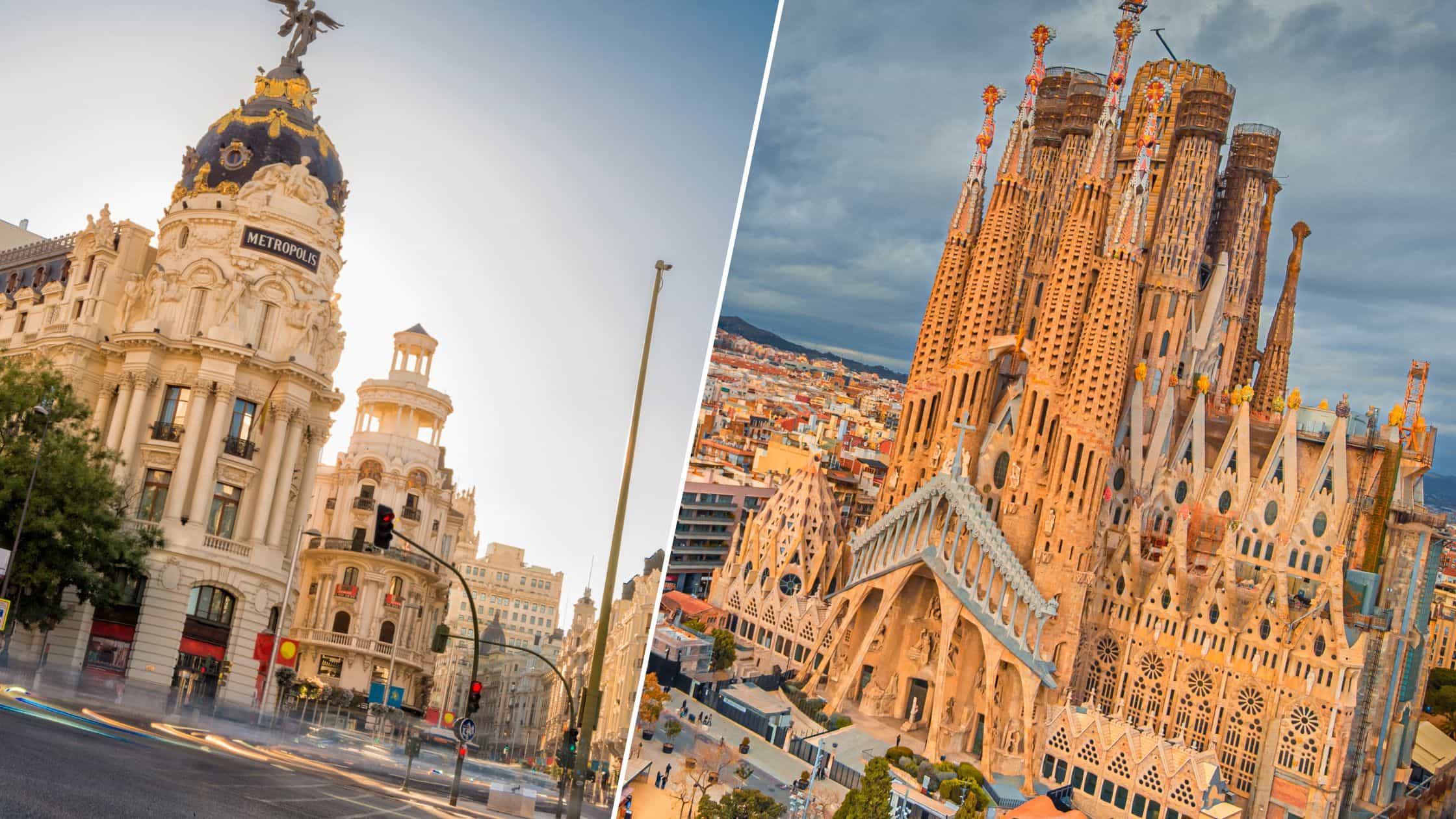
The question of Madrid or Barcelona: which city fits you better is one of the most common decisions travelers make before a Spain trip, and the answer genuinely depends on how you want to spend your days, not just what you want to see.
Both cities are large, confident, and worth more than a long weekend. But they operate on different frequencies.
Barcelona concentrates a lot into a small area. The old city, the waterfront, the architecture, the tourist corridors – it all sits within walking distance, which is part of the appeal and part of the experience because Madrid spreads differently.
It does not have a coast or a single dominant landmark pulling everyone in the same direction. What it has instead is a social rhythm that runs later and deeper into the night, and a city centre that still feels like somewhere people actually live.
Neither is the obvious right answer. The comparison works only once you know what kind of days you are actually planning.
What Madrid and Barcelona feel like for first-time visitors
Barcelona announces itself quickly. Within an hour of arriving, you are probably already walking through a pedestrian corridor with other tourists, looking at something architecturally significant, and navigating a pavement that is closely scaled to the amount of activity around it for the number of people on it.
That is not a complaint, it is how the city is built. It is dense in the way that compact, well-visited cities are dense: everything close, everything somewhat active, the good and the inconvenient arriving together.
Madrid takes longer to read. The first afternoon can feel like a big, ordinary city – wide streets, traffic, a lot of coffee shops.
The texture emerges in the evenings, when the terraces fill, the side streets in Malasaña or Chueca start moving, and dinner tables do not turn over before 22:00. By the second day, most travelers start to understand what the city actually is: a place where social life is the architecture.
In practical terms, this means Barcelona frontloads its energy toward the daytime and early evening, with visitor activity concentrated along a handful of corridors (Las Ramblas, the Gothic Quarter, the Eixample’s main diagonals).
Madrid distributes its energy more evenly across neighbourhoods, and the busiest hours run roughly two hours later across the board.
Madrid or Barcelona: which city suits your travel style?
Barcelona rewards travelers who want visual and physical variety within a short radius. If you want to walk from a Gothic street to a modernist block to a beach in the same afternoon, that is genuinely possible, and it works.
The city suits people who are happy moving through stimulation rather than settling into it, those who enjoy being in the middle of things even when the middle of things is also where everyone else is.
It is a more specific fit for travelers who need quiet to recharge. The central districts stay active and audible well into the evening. Finding a calm corner in the Gothic Quarter after 19:00 on a summer evening becomes easier once you understand the neighborhood layout, the narrow streets between tourist corridors can be noticeably quieter, but you do have to know which ones.
Madrid fits travelers who want to feel slightly more embedded in a city rather than visiting it. The neighbourhoods around Lavapiés, Malasaña, and La Latina have a density of bars, small restaurants, and covered markets that functions more like local infrastructure than a tourist amenity.
Travelers who already know Madrid is the better fit and are choosing where to stay can continue with the Madrid neighborhood guide, which compares the city’s main districts through atmosphere, pacing, and traveler fit.
Slow travelers and remote workers often find Madrid easier to pace around, because the city does not demand your attention the way a compact coastal destination does. You can work in the morning, walk in the afternoon, and let the evening take its time.
Travelers deciding whether Barcelona’s coastal setting is central to the trip may also find the Barcelona vs Malaga comparison useful, particularly when weighing beaches, atmosphere, and daily rhythm.
Where Madrid is a different fit: travelers who are specifically drawn to the coast, to Gaudí, or to the kind of visual spectacle that Barcelona delivers per square kilometre. Madrid’s museums are excellent and its parks are underrated, but it does not deliver that same immediate sensory variety in a small area.
Madrid vs Barcelona: pace, transport and daily rhythm
In Barcelona, the day starts earlier and the energy peaks around midday and again around sunset. Metro carriages are full by 09:00, the main sites are operating at at peak activity levels by 11:00, and the beach reaches its busiest point by early afternoon.
The evening social shift happens around 20:00-21:00, with dinner tables filling by 21:30 and the night finishing earlier than in Madrid for most visitors.
The walking distances are shorter than they appear on a map, but the the navigation pattern is worth understanding. Las Ramblas functions poorly as a transit route because of pedestrian density; the parallel streets (Carrer del Carme, Carrer de Ferran) are faster and more open.
Suitcase movement through the Gothic Quarter on cobblestones and uneven surfaces is noticeably different – this is not a complaint about the neighbourhood, just a physical reality worth knowing before you arrive.
Madrid’s rhythm is shifted roughly two hours later across most activities. Metro carriages approach capacity between 10:00 and 14:00 and again between 18:00 and 21:00, but they stay busy until well past midnight on weekends.
Dinner before 21:00 marks you as a tourist in most of the city. The side streets around Sol and Puerta del Álamo hold noise until 02:00 or later on Friday and Saturday nights, which is atmospheric from a bar and less so from a bedroom three floors above the street.
The terrain in central Madrid is flatter than Barcelona’s northern and hillside areas, which makes extended walking less more noticeable over several days.
Barcelona’s slope toward Gràcia and Tibidabo is manageable but noticeable by the third day, especially in late spring and summer heat. Both cities have reliable metro networks running frequent services; neither requires a car.
Best time to visit Madrid and Barcelona
This comparison shifts meaningfully by season, and in late spring it is worth being specific about what summer brings to each city.
Barcelona in July and August operates under significant visitor activity. The coastal location makes it a natural summer destination, and the concentration of that demand into a relatively compact city centre means that accommodation prices climb sharply, the main corridors stay busy from mid-morning until late evening, and the beach atmosphere changes from relaxed to operating at peak seasonal activity.
This is not a reason to avoid Barcelona in summer – the city is built for it, the evenings are genuinely good, and the sea is usable in a way that changes the day’s logic. But it is worth knowing that summer Barcelona is a more active version of itself.
Madrid in summer works differently. The heat is more intense (the city sits on a high inland plateau and the stone and asphalt hold temperature well past sunset), but a significant portion of Madrid’s residents leave in July and August, which thins the neighbourhood rhythm.
Terraces are full but the city’s social fabric is more tourist-facing than local-facing during those weeks. For travelers who find the local-life register important, late spring (now) or early autumn catches Madrid at its most balanced.
For Barcelona, late May and early June is the last window before summer demand fully arrives – warm enough to use the coast, not yet at peak visitor activity. If the timing is flexible, this window suits travelers who want Barcelona’s full offer without its most active seasonal version.
How choosing the right neighborhood changes each city
A common question underneath the Madrid or Barcelona comparison is not just which city fits better, but how differently the two cities ask you to move through them once you arrive.
The high-speed train makes combining both easy, roughly two and a half hours between Atocha and Sants, but the experience of each city starts to diverge quickly at neighbourhood level.
Barcelona tends to reward travelers who choose their base carefully. Staying near the Gothic Quarter, Eixample, Gràcia or Barceloneta changes the rhythm of the trip far more than many first-time visitors expect, especially once beach movement, late-night noise and tourist density start affecting the day-to-day experience.
The Barcelona neighborhood fit guide breaks down which areas actually work for different traveler types and pacing styles.
Madrid operates differently. The city spreads its energy across neighbourhoods more evenly, and the experience becomes noticeably better once you understand where the social rhythm actually lives after dark.
For travelers trying to understand whether Madrid fits their first Spain trip at all, especially compared with Barcelona’s more immediate visual intensity, the Madrid first-time traveler guide covers how the city feels operationally, socially, and seasonally once you are actually moving through it.
Madrid or Barcelona: which city fits you better?
Madrid or Barcelona: which city fits you better comes down to one question more than any other: do you want a city that reveals itself through what you see, or through how you spend your evenings? Barcelona delivers on the first.
It is visually concentrated and physically rewarding in a compressed area, and it suits travelers who are happy being somewhere that is also very clearly a destination. Madrid delivers on the second.
Its texture is social and temporal, it requires staying past dinner, moving slowly through neighbourhoods, letting the rhythm come to you rather than finding the next thing on the map.
Both cities work across a wide range of traveler types. The difference in pacing expectations is usually a pacing one: visitors who expect Madrid to move like Barcelona tend to find it slow and spread out; visitors who expect Barcelona to feel like a local neighbourhood tend to find it busy and tourist-facing. Neither perception is wrong – they are just reading the wrong city.
In late spring, both cities are at a good point in their seasonal cycle. Barcelona’s best weeks before the summer peak are right now. Madrid’s neighbourhood rhythm is close to its most balanced. If you can only do one, the answer is whichever version of a Spanish day you actually want to live inside.
Continue exploring: If you are building a longer Spain itinerary and want to understand how these two cities sit within a broader circuit, the Spain four-city circuit read maps the sequencing logic and pacing tradeoffs across Barcelona, Madrid, Seville and Valencia together.
Frequently asked questions: Madrid or Barcelona
1. Is Madrid or Barcelona better for a first visit to Spain?
It depends on what you want to feel on the ground. Barcelona is visually denser and more compact, with architecture and a coastline within walking distance of each other. Madrid has a more local, less visitor-focused centre and rewards travelers who enjoy evenings over mornings. Neither is universally better; they suit different rhythms and expectations.
2. Which city is better for slow travelers or remote workers?
Madrid tends to work better for slow travelers and remote workers who prefer a neighbourhood-based rhythm. The city does not front-load its energy toward tourists, which makes settling into a local routine easier. Barcelona is viable for remote work but its central zones stay busy throughout the day, which some find energising and others find more active.
3. When is the best time to visit Barcelona compared to Madrid?
Late spring (May-June) and early autumn (September-October) work well for both. Barcelona in July and August is operating at higher activity levels and hotter, with visitor activity concentrated in a compact area. Madrid in summer sees many locals leave, which thins the city’s social energy but also reduces crowds in museums and central streets.
4. Is Barcelona more expensive than Madrid?
Generally yes, especially for accommodation. Barcelona’s central and coastal neighbourhoods carry a visible price premium. Madrid’s mid-range accommodation and eating options tend to be more accessible, particularly outside the immediate tourist core around Sol and Gran Via.
5. Can you visit both Madrid and Barcelona on the same trip?
Yes, and many travelers do. The high-speed train between the two cities runs in about two and a half hours, which makes a split itinerary practical. Spending at least three nights in each is enough to get a sense of the rhythm; anything shorter and the comparison stays superficial.