

Corfu Town is not large, but it does not behave like a single place. The neighborhoods of Corfu Town have genuinely different characters, not in a brochure-differentiation way, but in the kind you notice by the second evening when you realize one street keeps going until midnight and another one goes quiet before nine.
The question of where to base yourself here is not obvious. The Old Town pulls everyone toward it, which is part of the appeal and part of the problem. Understanding what sits just outside it changes how you plan the stay entirely. This node focuses on the spatial logic: what each area feels like to move through, who tends to settle into each one comfortably, and where the friction shows up depending on your pace and purpose.
Corfu Town in photos
Best areas to stay in Corfu Town
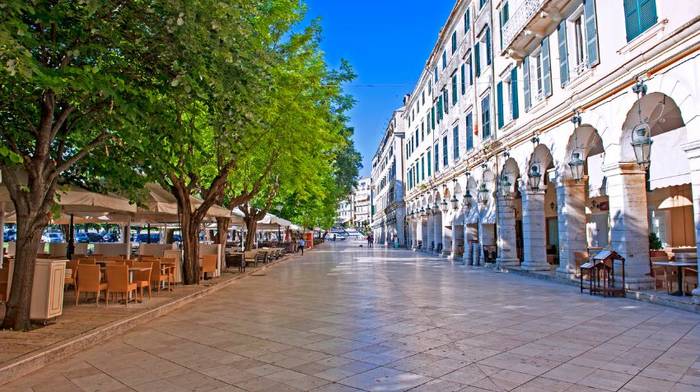
The core of Corfu Town is the Old Town, a UNESCO-listed area of Venetian architecture and narrow lanes that sits on a small peninsula between two fortresses. It is compact, almost entirely pedestrianized, and oriented around a central esplanade called Spianada Square and the arcaded strip beside it known as the Liston.
South of the Old Town, the neighborhood of Garitsa curves along a bay with a waterfront road and a calmer, more residential texture. It is where locals walk dogs in the evening and where the cafes are less likely to have English menus posted on A-boards. Further south, the Mon Repos estate sits on a wooded headland above the water, closing the area off from the rest of the town.
North of the fortress, past the New Port, is Mandouki. It functions as a transit zone and a local commercial area. Most travelers pass through it without noticing they are in a distinct neighborhood, which tells you something about its appeal as a base. The distances are short. Walking from the Liston to the start of Garitsa takes about fifteen minutes. That proximity makes the differences in feel more about choice than geography.
Is Corfu Old Town a good area to stay?
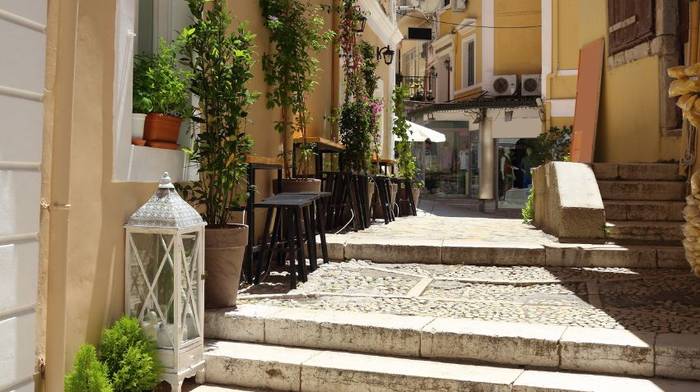
The alleys of the Old Town are narrow enough that two suitcases side by side become a problem. Arrive in summer and you will understand this immediately. The lanes around the Liston and the cathedral fill from mid-morning onward, stay dense through the afternoon heat, and then refill after 19:00 with a slower, dinner-oriented crowd that lingers considerably later than the sun does.
Staying inside the Old Town means you are inside that rhythm, which is either the point or the obstacle depending on what you need from the trip. For two or three nights, most travelers find the atmosphere worth the noise and the navigation.
For a week, particularly anyone working or recovering, the pace starts to feel less like a feature. The accommodation is mostly small guesthouses and apartments embedded in old buildings. Rooms tend to be on the smaller side. Stone walls keep things cooler in the afternoon heat, which matters more than it sounds in late June or July.
Breakfast is rarely included; coffee from one of the squares does the same job more enjoyably. One practical note: several streets inside the walls are technically no-vehicle zones, so taxi drop-off points are at the edges. The last stretch on arrival is always on foot, sometimes on uneven stone, sometimes uphill. Worth knowing before you pack.
Is Garitsa the best area for a quieter Corfu stay?
Garitsa is a five-minute walk from the southern edge of the Old Town and about twenty minutes from the Liston on foot, along a waterfront road with low traffic in the evenings. It is a real neighborhood in the sense that people live there year-round, shop there, and are not oriented toward tourist services.
The streets are wider. There are trees. Rooms are generally larger and quieter, and the buildings do not share walls with a bar. By around 22:30 on a weeknight, Garitsa is genuinely calm.
For slow travelers, remote workers, or anyone who needs a functional morning before they can enjoy the afternoon, Garitsa tends to absorb a longer stay more naturally. The cafes near the esplanade have the kind of unhurried seating where a laptop is not strange, and the evening walk into the Old Town for dinner becomes a pleasant ritual rather than a default.
The tradeoff is that the first evening may feel slightly anticlimactic if you expected to step directly into atmosphere. It takes a day to understand that the calm is the point, not a gap in the experience.
Is Mandouki a good area to stay in Corfu Town?
Mandouki is north of the New Port, which is where ferries from the mainland arrive. It is functional, affordable in terms of accommodation, and genuinely local in the sense that the shops and cafes there are not staffed by seasonal workers or oriented toward tourists arriving from cruise ships.
It is not, however, particularly interesting to stay in for most travelers. The architecture is post-war and unremarkable, the waterfront here is partly industrial, and the walk into the Old Town, about twenty to twenty-five minutes, passes through a stretch that does not reward the walk itself.
It works for travelers arriving late by ferry who want to get their bearings before moving on, or for anyone on a very specific budget. For anything else, the extra ten minutes of taxi ride to Garitsa or the Old Town is worth it.
Best Corfu Town neighborhood for summer
Late spring is currently the most useful framing, because the town is a week or two away from its summer transformation and the contrast is instructive. Through May and early June, the Old Town is active but not congested. The Liston has space at its tables. The lanes around the market area are easy to move through even at peak morning hours.
Restaurants take walk-ins. The atmospheric quality of the place comes through most clearly at this time, because the architecture and the light are the main event rather than the crowd. From late June onward, that changes. July and August push the Old Town toward its maximum density, particularly around Spianada Square and the stretch between the two fortresses. The social energy is high, which works well for travelers who came for exactly that.
For those who find dense crowds disorienting, the shift toward Garitsa as a base becomes more relevant. Garitsa barely changes between spring and summer. It absorbs the season without much disruption. That consistency is part of why it suits a different kind of stay.
If you are currently planning a summer visit and weighing neighborhood choice against the whole island picture, the Greece multi-city circuit read gives useful context on how Corfu fits within a broader Greek itinerary, and how its pace compares to other stops on that route.
How to get around Corfu Town and the island
The main bus station for island-wide routes sits near the New Port, which puts Mandouki in a practical position for transit but does not make it desirable as a base beyond that function. From the Old Town or Garitsa, the walk to the bus terminal is about fifteen to twenty minutes, which most travelers replace with a short taxi.
The Old Town itself has no meaningful vehicle access, so getting to the beach or to villages in the north or south of the island always starts with a walk to a pickup point or the port area. Taxis are plentiful and reasonably priced for island standards. For travelers planning to use Corfu Town as a base and make daily excursions, Garitsa is slightly better positioned, particularly if renting a scooter or small car. Parking near the Old Town’s edges is possible but inconsistent in summer.
Best Corfu Town area for your travel style
Two to three nights, atmospheric priority, no heavy luggage, no strong need for sleep before midnight: the Old Town. The density is the experience, and the Venetian architecture at dusk is the kind of thing that makes the inconveniences irrelevant.
Five nights or more, working mornings, lighter social tolerance, need for a real daily rhythm: Garitsa. The short walk to the Old Town for evenings means you are not sacrificing the atmosphere; you are just not submerged in it every hour.
Arriving by ferry late with an early onward connection: Mandouki, practically. One night, no emotional investment required. Families with children tend to sort themselves between the Old Town (if the kids are old enough to walk the cobbles comfortably) and Garitsa (if strollers or early bedtimes are factors). The Garitsa waterfront in the evening is genuinely pleasant for families – flat, relatively traffic-free, and calmer than the Liston area after 21:00.
For travelers who are still deciding between Corfu Town and other Greek destinations with a similar old-town character, the Thessaloniki first visit read covers a city with a comparable walkable historic center but a very different social energy and year-round rhythm, worth reading before committing to either.
Corfu Town neighborhoods FAQ
1. What are the main neighborhoods of Corfu Town?
The main areas travelers consider are the Old Town (Kerkyra), Garitsa to the south, and the quieter northern fringe toward Mandouki. Each has a different pace: the Old Town is dense and pedestrian-heavy, Garitsa is residential and calmer, and Mandouki is largely local with fewer tourist facilities.
2. Is the Old Town of Corfu good for staying, or just visiting?
Both, depending on what you need. Staying inside the Old Town puts you close to the Liston, the fortress, and most evening activity. The lanes are narrow and luggage is awkward on arrival. Lighter packers and travelers who prioritize atmosphere over convenience tend to prefer it. Those who value a quieter sleep and easier access by car often stay just outside.
3. Which part of Corfu Town is quietest at night?
Garitsa, south of the Old Town along the bay, is noticeably calmer after 22:00. It has a residential feel, a waterfront esplanade, and considerably less foot traffic in the evenings. It works well for travelers who want proximity to the center without being inside it.
4. Is Corfu Town walkable between neighborhoods?
The Old Town and Garitsa are walkable from each other, roughly fifteen to twenty minutes on foot along the seafront. Mandouki is further and less interesting on foot. Taxis are cheap and frequent. The bus terminal near the New Port connects the town to the rest of the island.
5. Which Corfu Town neighborhood suits remote workers or slow travelers?
Garitsa tends to work better for longer stays. It has cafes with reliable seating, fewer tour groups, and a daily rhythm that does not reset itself every 48 hours with new arrivals. The Old Town is rewarding for a few nights but can feel overstimulating for a week or more of working-while-traveling.
6. When is the best time to visit Corfu Town for a calmer experience?
Late spring (May, early June) and early September offer the most comfortable balance. The weather is warm, the town is active, but the density of summer crowds in the Old Town alleys is noticeably lower. Peak July and August push visitor numbers significantly higher, particularly around the Liston and Spianada Square.