
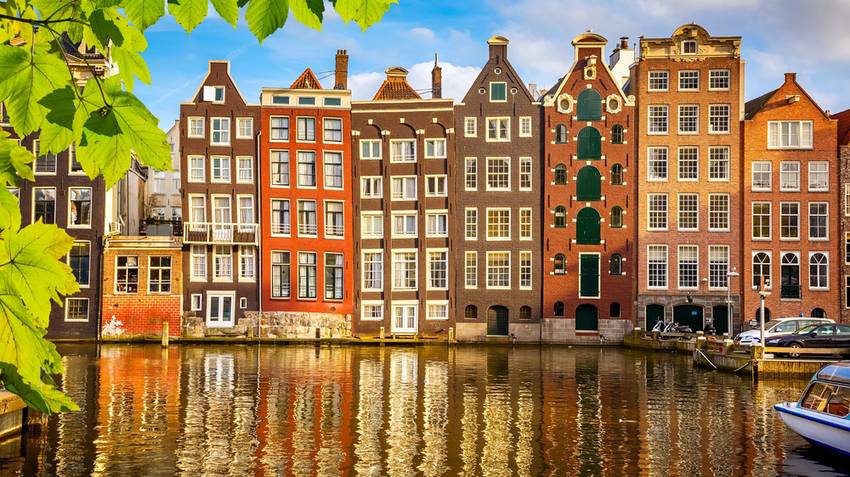
The Netherlands in early summer settles into a particular kind of rhythm: long evenings, canals reflecting a sky that stays pale well past 21:00, and a pace that shifts noticeably once you leave the main tourist corridor and find your way into a side street or a quieter district. Two cities define the country for most first-time visitors, and they are less interchangeable than they first appear on a map.
Amsterdam and Rotterdam sit 40 minutes apart by train. They share a country, a flat landscape, a cycling culture, and not much else in terms of atmosphere. The decision between them – or the question of which to prioritize on a first trip – tends to come down to what kind of daily rhythm you are actually looking for, not which city has the longer list of things to see.
This comparison is less about attractions and more about feel: how each city unfolds across a day, where the energy concentrates, and who each one tends to suit at different stages of travel.
What Amsterdam actually feels like on arrival
Amsterdam’s historic center arrives fast. Schiphol connects directly to Centraal Station in about 15 minutes, and by the time you exit the station you are immediately inside the city’s densest zone – water on three sides, bicycles moving faster than the pedestrian crossings suggest, and the canal ring starting to make its geometry felt within the first two blocks.
Travelers deciding whether Amsterdam’s density matches their travel style may also find the Amsterdam neighborhood guide useful for understanding how Jordaan, De Pijp, Oud-West, and the canal district create very different versions of the city.
The atmosphere is layered and continuous. Coffee at a canal-side café at 09:00 has one quality; the same street at 13:00 in June has another, with tour groups filling the narrower lanes and the cycle paths becoming something to navigate around rather than alongside. The historic core is genuinely beautiful and genuinely compressed, and both of those things are true at the same time.
By late afternoon, the rhythm shifts. The Jordaan district quiets slightly as the groups follow their maps toward the main museums. The light on the gabled facades around 19:30 in June has a particular quality – golden, long, low – that the city earns by being this far north. Dinner starts later here than most visitors expect. Kitchens that look open at 17:30 are often still setting up, and the real evening starts closer to 20:00.
Mornings in Amsterdam reward early movement. The canal ring before 08:30 is a different city, with mostly locals on bikes, near-empty bridges, and the water reflecting the brick facades without a tourist boat in sight. That window is worth building a day around if you are staying two nights or more.
Rotterdam’s different kind of scale
Rotterdam has almost nothing of Amsterdam’s historic visual language. The city center was flattened in 1940 and rebuilt across several decades, which means the architecture ranges from confident post-war geometry to contemporary buildings that architects specifically go to see. The Markthal, the cube houses near Blaak, the Erasmus Bridge waterfront – these are not consolation prizes for a city without an old town. They are a different kind of urban ambition.
The spatial register is different from the moment you leave Rotterdam Centraal. Streets are wider, sightlines longer. The city feels open in a way Amsterdam does not, and that openness carries a different energy: less compressed, more deliberate, easier to orient in. First-time visitors who find Amsterdam’s canal ring slightly dense in the first 24 hours tend to find Rotterdam immediately readable.
The Erasmus Bridge waterfront on a June evening has a particular draw. The bridge itself is lit from underneath after dark, and the promenade alongside it attracts a mix of locals finishing work, visitors walking after dinner, and cyclists moving between districts. The atmosphere is social without being loud in the way Amsterdam’s center is loud after 22:00.
Rotterdam’s food scene – particularly around the Fenix Food Factory in Katendrecht and the Markthal itself – rewards exploration in a way that feels more like a city showing itself off than a city performing for tourists. That distinction is subtle but consistent across a full day.
How pacing differs between the two cities
Amsterdam requires more decisions per hour. The canal ring is dense with options, and the gap between good experiences and mediocre ones is partly a function of how early you move, which streets you take, and whether you have built in enough unstructured time to let the city happen to you rather than presenting it as a list. Travelers who arrive with a tight itinerary and no slack tend to feel the city’s scale in a way that those with a more open day do not.
The Anne Frank House, the Rijksmuseum, and the Van Gogh Museum all require advance booking during June and July, and the morning queues for anything without a timed entry are real. The city does not slow down to accommodate visitors who show up unprepared – it simply continues at its own tempo and leaves that problem to you.
Rotterdam is slower by structure. There is no single corridor that concentrates the majority of tourist activity the way the Prinsengracht does in Amsterdam. The city distributes itself more naturally, and the result is that a day here has more breathing room even in summer. You can walk from the Markthal to Katendrecht across the Erasmus Bridge and back through the old harbor and feel like you have seen a city, rather than navigated through one.
Travelers pairing the two cities often find that two nights in Amsterdam followed by one night in Rotterdam gives the trip a welcome gear change – from high-input to lower-tempo – before the return journey. Some find they prefer Rotterdam after arrival, which is not an unusual realization.
If the Netherlands itinerary is something you are still building out, the Netherlands city loop covering Amsterdam, Rotterdam, Utrecht, and The Hague maps the sequencing logic across multiple nights, which is often where the real decisions sit.
Who Amsterdam suits and where the fit shifts
Amsterdam works well for first-time visitors who want a concentrated version of the Netherlands in a small geographic area, who are happy to plan ahead for the major museums, and who have either two or three full days to work with. It suits travelers who find density enjoyable rather than high-tempo – people who like the feeling of a city that is fully alive, where something is always happening around the next corner.
The city also works for travelers who are there specifically for the museum circuit. The Rijksmuseum and the Van Gogh Museum are within a short walk of each other and represent a serious half-day each. The Anne Frank House is worth the advance booking. None of these are things Rotterdam can substitute for.
The fit shifts for travelers who want more than two days in one place and prefer to settle into a neighborhood rhythm rather than cover ground systematically. Amsterdam’s tourist center is compact enough that by day three, if you have already done the main museums and the Jordaan, the law of diminishing returns starts to apply. At that point, Rotterdam or Utrecht become more interesting options than a third day in the same radius.
Solo travelers and remote workers who want to stay longer tend to find Amsterdam’s pricing structure the biggest variable. Accommodation in the canal ring runs noticeably higher than Rotterdam for comparable quality, and the daytime energy in coffee shops and co-working spaces does not necessarily justify the difference.
Who Rotterdam suits and what it does not offer
Rotterdam fits travelers who already have Amsterdam in their history and want a different register of Dutch city. It also fits those on a first trip who specifically care about architecture, contemporary urbanism, or port culture – in which case Rotterdam is the more interesting primary destination.
The city suits travelers who want to move at a slower tempo without leaving the country’s infrastructure. Rotterdam Centraal is one of the better-designed train stations in Europe, and from there you can reach Amsterdam, Utrecht, The Hague, and Eindhoven within an hour. Using Rotterdam as a quiet base while making day trips works particularly well for trips of three nights or more.
Visitors who are coming to the Netherlands for the first time with limited days and a specific expectation of canals, Golden Age architecture, and the visual vocabulary that defines the country internationally will find Rotterdam incomplete on its own. The Delfshaven neighborhood offers a fragment of that atmosphere – a preserved harbor district with gabled warehouses and a quieter canal – but it is a small area, and it functions as a footnote rather than as a substitute.
Travelers who have been thinking about Utrecht alongside these two might find the first-time guide to Utrecht useful at this stage – Utrecht sits squarely between Amsterdam and Rotterdam in scale and atmosphere, and for some travelers it resolves the choice entirely.
The trade-off in a single line
Amsterdam gives you more to see and requires more preparation. Rotterdam gives you more room to breathe and surprises more travelers than they expect.
That is an accurate summary, but it leaves out the most useful part: they complement each other better than they compete. A trip that treats them as a sequence – arriving into Amsterdam’s density, spending two nights, then taking the 40-minute train to Rotterdam for a slower final day or two – tends to produce a more complete sense of the Netherlands than either city alone.
The combined rhythm works because the gear change is the point. Amsterdam establishes the country’s historic weight and visual identity; Rotterdam shows what came after, and what Dutch urban ambition looks like when it is not constrained by a 17th-century canal grid. Both of these things are interesting, and they are more interesting together.
Which one to prioritize if you only have time for one
Amsterdam, on a first visit to the Netherlands with, is the more complete single-city answer. The canal ring, the museums, the Jordaan, the particular evening light at this latitude in June – these things form a coherent identity that the country is partly built around, and they are available within walking distance of each other.
Rotterdam is the better answer if you have already been to Amsterdam, if you are traveling with someone who cares about architecture or contemporary urbanism, or if your trip is long enough that you genuinely want a quieter second base rather than more of the same density.
The honest position for most first-time travelers is that both cities deserve a visit on the same trip, and the 40-minute train between them makes that easier than any other two-city combination in the country. Choosing between them is usually a false constraint – the real question is sequencing and how many nights to allocate to each.
On a four-night trip, two nights in Amsterdam and two in Rotterdam is a clean split. On three nights, two in Amsterdam and one in Rotterdam leaves enough time in each city to feel present rather than transiting. On two nights only, Amsterdam stays the right choice for a first visit, with Rotterdam as the obvious next trip rather than a compressed addition.
The Netherlands through both cities
Neither Amsterdam nor Rotterdam is a shorthand for the country on its own. Together, they give a first-time visitor a more accurate and more interesting read on what the Netherlands actually is – a country with a specific historical weight in one corner and a willingness to rebuild entirely in another. The canal ring and the Erasmus Bridge are 40 minutes and about 400 years apart in atmosphere, and that gap is what makes the combination work. For travelers with the time to let both cities settle, the Netherlands tends to leave a more durable impression than either city would produce alone.
Amsterdam vs Rotterdam: common questions
1. Which city is better for a first visit to the Netherlands: Amsterdam or Rotterdam?
Amsterdam covers more of what most first-time visitors expect from the Netherlands, with its canal ring, museums, and concentrated historic atmosphere. Rotterdam suits travelers who prefer a less visited, architecturally distinct city with a quieter daily rhythm and fewer tourist queues.
2. Is Rotterdam worth visiting for first-time travelers to the Netherlands?
Rotterdam works very well as either a standalone destination or a day trip from Amsterdam. The city has a distinct architectural identity, a waterfront that opens up around the Erasmus Bridge, and a market hall that gives a good sense of how locals actually move through the city.
3. How far is Rotterdam from Amsterdam?
The two cities are connected by a direct intercity train that takes roughly 40 minutes. Most first-time travelers split their Netherlands trip between both, using the train as a natural bridge rather than choosing one over the other.
4. Which city is easier to navigate for a first visit?
Rotterdam is easier to orient in on arrival. Its street layout is post-war and largely grid-influenced, its metro is straightforward, and the main attractions cluster near the waterfront and central station. Amsterdam’s canal ring is beautiful but genuinely easy to get turned around in, especially in the first 24 hours.
5. Can you do both Amsterdam and Rotterdam on a first trip to the Netherlands?
Easily, and the combination tends to work better than either city alone for travelers with four or more days. Arriving into Amsterdam, spending two nights in the canal ring, then taking the 40-minute train south to Rotterdam gives the trip a natural rhythm shift – from dense and historic to open and architecturally ambitious – and leaves both cities feeling properly visited rather than rushed.