
After a full afternoon on the sand, most people in Antalya either stay at the resort or make their way toward the obvious: a seafront restaurant, a bar in the tourist quarter, more of the same.
That is fine for a night, but it does not answer the real question, what parts of Antalya offer genuine local life after a busy day on the beach? The answer exists, but it requires moving away from the coastal hotel strip rather than parallel to it. Antalya has a functioning residential city behind its resort identity. It is not hidden so much as it is simply in a different direction from the beach.
The transition from tourist-facing infrastructure to something closer to everyday Turkish life can happen in under twenty minutes on foot or a short tram ride, and the change in atmosphere is disproportionately large given the distance. Late spring is probably the most useful season to explore this side of the city. The heat in May is present but workable, the streets are not yet at summer density, and local rhythms are still intact rather than compressed by the volume of July. That changes quickly as June builds toward peak season, so the traveler who arrives now has a brief window where both worlds are legible at once.
What Kaleiçi is like in the evening
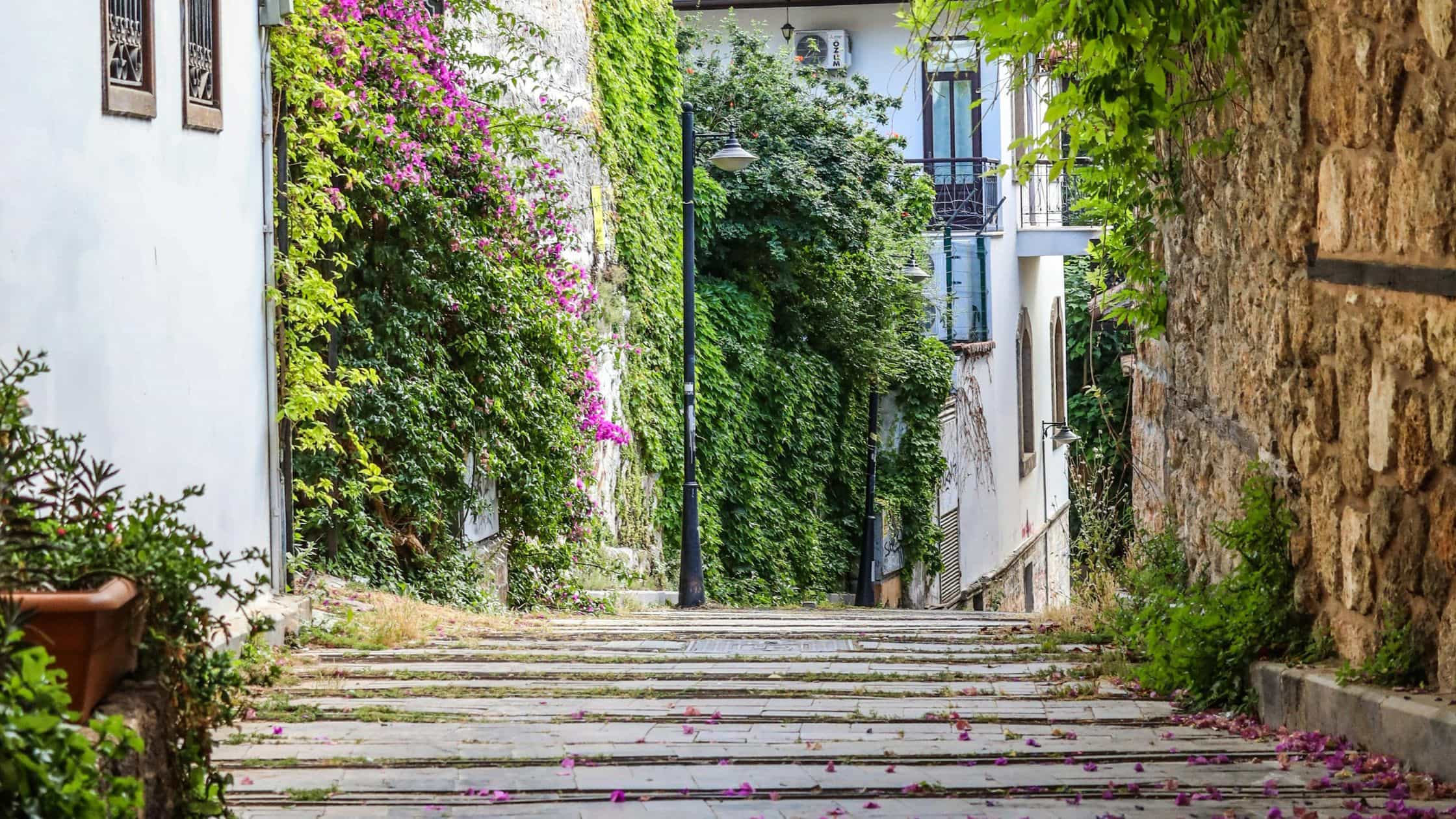
Kaleiçi, the old walled town, is where most people start their post-beach exploration, and it is the right instinct, just badly timed. The late morning and early afternoon belong almost entirely to tour groups moving between the Roman harbor, Hadrian’s Gate, and the clock tower. Narrow stone lanes with carpet and leather shops running tight on both sides, everyone moving in the same direction, the walls holding the heat in.
By 17:00 the pace noticeably changes. Groups return to buses, the main commercial lanes empty back toward a manageable pace, and the old town starts to feel less like a sightseeing corridor and more like a small, dense neighborhood. Some of that is real: people actually live inside Kaleiçi, in converted Ottoman houses behind high courtyard walls, and the evening brings out a different set of residents. Children, older couples, tea glasses appearing outside.
The cobblestones are worth acknowledging practically. The surface is uneven and the gradients inside the old town are not steep but persistent. After a day on the beach, the difference becomes noticeable between a 30-minute walk on sand and 45 minutes on polished stone. The map makes Kaleiçi look compact and easy; the body’s accounting at the end of the evening is slightly different.
Flat sandals or light sneakers make this significantly more comfortable than anything designed for beach use. The rooftop bars and restaurants above the harbor are the most visible evening option, and some of them do attract a mixed crowd of locals and visitors rather than purely resort guests. They work best around 20:00 to 21:00 before they get loud. After 22:00, the dynamic shifts toward a younger, more energetic profile that is its own thing, neither particularly local nor particularly calm.
Where locals spend evenings in Antalya
A short walk from the eastern edge of Kaleiçi, Karaalioğlu Park sits along the cliffs above the sea. It is one of the clearest examples in Antalya of a public space that genuinely belongs to residents rather than visitors, partly because it requires knowing to go there and partly because there is nothing specifically to do except walk and sit, which is exactly what makes it work.
In the early evening, particularly on weekdays, the park fills with local families, older men on benches, people walking dogs, tea garden tables occupied by groups who seem to have no particular intention of leaving. The view over the water is good, but that is almost incidental to the social function the space serves. It is loud in the way that relaxed public spaces are loud, conversation, children, not music or amplification.
The tea gardens inside the park are the most accessible entry point for a traveler who wants to sit rather than wander. Ordering çay requires no Turkish and the service is calm and slow in the right way. A table here around 19:00 on a May evening, with the light dropping behind the city, costs almost nothing and delivers more of what people describe as “local atmosphere” than most paid experiences in the tourist quarter.
The walk back along the promenade toward Kalekapısı Square takes about 15 minutes and passes through a gradient of social density. The park end is quiet, the square end, where the old town meets the main commercial streets, is considerably more animated by 21:00, locals meeting for dinner, people moving between restaurants, the kind of street energy that belongs to a city that eats late and stays out.
Muratpaşa for local food and everyday city life
For travelers who want to understand what Antalya looks like when it is not performing for visitors, Muratpaşa is the district to explore. It sits immediately behind and slightly north of Kaleiçi, close enough to walk to from the old town in 10 to 15 minutes, but operating on a completely different register.
The streets here are wider, shadier in the afternoons, and lined with the kind of businesses that serve a local population rather than a tourist one. Bakeries, phone repair shops, small restaurants with handwritten menus, grocery stores where the fruit is priced in Turkish lira per kilo without an English translation anywhere nearby. None of this is exotic in the traveler-seeking-authenticity sense, it is just a city going about its business, which is exactly the point.
Local restaurants in Muratpaşa tend to serve dinner earlier and more practically than the harbor-facing establishments in Kaleiçi. A table at 19:30 is entirely reasonable. The menus are shorter, the portions larger, and the prices reflect a local rather than tourist economy. Travelers wanting a broader overview of how Antalya’s districts differ can continue with the Antalya neighborhood guide, which compares the city’s main areas through atmosphere, pacing, and traveler fit.
A full meal for two, including bread and a soft drink, sits well below what the same food costs with a sea view attached to it. Travelers weighing Antalya’s resort identity against its urban depth often find that the two coexist more clearly in Muratpaşa than anywhere else in the city. You can have a morning on Konyaaltı beach, be back in the city by early afternoon, and spend the evening in a neighborhood that has no particular interest in your presence as a tourist. That combination is not always easy to find in a beach destination of this scale.
What Konyaaltı is like after sunset
The stretch behind Konyaaltı beach changes function dramatically after 18:00. During the day it is beach infrastructure – sunbeds, cafes serving cold drinks, the noise of water slides at the park end. By early evening, as beach density drops and families with young children start heading back, the promenade along the top of the beach becomes an evening walking corridor that draws local residents who have no particular interest in the beach itself.
This is a useful thing to know: the Konyaaltı promenade at 20:00 is a different social space from the Konyaaltı beach at 13:00. The shops and restaurants just off the coastal road see a more mixed clientele in the evenings, and the atmosphere along the waterfront is genuinely relaxed rather than visitor-oriented. People walk slowly and nobody is trying to sell anyone anything.
The distance from the beach strip to the city center means this area stays quieter and more residential in tone than Kaleiçi. Travelers staying in the hotel district west of Konyaaltı who want to avoid the long tram journey into the old town in the evening often find that simply walking the promenade and finding a local restaurant one street back from the water serves the same need at a with a simpler evening transition.
Is Antalya good for travelers who want beach and city life?
The post-beach local life of Antalya is accessible but requires a particular travel style. It rewards people who are willing to walk toward something rather than have it delivered to them, and who do not need the evening to have a defined arc. Kaleiçi in the evening, Karaalioğlu at dusk, Muratpaşa for dinner, none of these require planning, but all of them require leaving the resort zone deliberately.
For travelers on a week-long beach holiday who are looking for one or two evenings of something different, this works well. For someone who wants every evening to have clear social energy and organised entertainment, the old town’s bar scene serves that need, though it is not particularly local in character past 22:00.
The combination that tends to work best in late May is two or three days anchored to the beach for the morning and early afternoon, then a deliberate shift toward the city in the evenings. The tram between Konyaaltı and Kaleiçi runs reliably and makes the transition logistically easy. The walk back after dinner, if the evening is not too warm, takes about 35 minutes along the seafront – which is its own kind of useful decompression after a long day.
Travelers building a longer Turkey itinerary sometimes find that Antalya’s split between beach pace and urban life is easier to manage once they understand the city’s geography in that context. The Turkey loop multi-city read covers how Antalya fits within a broader coastal-to-inland journey, which changes how much time most people want to spend here.
Who Antalya’s local evening rhythm suits best
Antalya’s post-beach local life works best for people who are neither pure beach tourists nor pure city travelers. The city does not particularly reward someone who wants a compact, walkable urban experience without the resort infrastructure around it, that version of Turkey is better found in a city that is not built around beach tourism as its primary economic identity.
What Antalya does offer, and does it well, is a large city with functioning residential neighborhoods, real urban infrastructure, good food at honest prices, and enough spatial variety that a week here does not feel repetitive if you move around correctly. The beach is the frame. The city is the depth.
Solo travelers and couples who pace their days loosely – beach until early afternoon, a slow walk through Kaleiçi in the late afternoon, dinner in Muratpaşa, maybe a tea at Karaalioğlu before returning – tend to find this rhythm very comfortable. Families with young children who prefer more structure around the beach schedule sometimes find the distances between zones mildly inconvenient, though the tram resolves most of that.
Travelers who have already covered Istanbul and are wondering how Antalya compares as an urban experience will find the cities very different in register. The Istanbul first-timer read covers what that city actually feels like in terms of density and stimulation, useful context for calibrating what Antalya’s pace will feel like by comparison, which for most people is considerably lighter.
Best way to spend an evening in Antalya after the beach
What parts of Antalya offer genuine local life after a busy day on the beach? The answer is distributed rather than concentrated. Kaleiçi after 17:00 carries the most atmosphere in the most accessible form. Karaalioğlu Park delivers the clearest sense of local evening culture with the least tourist overlay. Muratpaşa gives the city its everyday texture, the version that exists regardless of whether anyone visiting notices it.
None of these require significant planning or local knowledge to reach. They require the decision to leave the beach zone, which is the main transition point. The city that exists behind Antalya’s resort identity is not difficult to find, it is simply in a different direction from where most people point themselves after the sunbed. This rhythm, beach until mid-afternoon and city from early evening onward, suits travelers who want both things from a trip without committing entirely to either.
It fits best in late May and September, when the city is fully operational but not yet at peak-season activity levels. In July it still works, but the heat changes the rhythm of how far and how long an evening walk feels reasonable to sustain.
Antalya local life after the beach FAQ
1. What parts of Antalya have genuine local life after a day on the beach?
Kaleiçi, the old town, has the most concentrated atmosphere once the afternoon tour groups thin out. Karaalioğlu Park along the cliff edge draws local families and walkers in the early evening. Slightly further, the Meltem and Muratpaşa districts have residential streets, neighbourhood cafes and markets that see very few tourists at any hour.
2. Is Kaleiçi worth visiting in the evening or is it too touristy?
It depends on the time. Kaleiçi is busy with day visitors until around 17:00. After that the character shifts considerably: fewer group tours, more people sitting outside restaurants for actual dinner, and some of the rooftop bars attract a local-ish crowd rather than purely resort guests. It is never fully quiet, but evening is when it becomes most usable.
3. Where do locals in Antalya actually spend their evenings?
Karaalioğlu Park and the tea gardens along the cliff edge are popular with local families, especially in spring and early summer before the heat becomes heavy. The Muratpaşa district has local restaurants and pastry shops that stay busy with residents well into the night. Kalekapısı Square is a meeting point that mixes locals and visitors and is worth a visit around 20:00 to 22:00 when the evening tempo picks up.
4. How far is local neighbourhood life from the main beach hotels?
From Konyaaltı beach, Kaleiçi is roughly 3 to 4 km depending on where you enter – accessible by tram along the coastal corridor, or a 35 to 45 minute walk along the seafront. The Muratpaşa residential area sits just inland from Kaleiçi and adds another 10 to 15 minutes on foot. Neither requires a taxi unless the heat makes walking impractical.
5. What is the best time of year to experience local Antalya life without too many crowds?
Late April through late May is the window where local rhythm is most visible and tourist volume has not yet peaked. September is the comparable window on the other side of summer, when the heat softens and the city returns to a more residential pace. July and August bring the highest pressure on every popular street and space in the city.