
The best areas to stay in Bilbao are a short question with a genuinely interesting answer. The city is compact enough that almost no neighbourhood is inconvenient, but the character difference between them is real – and it shapes the kind of trip you end up having.
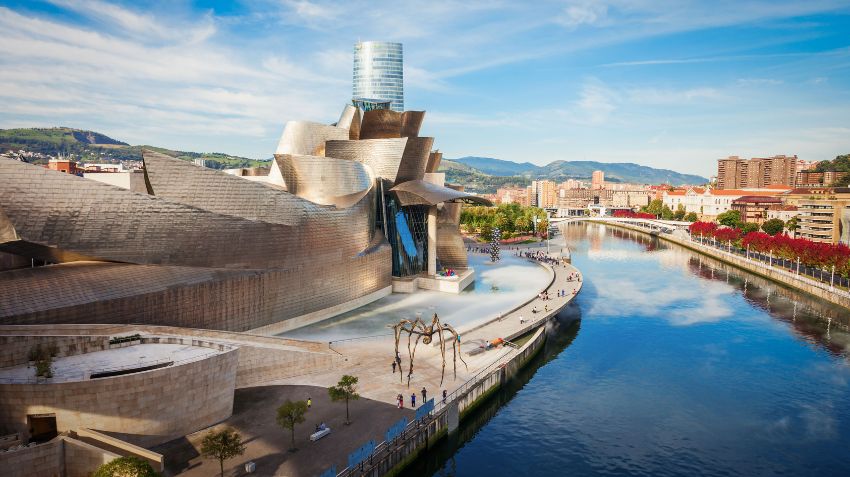
Bilbao unfolds along the Ría del Nervión, with the Casco Viejo on one bank and the 19th-century Ensanche spreading out from the city’s commercial centre. The Guggenheim sits roughly between them, near Abando, which gives the whole visitor zone a natural triangle.
In summer, this triangle is animated well into the night: terraces fill around 19:00, pintxos bars cycle through rounds of people from 20:00 onward, and the streets around the old town stay busy until past midnight.
What Bilbao’s neighbourhoods feel like for visitors
The Casco Viejo is the most immediate version of the city. Seven narrow streets – the Siete Calles – form a pedestrianised grid where the bars, the Mercado de la Ribera and most of the oldest architecture sit within a few minutes of each other. The stone underfoot is worn and slightly uneven, the facades lean close, and the acoustics carry conversation from the bars well past 23:00. It has the kind of density that rewards arriving without a fixed plan.
The Ensanche, by contrast, was built to a 19th-century grid and it shows: wide boulevards, higher ceilings, a more residential morning pace. Moyua square anchors the commercial centre here, and the Guggenheim is a 15-minute walk along the river. The area around Calle Ledesma has a strong pintxos scene that locals use more than tourists do – which matters if you are staying more than two nights and want the evening circuit to feel different on the third day.
Abando sits just east of the Ensanche and overlaps with it in the visitor imagination, but it has a slightly quieter character away from the main boulevards. The train station and the old market building give it a different texture – useful, unhurried, and easy to walk from in any direction.
Indautxu is further west, a largely residential neighbourhood with fewer tourist anchors but good metro connections and noticeably lower accommodation noise. It works as a base for people who want to use Bilbao as a slow anchor rather than a concentrated two-night cultural visit.
Is the Casco Viejo the right base for your Bilbao stay?
For a first visit of two or three nights, the Casco Viejo is often the right answer – not because it is the most convenient in a logistical sense, but because it is the most immediately alive. The evening energy here is the core of what makes Bilbao feel like Bilbao: the clatter of glasses on zinc counters, the small plates of pintxos changing every half-hour, the groups moving between bars in the Siete Calles as the night settles in.
Travelers comparing Bilbao with another northern Spanish city before choosing a base may also find the Madrid travel guide useful for understanding how the two cities differ in scale, pace, and neighborhood structure.
Where the fit shifts is around length of stay and sensitivity to noise. On Friday and Saturday nights, the streets around Plaza Nueva and García Rivero run loud until at least 01:00. If your room faces the street, this is not background noise – it is the room’s dominant acoustic register. Hotels on the quieter edges of the old town, or those with good soundproofing, are worth finding before arriving rather than discovering afterward.
For stays of four nights or more, the Casco Viejo tends to feel dense rather than atmospheric by the second half. The streets are short, the options are well-mapped quickly, and the evening circuit starts to repeat. A longer stay often works better from the Ensanche, with the old town becoming somewhere you walk to rather than somewhere you return to sleep in.
Where to stay in Bilbao’s Ensanche and Abando for easy access and local rhythm
The Ensanche’s advantage is its relationship with everything else. Moyua station puts you one metro stop from the Casco Viejo, one stop from the Guggenheim’s closest exit, and around 35 minutes from the airport on Line 3. Larger accommodation options tend to be here, along with the city’s more reliable breakfast infrastructure – the kind of café that opens at 07:30 and takes pastries seriously.
If neighborhood choice is your main planning priority, the Barcelona neighborhood guide offers a useful comparison with another highly walkable Spanish city.
Mornings in the Ensanche have a different quality from the old town. The boulevards catch the Atlantic light across their full width, and the streets are wide enough that the pace never feels compressed. By 09:00 on a weekday, the neighbourhood is quietly functional in a way that makes slow starts feel natural rather than indulgent.
Abando adds the river as a daily orientation point. Walking south along the Ría toward the Guggenheim or north toward the Zubizuri footbridge becomes a natural part of the day’s movement, and the water at dusk – reflecting the museum’s titanium panels from a distance – is one of those views that arrives without ceremony and stays with you. Accommodation here tends to cost slightly less than the equivalent room in the Casco Viejo or the main Ensanche hotels, without meaningfully sacrificing access.
How to get around Bilbao and arrive from the airport
Bilbao’s metro is small by European standards – two lines and a single tram line – but it covers the visitor geography efficiently. Line 3, which connects the airport to Moyua in around 35 minutes, is a clean and direct arrival path. Signage at the airport is clear, and the journey requires no transfers. Taxis cover the same route in 20 to 30 minutes and are more practical with larger luggage.
Within the city, most visitors walk more than they expect to. The Casco Viejo to the Guggenheim is a 20-minute walk along the river, and the walk is the better choice in summer once the afternoon heat has softened – usually from around 18:30 onward. The tram line runs along the Ría and is useful for covering longer stretches of the waterfront without effort.
Luggage is worth thinking about before arrival. The Casco Viejo’s cobbled streets and the absence of lifts in older buildings there mean that rolling a large case through the seven streets at noon in July is a different experience from the same journey at 08:30 in September. It is not a serious problem, but it is worth knowing before you book.
Travelers planning a broader route across Spain can also explore the Spain itinerary guide to see how Bilbao fits alongside the country’s classic city circuit.
Day trips and wider movement from Bilbao
San Sebastián sits 100 kilometres east on the coast and is one of the cleanest day-trip options from Bilbao: frequent trains, an hour’s journey, a different city register entirely. Where Bilbao is industrial, atmospheric and navigated mostly on foot through its own logic, San Sebastián is built around its bay and its beaches, with a pintxos culture that runs parallel to Bilbao’s but feels airier and more oriented toward the water.
The Basque coast between the two cities – Zarautz, Getaria, Zumaia – is worth the time if the trip extends beyond three or four nights. Buses and occasional trains connect them to Bilbao, and the coastal light in summer, especially in the late afternoon when it falls flat across the cliffs at Zumaia, is the kind of thing that reorders the trip in memory.
Travelers who find themselves weighing Bilbao against a longer northern Spain arc often reach the point of asking which cities pair naturally with it. The first-time Bilbao guide covers that broader orientation, including where the city sits on a Basque Country loop.
For travelers who want to compare Bilbao’s rhythm against other Spanish cities before committing to a base, the Madrid or Malaga comparison addresses the register difference between the north and south of the country – useful if Bilbao is one node in a longer itinerary rather than a standalone trip.
If you’re deciding between Bilbao and another coastal city for a longer stay, the Malaga travel guide highlights a very different Mediterranean travel rhythm.
Is Bilbao worth staying in for more than two nights?
Bilbao works on two nights and it works on five, but the experience is structurally different. On two nights, the city is concentrated: the Guggenheim, the Casco Viejo’s evening circuit, the Mercado de la Ribera in the morning, the river walk connecting them. That is a lot of density in a small footprint, and it is satisfying in the way compact cities often are.
On five nights, the city starts to reveal its slower version. Morning routines settle around a specific café, the pintxos bars stop being an event and become a habit, and the river becomes part of daily movement rather than a destination. That version of Bilbao suits people who travel to settle briefly rather than to cover ground, and it tends to work better from the Ensanche or Abando than from the Casco Viejo.
The best areas to stay in Bilbao are ultimately the ones that match your rhythm: the old town for the immersive short stay, the Ensanche for the easier longer one, and the quieter residential edges for anyone who wants the city without its loudest register.
Travelers weighing a Bilbao stay alongside other Spanish coastal and city options will find the best areas to stay in Valencia a useful parallel read, especially for understanding how a different kind of Spanish city structures its neighbourhoods and visitor zones.
If the broader Spain itinerary is still open, the Seville or Valencia comparison covers the southern and Levante alternatives for first-timers deciding where to anchor a Spain trip.
Bilbao neighbourhood stay FAQ: best area, Casco Viejo, Ensanche, airport transfer and summer timing
1. What is the best area to stay in Bilbao for a first visit?
The Ensanche is the most practical base for a first visit: central, well-connected by metro and tram, and within easy walking distance of the Guggenheim and the Casco Viejo. It tends to be quieter to sleep in than the old town while keeping everything accessible. The Casco Viejo itself works well for shorter stays where atmosphere is the priority.
2. Is the Casco Viejo a good place to stay in Bilbao?
It is the most atmospheric option, with pintxos bars, the Mercado de la Ribera and the compact medieval street pattern all within steps of most accommodation. Noise from bar streets carries into the night on weekends, so room position matters. Those who want to be inside the evening energy from the moment they step outside tend to enjoy it most.
3. How do you get from Bilbao airport to the city centre?
The metro Line 3 connects Bilbao Airport directly to Moyua station in the heart of the Ensanche in around 35 minutes, with clear signage and a single transfer-free journey. A taxi covers the same route in 20 to 30 minutes depending on traffic. Most accommodation in the Ensanche or Abando is a short walk from Moyua.
4. What is Bilbao like to visit in summer?
Summer in Bilbao runs warmer than most Atlantic cities but cooler than the Spanish interior, with long evenings that stretch the social day well past 22:00. The Casco Viejo and the Guggenheim esplanade are at their busiest from mid-July through August. The city’s evening rhythm – terraces filling, pintxos bars cycling through rounds of people – is at its most alive during this window.
5. Which Bilbao neighbourhood suits a longer or slower stay?
Abando and the quieter residential streets just beyond the Ensanche tend to suit longer stays: lower accommodation noise, a morning coffee and bakery rhythm that feels more local, and the Ría within walking distance for a slower afternoon pace. The Casco Viejo is better for two or three nights than for a week.