
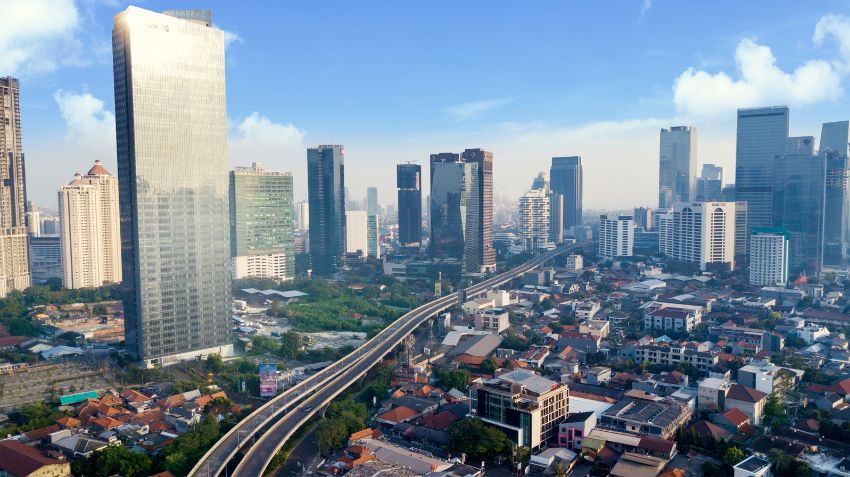
The city of Jakarta is already at full speed before you’ve even sat down – traffic moving in layers, the smell of coffee and street food arriving simultaneously, the late afternoon light filtering through the glass towers and Dutch colonial facades on the same street.
Finding the best areas to stay in Jakarta matters more here than in most Southeast Asian capitals, because the city’s character shifts significantly from one district to the next, and where you anchor shapes everything from your morning routine to how long your evenings last.
The neighbourhoods that work best for visitors aren’t the ones closest to the most famous sights. They’re the ones that give you a real daily rhythm – somewhere you can eat well within walking distance, reach the rest of the city without spending an hour in traffic each direction, and feel the specific tempo of Jakarta rather than just its surface. This is a city that rewards having a base you actually like.
What follows covers the areas that consistently make sense for different kinds of stays – their atmosphere, their movement logic, and the conditions under which each one suits or doesn’t suit a particular traveler.
What Jakarta’s neighbourhoods actually feel like to stay in
Jakarta is not one city – it’s a loose federation of distinct urban villages connected by traffic and held together by a shared, slightly chaotic ambition. The older colonial districts sit in the north around Kota Tua, where the streets narrow and the buildings carry the weight of Dutch Batavia. South of there, the city opens into the central and south Jakarta grid, where Menteng’s tree-lined residential streets, the corporate towers of SCBD, and the social density of Kemang each operate on their own terms.
The key practical reality: walking between these areas is not the mode. Jakarta is a car city. Within a neighbourhood – especially Menteng, SCBD and Kemang – a 15 to 20 minute walk is entirely viable, and the streets reward it. But the distances between districts, combined with heat that builds steadily from mid-morning, mean that inter-neighbourhood movement runs on GrabCar or occasionally the MRT South-North line, which covers the southern corridor cleanly.
The city is warm and humid year-round. In July and August – Jakarta’s drier months – the humidity is lower than the wet season, afternoons are clearer, and the pace feels more manageable. Mornings are the time to move; the city’s social energy reverses into evening, with restaurants and streets coming alive again after 19:00 in a way that stays active well past midnight.
Best Jakarta neighbourhoods for visitors: Menteng, SCBD, Kemang and Kota Tua
Menteng
Menteng is the area that most closely resembles what a residential Jakarta neighborhood looked like before the city accelerated. Wide streets with large trees, colonial Dutch houses converted into embassies and private clubs, independent cafes and good restaurants spaced out rather than compressed into malls. The atmosphere is quieter than the rest of central Jakarta without feeling removed from it.
For a first visit, Menteng offers a useful spatial logic: you’re close to the National Monument (Monas), the National Museum, and the historical centre without actually being in the thick of them. The MRT passes nearby, GrabCar trips into SCBD or toward Kota Tua run at 20 to 30 minutes depending on traffic, and evenings in the neighbourhood have a low-key restaurant energy that doesn’t require going anywhere else unless you want to.
It suits travelers who want a quieter residential base with cultural proximity – not isolation, but a pause between the city’s more intense zones.
SCBD (Sudirman Central Business District)
SCBD is where Jakarta’s international infrastructure concentrates. The major malls, hotel groups, rooftop bars, and a dense cluster of restaurants from Indonesian street food to Japanese omakase all sit within the district. The MRT South-North line passes through it, which makes it the most transit-connected base in the city for visitors staying a short time.
The trade-off is atmosphere. SCBD is polished, efficient, and slightly anonymous in the way that all well-engineered business districts are. Evenings are genuinely lively – the area around Pacific Place and the Senayan corridor fills up after 18:30 and stays active late – but the daytime character between those peaks is more corporate than exploratory. For travelers who prioritize connection, convenience and a mid-to-upscale accommodation range, it’s the clearest practical choice.
Kemang
Kemang is where Jakarta goes out. The neighbourhood south of SCBD has been the city’s social centre for decades – expat community, creative industry, old restaurant families and new concepts all layered on top of each other along the same stretch of road. On a Friday evening around 21:00, the pavements around Kemang Raya fill with people moving between venues in a way that feels spontaneous rather than planned.
The streets are narrower and the traffic on a weekend night can hold a GrabCar in place longer than you’d hope. But the density of good eating and drinking within walking distance of any accommodation in Kemang is genuinely hard to match elsewhere in the city. It works best for travelers who plan to stay three nights or more and who want a social, food-led evening rhythm rather than a conventional sightseeing base.
Kota Tua (Old Town)
Kota Tua is Jakarta’s most atmospheric district and also its most contained one. The Dutch colonial buildings around Fatahillah Square have been partially restored, and the pedestrianised plaza fills with families and local visitors on weekend mornings – a rhythm that feels more community-shaped than tourism-shaped, which is part of what makes it interesting.
It isn’t a practical base for most visits. The district quiets significantly by mid-afternoon, restaurant options are limited compared to the south, and it sits outside the MRT footprint – getting to SCBD or Kemang requires a car or the TransJakarta bus network. For travelers who want to spend two or three nights specifically in the colonial north before relocating south, it works well as a first anchor. For anyone trying to cover the full city from one base, it’s less suitable.
Jakarta in photos
Is Jakarta right for your travel style?
Jakarta suits travelers who are comfortable with a city that doesn’t perform for tourism. There are no easy pedestrian loops connecting the main sights, no old-town quarter that serves as a universal base, and no single neighbourhood that covers everything. What the city offers instead is depth – a food culture that rewards curiosity, a social energy that comes alive genuinely after dark, and a physical scale that makes it feel unlike anywhere else in Southeast Asia.
It works well for travelers who stay at least three to four nights, who use GrabCar comfortably as part of daily movement, and who find the rhythm of a real working megacity more interesting than a polished tourist infrastructure. Remote workers and longer-stay visitors tend to find Kemang or Menteng a good fit – both have reliable cafes, good restaurant density, and a pace that supports a mixed work-and-exploration day.
Travelers on a tight two-night transit itinerary do better anchoring in SCBD, using the MRT for the Monas and museum corridor, and saving Kemang for one evening. Kota Tua deserves a half-day regardless of where you’re staying – the morning light on the square around 08:30, before the day fully heats up, has a quietness that contrasts sharply with the rest of the city.
Those looking for a slower, more walkable Southeast Asian base sometimes find Jakarta’s scale and traffic-dependent movement at odds with what they were imagining. If that sounds like you, the first-time Bali guide covers a very different rhythm within the same country – worth reading before deciding how to split a longer Indonesia trip.
How to move between Jakarta’s areas and arrive from the airport
Soekarno-Hatta International Airport sits roughly 25 kilometres west of central Jakarta. The Airport Railink (Kereta Bandara) runs directly into Sudirman station in SCBD, taking around 50 minutes with a set fare and no traffic exposure – this is the clearest option for travelers heading to the southern and central districts. Damri airport buses serve a wider range of drop-off points including Gambir station near Menteng and Rawamangun in the east, with travel times that vary more depending on the hour.
GrabCar from the airport is available and bookable before you clear arrivals, with fares that are visible in advance. The journey takes 45 minutes to over 90 depending on traffic; heading toward the airport during morning peak hours on a weekday is when the variance is highest.
Once in the city, the MRT South-North line is the cleanest connection between SCBD, Dukuh Atas, Blok M and the Lebak Bulus terminus in the south. It runs frequently, fares are low, and the carriages are air-conditioned. For anything not on that corridor – Kota Tua, Kemang, Menteng – GrabCar is the practical default. TransJakarta buses cover a wide network at very low cost but require some navigation fluency and patience with traffic-dependent timing.
If you’re arriving and weighing how the Jakarta leg fits with the wider Indonesia itinerary, the Jakarta travel guide covers the broader orientation – what to expect from the city, how many days it warrants, and how it sits as a gateway to the rest of the country.
Is Jakarta worth visiting as a base for exploring Indonesia?
Jakarta works as a base for the best areas to stay in Jakarta when you approach it on its own terms – a large, layered, food-serious city with a social rhythm that runs deep into the evening and a neighbourhood character that differs enough between Menteng, SCBD, Kemang and Kota Tua to justify choosing carefully. The city doesn’t compress into a weekend itinerary cleanly, but three to five nights with a clear neighbourhood anchor gives most travelers enough time to find the specific version of Jakarta that fits them.
The fit shifts for travelers who want walkable scale, quiet streets, or a coastal atmosphere – those are qualities Jakarta doesn’t carry. But for the traveler who wants to understand what an Indonesian megacity actually feels like at street level, who eats well as a priority, and who is comfortable with a city that operates at its own tempo rather than a tourist one, Jakarta is a genuinely rewarding place to spend time. The evenings in Kemang, the morning walk through Menteng before the heat arrives, the quietness of Fatahillah Square at 08:00 – these are experiences that belong specifically here.
Continue exploring similar destinations: For the contrast – a slower, coastal Indonesia rhythm – the first-time Bali read covers what to expect from a very different island pace.
Jakarta neighbourhoods FAQ: best areas, transport, safety, nightlife and visiting in summer
1. What is the best area to stay in Jakarta for first-time visitors?
Menteng and SCBD are the most practical bases for a first visit. Menteng sits close to the historical and cultural core with good restaurant access and a quieter residential atmosphere; SCBD places you near international dining, shopping and the MRT South-North line, which makes movement across the city straightforward without relying entirely on cars.
2. Is Jakarta safe to walk around at night?
In well-established areas like SCBD, Kemang and central Menteng, walking after dark is normal and comfortable. The city’s evening energy is genuine – restaurants, cafes and street food fill the pavement well past 22:00 in these neighbourhoods. Outside these zones, a GrabCar is the more practical option after dark.
3. Which Jakarta neighbourhood is best for nightlife and restaurants?
Kemang is the longstanding social anchor for Jakarta’s restaurant and bar scene – dense with options, active well past midnight, and noticeably livelier than its residential streets suggest from the outside. SCBD carries a more polished, international version of the same energy, with rooftop bars and larger restaurant groups concentrated around the main mall cluster.
4. How do you get around between Jakarta neighbourhoods?
GrabCar handles most inter-neighbourhood movement efficiently and at transparent fares. The MRT South-North line covers the SCBD-Dukuh Atas-Menteng corridor cleanly and is worth using when it fits the route. Kota Tua sits outside the MRT footprint and is best reached by car or the TransJakarta bus network.
5. Is Jakarta worth visiting in summer?
July and August fall in Jakarta’s drier season, which makes it one of the more comfortable windows to explore the city – lower humidity than the wet months, cleaner afternoon skies, and the city’s social and restaurant culture in full rhythm. The evening pace across Kemang, SCBD and the old town feels notably more relaxed than the heavier wet-season afternoons, and Fatahillah Square in the morning carries a particular quietness that the city earns.