
Seoul spreads across both sides of the Han River in a way that makes the city feel like several overlapping places at once. The neighborhoods of Seoul don’t follow a single rhythm – some are dense and loud well past midnight, others empty by 21:00 and feel almost residential. Understanding which part of the city you are sleeping in changes the experience considerably, not just the commute.
Late spring in Seoul means the city is building toward its most social season. Streets that were quiet in February are filling out again, rooftop bars are reopening, and the younger crowds are back in Hongdae until very late on weekends. Choosing a base now means choosing how much of that energy you want surrounding you by default.
This is a read about atmosphere, pacing, and fit – not a ranked list. Each district has a logic of its own, and the right one depends almost entirely on what kind of traveler you are when you land.
Myeongdong and the central districts: density and convenience
Myeongdong is the part of Seoul most first-time visitors default to, and not without reason. It sits close to major metro lines, the streets are navigable, and almost everything a new arrival needs is within walking distance. The trade-off is that the main pedestrian corridor runs at full pace from early afternoon until late evening, with vendors, music, and moving bodies in every direction.
Two streets back from the central drag it quiets noticeably. The residential texture returns, and the cafés that were too crowded at 14:00 become pleasant by 20:00. Myeongdong rewards travelers who learn to sidestep the main artery rather than fight it.
Jung-gu more broadly – the administrative district that contains Myeongdong as well as areas like Namdaemun Market and City Hall – is one of the best-connected parts of Seoul for transit. Lines 1, 2, and 4 all run through this zone, which makes cross-city movement easier than from many peripheral neighborhoods. The metro runs reliably and the signage is multilingual throughout; last trains on most lines depart around 23:30, which is worth knowing if you are staying out late and don’t want to commit to a taxi.
Insadong and Bukchon: slower days, traditional scale
Insadong runs at a noticeably different pace. The streets here are narrower, the architecture lower, and the aesthetic pull comes from traditional crafts, tea houses, and a texture that feels genuinely distinct from the commercial center. It is not quiet exactly, but it is calmer, and afternoons here tend to drift rather than rush.
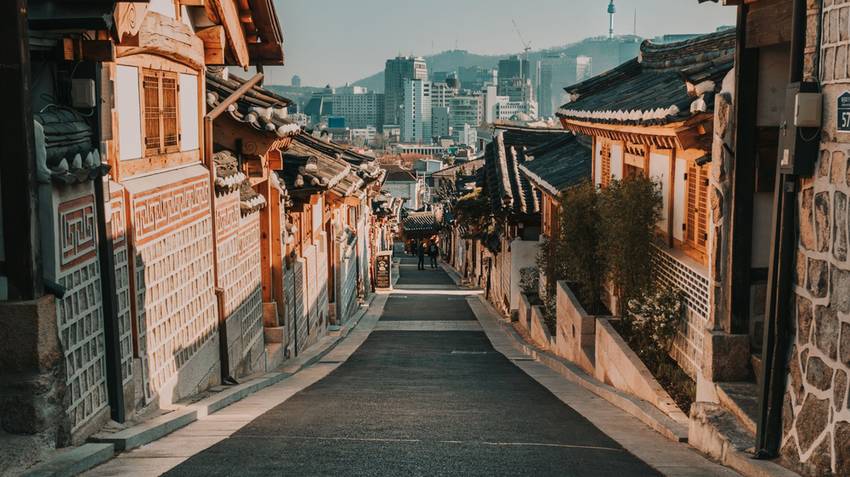
Bukchon Hanok Village sits adjacent and takes that logic further. The restored hanok lanes between Gyeongbokgung and Changdeokgung palaces are one of the more atmospheric parts of the city, but the area functions less as a neighborhood and more as a corridor that tourists walk through and then leave.
Staying inside Bukchon at a traditional guesthouse is possible and delivers an experience that’s genuinely different – waking up inside wooden architecture to a city that hasn’t quite surfaced yet. The terrain is worth noting though: the alleys slope steeply, suitcases are awkward, and the area thins out after 20:00, so evening meals and social activity require a metro ride back into the denser parts of the city.
This corner of Seoul suits travelers who want their mornings to feel unhurried, who are interested in Korean architectural heritage, and who don’t need the neighborhood itself to generate evening energy.
Hongdae: Seoul’s late-night rhythm, built in
Hongdae is the district where Seoul’s younger, louder, more social character concentrates most visibly. The area grew around Hongik University and never quite stopped feeling like it. Street performance, live music in small venues, outdoor bars, and food carts are all present and genuinely busy on weekend nights – this is not a manufactured nightlife district, it’s a neighborhood that simply grew into this pattern over decades.
The practical consequence is that Hongdae works best for travelers who are here for that energy, or who at minimum don’t mind it. If you are staying three or four nights and plan to be out until 01:00 twice, the neighborhood rewards that rhythm entirely. If you are jet-lagged and want quiet by 22:00, the sound from the street will be more present than most travelers anticipate.
Mornings in Hongdae are a different city. The streets that were full at midnight are genuinely empty at 09:00, and there is a particular calm in the area before noon that some travelers find unexpectedly pleasant. Hongdae sits directly on Metro Line 2, which is one of the most useful cross-city lines, and the Hongik University station connects onward to Incheon Airport via the AREX line – a detail worth noting if you are arriving or departing from there.
Itaewon and Haebangchon: international texture and slope
Itaewon is the part of Seoul where the city’s international layer is most visible – a longer history of foreign residents, a wider range of cuisines, and a nightlife scene that runs on similar logic to Hongdae but with a different social composition. It has been going through some shifts in character over recent years, and the district feels less uniformly polished than some other Seoul neighborhoods, which is part of its appeal for certain travelers and a reason others look elsewhere.
Haebangchon, immediately adjacent on the slopes behind Itaewon, is quieter and more residential. It has a reputation among longer-stay visitors as a place where the city’s social texture is present but less pressured. The hill is real – if you are based there and moving in and out of the city repeatedly, the incline becomes a daily physical reality rather than a picturesque detail.
Travelers who have spent a few days across the river and want to understand how Seoul changes in register often gravitate toward the Itaewon-to-Haebangchon strip as a counterpoint to the more commercial central districts. For those weighing Seoul against a very different kind of Korean city, the Seoul versus Busan comparison node maps that decision at the same travel stage.
Gangnam: efficient, commercial, and atmospherically thin
Gangnam sits south of the Han River and operates on a different logic than most of the neighborhoods above. It is polished, well-serviced, and efficient. The streets are wider, the transit is strong, and the accommodation options lean toward business hotels and higher-end serviced apartments. For a certain kind of traveler – someone here primarily for meetings, someone doing a longer stay who values stability and quiet evenings – Gangnam is genuinely comfortable.
The atmospheric pull is weaker than the northern districts, and travelers who arrive hoping the neighborhood will generate spontaneous exploration tend to find themselves taking the metro back north more often than they expected. It is not the wrong base, but it is a conscious choice rather than a default.
How the transit layer connects it all
Seoul’s metro is one of those systems that makes neighborhood choice less decisive than it might otherwise be. Lines run frequently, signage works in English, and most of the districts above connect within 20-30 minutes on a single line. The practical implication is that you are not locked into your neighborhood’s evening atmosphere if you want something different – you can be in Hongdae from Insadong in under 20 minutes, and back again before midnight without anxiety about the last train.
The late-night caveat is consistent across all lines: services on most routes end around 23:30. Staying out later than that means taxis, which are available but add cost and occasional negotiation. Some travelers plan their nights around this cutoff naturally; others ignore it and spend slightly more on the way home. Either is fine, but it is worth knowing before you commit to a neighborhood that assumes late-night transit.
For travelers who want a complementary read on Korea’s other major city, the Busan first-timer guide covers a different kind of Korean urban rhythm – coastal, more compressed, with a very different relationship to pacing and scale.
If the question of neighborhood fit resonates and you are thinking through similar decisions elsewhere, the Naples neighborhood fit node applies the same logic to a European city with comparable complexity across its districts.
Who Seoul’s neighborhoods suit, and who they push back against
Seoul as a city rewards travelers who are comfortable with density, enjoy evening activity, and find stimulation energizing rather than draining. The neighborhoods of Seoul are varied enough that pacing is a real choice – you can have slow mornings in Insadong and loud evenings in Hongdae within the same trip, and many people do.
The city is less naturally suited to travelers who need extended quiet, who want a neighborhood that functions as a retreat as well as a base, or who find high social density tiring over multiple days. That is not a reason to avoid Seoul, but it is a reason to choose the base carefully and to build in recovery time rather than assuming the city’s rhythm will match theirs by default.
For travelers weighing neighborhood texture across different city scales, the Athens neighborhood guide covers a city with similar contrasts between historic, social, and residential districts – useful reading if Seoul is part of a wider planning process.
Reading the neighborhood of Seoul that fits you
The neighborhoods of Seoul don’t divide neatly into good and bad, convenient and inconvenient. They divide by rhythm. Myeongdong and Jung-gu suit travelers who want transit access and proximity to everything without committing to a particular atmosphere. Insadong and Bukchon suit those who want their immediate environment to feel calmer and historically textured. Hongdae suits anyone whose natural travel tempo runs toward late evenings and social density. Gangnam suits travelers who need efficiency and quiet over atmosphere.
What makes the choice worth thinking through is that Seoul’s metro is good enough to reach any of these districts from any other in under 30 minutes. The neighborhood you sleep in shapes your mornings and your late nights – the hours in between are largely transferable. Starting from there, the decision becomes cleaner.
See which traveler profiles fit this destination
Explore further
Travelers deciding between Seoul and a very different Korean experience often find the Seoul versus Busan first-timer comparison useful at exactly this stage.
Neighborhoods of Seoul: frequently asked questions
1. Which neighborhood in Seoul is best for first-time visitors?
Myeongdong and Insadong are the two most common bases for first-time visitors: Myeongdong puts you close to transport links and concentrated commercial activity, while Insadong offers a calmer pace with traditional architecture and quieter side streets. Hongdae works better for travelers who want a younger, more social atmosphere and plan to stay out late.
2. Is Hongdae a good area to stay in Seoul?
Hongdae suits travelers who lean into Seoul’s late-night energy. The area is built around bars, live music, and street performance, and it stays genuinely active well past midnight on weekends. Mornings are quiet by contrast, which makes the rhythm work well for people who move slowly in the first half of the day and come alive later.
3. How do Seoul’s neighborhoods differ in terms of pacing?
The differences are real and worth planning around. Itaewon and Hongdae run on a late-night rhythm, while Insadong and Bukchon feel calmer and more suited to slower daytime movement. Gangnam sits in a different register entirely – polished and efficient, but thinner on the atmospheric texture that makes the northern districts easy to spend time in.
4. What is the best area to stay in Seoul for easy transit access?
Virtually any central district connects well to Seoul Metro, which covers the city thoroughly and runs until around 23:30 on most lines. Jung-gu and the area around City Hall give strong multi-line access in several directions, while Hongdae sits directly on Line 2, one of the most cross-city useful routes, with a direct airport connection from Hongik University station.
5. Is Bukchon Hanok Village worth staying in for a few nights?
Staying inside Bukchon at a traditional guesthouse delivers something genuinely different – narrow lanes between restored hanok rooflines, mornings that feel quieter than the map suggests, a texture that reads nothing like a hotel corridor. The area’s social life ends early, so evenings tend to pull you back toward the city’s livelier districts by metro, which most visitors find a comfortable rhythm after the first night.