
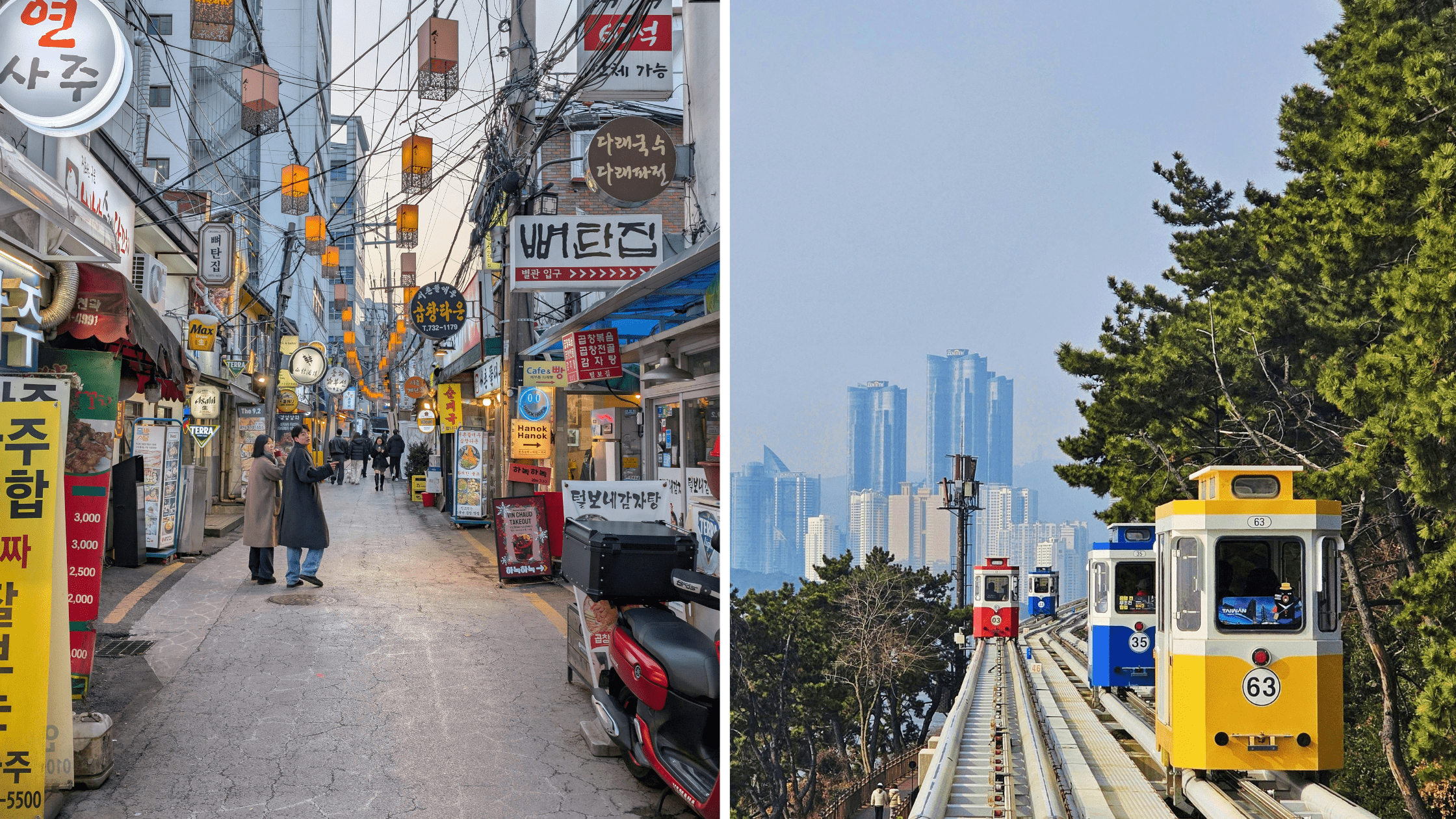
Seoul and Busan land in the same search, but they answer different travel questions. Seoul is a capital in the fullest sense , dense, fast, multi-layered, difficult to exhaust in a week.
Busan is a port city that moves differently: coastal, more physically textured, with a pace that settles over a couple of days rather than accelerating. For most first-time travelers choosing between Seoul vs Busan, the real question isn’t which is better – it’s which rhythm fits the trip they’re actually planning.
The good news is that a KTX train connects them in under three hours, so “choosing” doesn’t have to mean excluding. What the comparison really does is help you decide where to anchor, how long to spend in each, and whether you even need both on a first visit.
What Seoul actually feels like on the ground
Seoul’s scale is one of the first things people notice. Not just the size of the city, but how the density distributes itself across neighborhoods that each feel like separate towns.
Itaewon and Myeongdong run at a different register than Insadong or Bukchon, and moving between them – even by metro, takes real time.
The subway covers it well, with bilingual signage throughout, but the network has over nine lines and the interchanges at major stations like Sindorim or Express Bus Terminal require paying attention to platform directions. First-timers usually get the rhythm within a day; the cognitive load is real but manageable.
The city’s activity window stretches past midnight on most nights in areas like Hongdae or Gangnam. Restaurants rarely feel pressure to turn tables quickly, convenience stores run 24 hours across every neighborhood, and the social energy in the tourist and entertainment corridors stays high from mid-morning until well past dark.
For travelers who calibrate well to urban stimulation, this is part of Seoul’s appeal. For travelers who find capital-city intensity wearing by day three, it’s worth knowing that the pace doesn’t naturally soften, you have to engineer that yourself, usually by choosing quieter neighborhoods or slower hours.
Walking between areas requires more physical effort than apps suggest. The map distance from Gyeongbokgung to Insadong is short; the actual walk involves navigating wide multi-lane roads, uneven paving in older sections, and foot traffic that bottlenecks around market entrances. By the second full day, most people feel it in their feet even before accounting for any hills.
What Busan actually feels like on the ground
Busan is physically different in a way that surprises travelers who expect it to feel like a smaller Seoul. The city is built on hills and narrow coastal valleys, with neighborhoods stacked vertically in ways that make walking more demanding than the street-level map implies.
The area around Gamcheon, for instance, involves a sustained climb on stepped lanes before any views become available. Busan’s terrain loads the body differently – it’s less about distance and more about elevation, and that changes by day two.
The pace is notably slower near the waterfront and in residential areas. Jagalchi fish market operates through the morning with a working-port energy that has nothing to do with tourism performance, trucks, wholesalers, locals buying before noon, and a smell of brine that doesn’t fully leave the surrounding streets until evening.
Haeundae Beach in late spring carries a different crowd than peak summer, with families and older locals rather than the wall-to-wall July density. The shift between those two versions of the same beach is significant.
Busan’s metro has four main lines. Transfer points are straightforward and the system takes about thirty minutes to read confidently. The taxi app infrastructure mirrors Seoul’s, KakaoTaxi works reliably and most drivers accept card payment without friction. Getting from Gimhae Airport to the city center by Busan-Gimhae Light Rail and metro takes around 40 minutes, with no real navigation challenge involved.
Who each city actually suits
Seoul suits travelers who want range. Multiple distinct neighborhoods, strong coffee shop culture, restaurant variety across every price point, a museum and gallery scene that doesn’t require extensive planning to access, and a nightlife geography detailed enough to occupy evenings for a week without repetition.
It also suits travelers who are comfortable navigating a large transit network and who don’t need the city to slow down around them.
Busan suits travelers who want a different register from Seoul but still want genuine urban texture, not just a beach resort. The city has enough to anchor three full days without forcing an itinerary, the port area, the old neighborhoods above it, Haeundae, and the market corridor each occupy a half-day comfortably.
It suits solo travelers who prefer physical exploration over structured touring, and couples who want the trip to feel less capital-city relentless by day four or five.
Travelers who find urban density genuinely draining – rather than just tiring in a pleasant way – may find Seoul hard to sustain beyond three nights without building in deliberate recovery time. Busan absorbs that kind of traveler better because the city’s rhythm tolerates slower days without making them feel like wasted time.
The combined trip: how to pace Seoul and Busan together
Most first-time visitors do Seoul first, then take the KTX south to Busan. This order works because Seoul front-loads the more demanding urban experience while energy is highest, and the arrival in Busan feels like a natural shift in gear.
The train itself is worth knowing: the journey is about two hours and forty minutes, trains leave from Seoul Station throughout the day, and booking a day ahead is usually sufficient outside Korean public holidays.
Four nights in Seoul and two to three nights in Busan is the most common rhythm, and it holds up in practice. Four nights in Seoul leaves enough time to cover three or four distinct neighborhoods at a realistic pace without sprinting. Two nights in Busan is enough for a first read of the city; three nights allows for a slower day where you’re not accounting for every hour.
Some travelers reverse the order, arriving into Busan via KTX from Seoul’s Incheon Airport connection, then finishing the trip in Seoul for the flight home. This avoids ending on a transit day and keeps Seoul, which has more airport logistics complexity, as the exit point. The tradeoff is that you land in Busan while still adjusting to the time zone, which some people find easier and others find disorienting.
Travelers weighing this against other comparison frameworks in Asia, where a capital versus a secondary coastal city creates a similar choice – will find the Tokyo first-time visitor read useful for calibrating how Seoul’s scale compares to another high-density capital in the region.
Seasonal fit: spring and summer specifically
Late spring – roughly mid-April through early June – is the most comfortable window for both cities. Temperatures in Seoul sit between 15°C and 22°C through May, outdoor markets and palace grounds are fully open, and the tourist corridor density hasn’t yet reached its July peak.
Busan in May is easier on the beach than August: Haeundae and Gwangalli are accessible without the summer crowd compression, and the coastal neighborhoods are walkable without the humidity weight that arrives by July.
Summer changes both cities noticeably. Seoul becomes humid and warm from late June onward, with occasional multi-day rain events from the monsoon season (typically late June to late July).
The city functions through it, indoor venues, subway connectivity, and covered markets absorb the schedule change, but it adds a physical cost to extended outdoor walking. Busan’s beaches become the city’s dominant draw in July and August, which suits travelers explicitly seeking that atmosphere but creates a different version of Busan for everyone else.
For travelers planning around the upcoming summer window, the Seoul-first structure still works, with the adjustment of front-loading outdoor areas in Seoul earlier in the day and leaning more on evening hours for Myeongdong and Hongdae. Busan in July is a reasonable choice if the beach energy is the point; if it isn’t, late spring or September is more comfortable.
Practical friction worth knowing before you go
Incheon Airport is large and efficient, but the journey to central Seoul takes 50 to 60 minutes on the AREX express train, which runs from the airport basement. The express is the faster option; the all-stop commuter version is cheaper and takes around 20 minutes longer. Neither is complicated, but the distance from airport to neighborhood is real and worth factoring into arrival-day energy.
Data and navigation are straightforward in both cities. T-money cards (a transit IC card available at airport convenience stores) work on subway, bus, and most taxis across both Seoul and Busan. Google Maps reads both cities well for transit directions.
Naver Maps is more accurate for walking routes, especially in areas where alley-level navigation matters – Busan’s hillside neighborhoods in particular benefit from a more granular map read.
Korean SIM cards with data are available at Incheon on arrival. The process takes around ten minutes and the cards work across both cities without configuration changes. This is worth doing at the airport rather than after, since navigation and food search become immediately relevant from the Incheon-to-Seoul train onward.
The Madrid vs Barcelona traveler-fit read runs a structurally similar capital-versus-secondary-city comparison if you’re interested in how the same decision logic plays out with a European register – the dynamic between urban density and coastal pacing maps quite closely.
Seoul and Busan together: who the combination suits
The Seoul and Busan pairing works because the two cities cover different registers of Korean urban life without requiring significantly different logistical setup. Both are safe, transit-connected, and easy to navigate independently. The combination rewards travelers who want range in a single trip – cultural weight in Seoul, physical texture in Busan – and who are comfortable with a mid-trip transit transfer.
For a first visit of seven days or fewer, Seoul alone is a coherent choice if you prefer depth over coverage. Busan alone is a coherent choice if a coastal city with manageable scale suits your current energy better than a capital.
The Seoul vs Busan decision is less about which is superior and more about which daily shape you want to wake up inside for most of the trip. Both reward a bit of slowness; neither requires it.
Seoul vs Busan: common questions
1. Should I visit Seoul or Busan on a first trip to South Korea?
Most first-time travelers do well with Seoul for 4-5 days, then Busan for 2-3 days. Seoul has more range in terms of neighborhoods, food variety, and cultural sites, while Busan adds a coastal shift in pace that makes the trip feel more complete. If you only have time for one, Seoul is the more layered experience.
2. Is Busan worth visiting as a standalone destination?
Yes, especially if you prefer a coastal city over a capital. Busan has its own distinct rhythm, a working port, seafood markets, and beach neighborhoods that Seoul does not replicate. It works well as a standalone trip for travelers who find capital cities overstimulating or want a slower daily pace.
3. How easy is it to travel between Seoul and Busan?
The KTX bullet train connects Seoul Station to Busan Station in roughly 2 hours 40 minutes. Trains run frequently throughout the day, and booking a day or two in advance is usually enough outside major Korean public holidays.
4. Which city is better for first-time solo travelers?
Both cities are easy for solo travelers in terms of safety and transit. Seoul tends to suit solo travelers who want more social infrastructure, including hostels with active common areas, late-night neighborhoods, and a denser restaurant and café culture. Busan suits solo travelers who prefer quieter days and more physical wandering.
5. Can I do Seoul and Busan in one week?
A week works well for a combined trip. A typical rhythm is 4 nights in Seoul and 2-3 nights in Busan, with the KTX as the connector. Some travelers reverse the order to arrive fresher in Busan before returning to Seoul for the flight home, which reduces transit fatigue on the last day.