
Busan arrives differently from most big cities. The sea is always present, not as scenery you travel to visit but as something that shapes the light, the air, and the pace of an ordinary afternoon. It is South Korea’s second-largest city, but it does not feel like a secondary experience.
This first-time traveler guide to Busan is aimed at people sitting in late spring, watching summer appear on the horizon, and wondering whether a Korean coastal city fits into the decision. The short answer is that Busan tends to suit people who want Seoul-level energy in shorter doses, framed by beaches, mountains, and a waterfront that actually functions as part of daily life.
The city spreads along a coastline broken by hills, which means neighborhoods are separated by geography as much as by distance. That gives each area its own density, its own social register, and its own rhythm across the day.
What Busan actually feels like as a first destination
The first thing most visitors notice is that Busan does not perform for tourists the way coastal resort cities sometimes do. Jagalchi fish market opens before dawn and smells exactly like a working fish market. The vendors are there because they have been there for decades, not because it is a tourist draw, though it is that too.
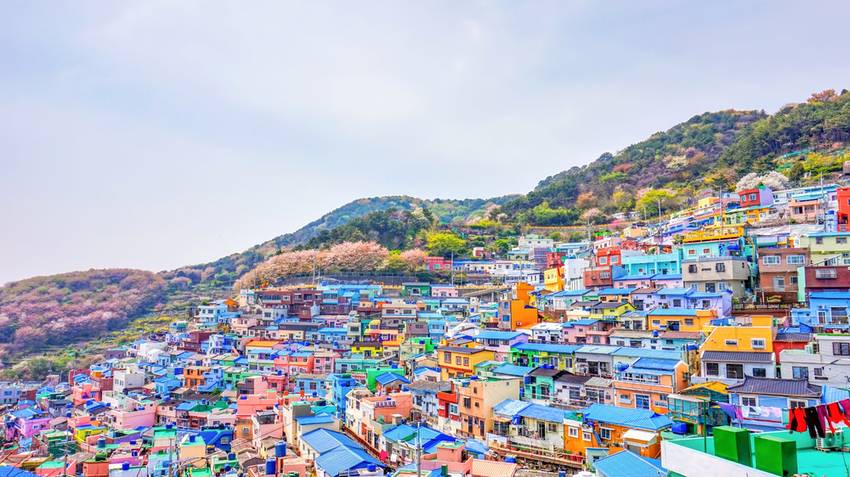
At street level, the city alternates between industrial-port grittiness near the harbor, sleek high-rise corridors around Haeundae, and layered hillside neighborhoods like Gamcheon, where painted houses stack up the slope with no particular sense of ceremony. The contrast is real and fairly abrupt. Walking two blocks in the wrong direction can change the energy completely.
By late afternoon, the city shifts. Markets slow, the beaches pick up, and the seafood restaurants near Gwangalli and Haeundae start filling with people who clearly know where they are going. Evenings are long and social in a way that feels genuinely local rather than manufactured.
Which neighborhoods make sense for a first visit
Haeundae is the easiest entry point, particularly for first-time visitors arriving in late spring or early summer. The beach is wide, the infrastructure is polished, and accommodation ranges from international hotel chains to smaller guesthouses within a few minutes’ walk of the water. The promenade stays busy through the evening, with the crowd shifting from families and older couples earlier in the day toward a younger, louder mix after 20:00.
Seomyeon works better for people who want to feel embedded in the city rather than adjacent to it. It is centrally located, dense with restaurants, and the metro connections from here make the rest of Busan accessible without much planning. It lacks the beach, but at night the streets have more local texture than Haeundae’s tourist corridor.
Nampo-dong and the area around Gwangbok-ro sit in the older city center, close to Jagalchi market and the ferry terminals. This is the part of Busan that feels most port-city: loud, layered, alive in the mornings, and worth a half-day even if you are not staying there. Gamcheon Culture Village is the hillside neighborhood most visitors photograph, and it earns its reputation, though the climb through its narrow lanes takes more energy than the map suggests, especially in the warmer months.
Gwangalli is worth considering as a base for longer stays. The beach is smaller than Haeundae but the surrounding streets have a genuine neighborhood feel, with cafes and restaurants running down to the waterfront that seem to exist for residents as much as visitors.
Who Busan fits and who might find it frustrating
Busan works particularly well for travelers who want coastal atmosphere without sacrificing city substance. If you want to swim in the morning, eat grilled fish at a market stall, spend the afternoon in a neighborhood that takes forty minutes to explore properly, and have genuine dinner options within walking distance, Busan handles all of that without strain.
It also suits travelers who find Seoul slightly overwhelming on a first Korea visit. The pace is lower, the spatial logic is easier to read, and the coast provides a natural reset when the city gets to be too much. Remote workers who prefer flexibility over rigid daily structure tend to find the rhythm here accommodating, though the humidity in July and August can make any kind of outdoor working rhythm difficult.
Travelers looking for deep historical layers or dense cultural programming may find Busan thinner than Seoul. The city’s identity is genuinely coastal and port-city in character, which is a real thing and not a consolation prize, but it is not the same as being a capital city with thousands of years of palace architecture and museum infrastructure. If that is primarily what you are after, Busan works better as a counterpoint to Seoul than as a standalone destination.
The city can also feel disjointed on a first visit. The neighborhoods do not connect into one walkable whole. You navigate by metro and taxi between areas that feel quite different from each other, which some travelers find interesting and others find tiring after a few days.
How days actually unfold: pacing and movement
Mornings in Busan tend to anchor around food. The fish market opens early, and the area near Jagalchi is worth visiting before 10:00, when the energy is still working-market rather than tourist-market. A breakfast of raw fish or fish soup at one of the stalls near the water is a specific and unrepeatable kind of morning.
The metro connects most of what a first-time visitor needs across four lines. The signage is in English and Korean, and the fare system is straightforward, though the transfer at certain busy stations like Seomyeon involves longer platform walks than the map implies. Gamcheon involves a bus or taxi from the nearest metro station, followed by a walk that becomes noticeably steep once you reach the painted lanes. The views repay the climb, but go in the morning if you want quieter streets and cooler conditions.
Beach time works best in the early morning or late afternoon, particularly from June onward. By late morning, Haeundae reaches its peak activity and finding space on the sand requires patience. The stretch toward the eastern end of the beach tends to be somewhat less concentrated.
Evenings in Busan are genuinely good. The seafood is the reason most people make food the organizing principle of the day, and the area around Gwangalli Bridge at night, with the illuminated bridge reflected in the water and a row of restaurants at close range, is the kind of thing that stays with people. It is not subtle, but it is worth it.
Travelers weighing Busan against Seoul before committing to either will find a detailed breakdown of the pacing and neighborhood logic in the Seoul vs Busan first-timer comparisonwhich runs through the specific tradeoffs between the two cities for someone on a first Korea trip.
Practical logistics for arriving and moving around
Most international visitors arrive through Gimhae International Airport rather than flying directly from Seoul. The airport limousine bus reaches Haeundae in roughly 50 minutes and costs considerably less than a taxi. The subway from Gimhae takes a similar amount of time once you account for the transfer, but the bus is more direct for most accommodation areas.
The KTX high-speed train from Seoul to Busan takes about two and a half hours and is comfortable, frequent, and a reliable way to combine both cities on a single trip. Booking in advance for summer weekends is sensible since the trains do fill.
Kakao T is the standard ride-hailing app and it works well throughout the city, with metered taxis as an alternative. Neither is expensive by the standards of most destinations people compare Korea against. The metro is the default for getting between neighborhoods during peak hours, when surface traffic slows considerably around Haeundae and the port areas.
Seasonal timing: what changes as summer arrives
Late spring, when this is being written, is the window before the city’s character shifts toward its high-summer mode. The beaches are open but not yet operating at full capacity, the weather is warm without the July and August humidity, and accommodation runs at better rates than peak season. For a first visit, the late May to early June window has a real case for being the most comfortable entry point.
Summer proper, from July through August, is the busiest period. The beaches draw large crowds, the city’s food and nightlife scene is fully activated, and the energy on the Haeundae promenade in the evenings is something the city does well. The humidity is real and concentrated, and the rainy season in late June and early July can interrupt outdoor plans without much warning. That version of Busan is still worth experiencing, particularly for travelers who do well with heat and social density, but it asks more of you than spring does.
Autumn, from late September through November, is when the city quiets and the temperatures return to something comfortable without being cold. Many travelers who have been to Busan more than once tend to name autumn as their preferred season, though spring increasingly competes with it as the word gets out.
For travelers looking at a first city visit framed around food, atmosphere, and neighborhood texture, the Osaka first-visit pacing read covers a similar kind of Japanese coastal city experience, and the two destinations sit in an interesting comparison for anyone considering a wider East Asia itinerary.
What kind of trip Busan actually is
As a first-time traveler guide to Busan, the honest synthesis is this: Busan is a real city that happens to have beaches, not a beach destination that happens to have a city behind it. That distinction matters for setting expectations and for deciding how to pace a first visit.
It suits travelers who are comfortable navigating a city by metro, who want seafood to play a central role in how they spend money, and who find the presence of the sea genuinely restorative rather than merely scenic. Three to five days is enough for a first visit to find your footing and understand what the city is. A week starts to reveal the quieter parts.
Travelers who want everything within walking distance, or who are primarily interested in historical and cultural programming, may find Busan slightly unresolved, particularly if Seoul is the comparison point. But travelers who arrive without forcing the city into a shape it does not hold tend to find it gives back more than they expected.
If you are still mapping the broader decision between a city-heavy and coast-heavy itinerary in South Korea, the Seoul vs Busan first-timer comparison works through the tradeoffs in detail. For travelers building a wider first visit to East Asia, the Osaka first-visit node sits in a complementary register, covering a city that shares Busan’s food-forward, port-city character at a different cultural pitch.
Frequently asked questions: Busan for first-time visitors
1. What is the best time of year to visit Busan for the first time?
Late spring (April to early June) and autumn (September to November) are the most comfortable windows for a first visit. Summers are hot and humid with a rainy season in late June and July, though the beaches are at their most active. Spring brings mild temperatures and quieter streets before the peak crowds arrive.
2. How many days do you need in Busan as a first-time visitor?
Three to five days is enough to understand the city’s different rhythms without rushing. The first two days tend to resolve the layout and main districts; by day three, the pace slows naturally and you find the streets that suit you. A week works well for slower travelers who want to use the city as a base.
3. Is Busan easy to navigate without speaking Korean?
Yes, reasonably so. Metro signage is in English and Korean, and most tourist-facing areas have enough English for basic navigation. Ordering food in smaller local restaurants can take some pointing or a translation app, but that is part of the texture rather than a real obstacle.
4. Should I stay in Haeundae or closer to the old city center?
Haeundae is the cleaner, more resort-like choice, particularly appealing in late spring and summer when the beach is a daily part of the rhythm. Staying near Seomyeon or Nampo-dong puts you closer to the market districts and the older city energy, with more local foot traffic and a different kind of evening.
5. How does Busan compare to Seoul for a first visit to South Korea?
Seoul is denser, faster, and more demanding on a first visit. Busan moves at a noticeably different pace, with the sea providing a natural counterweight to any urban intensity. Many travelers find Busan easier to settle into, particularly if they want a mix of city and coast rather than a pure metropolitan experience.