
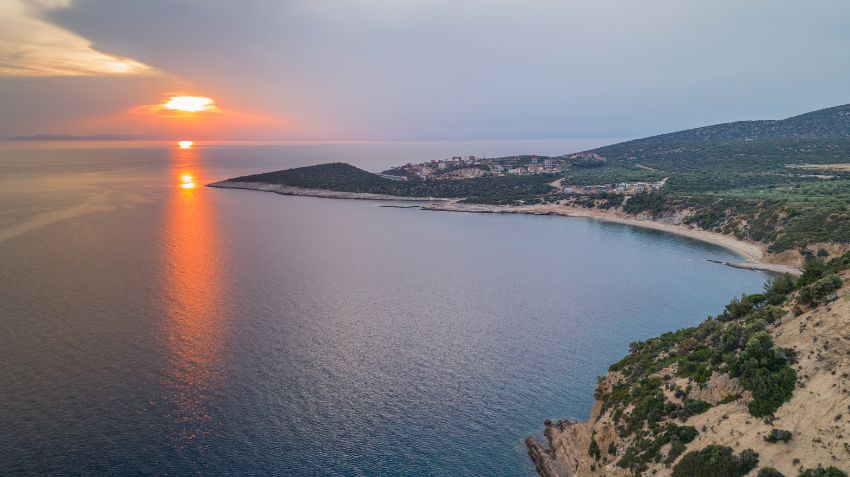
Thassos sits close enough to the northern Greek mainland that the ferry crossing takes under an hour, yet the island operates at a different register entirely. The water runs remarkably clear even at the busy beaches, the interior smells of pine resin and wild thyme, and the evenings stretch long and unhurried in a way that takes a day or two to properly settle into.
Choosing the best areas to stay in Thassos matters more here than on some larger islands, because each stretch of coastline has its own tempo and its own kind of traveler.
The island is not large – the ring road covers the whole perimeter in under two hours – but the difference between the busy northeast corner and the quieter southwest is real enough to shape the entire trip. Whether you anchor near the ferry port and the old capital, or push further around the coast toward smaller coves and slower harbours, the pacing of each area carries through into how the days actually feel.
What follows is not a ranking. It is a read of each main area’s character, rhythm and fit, written for the kind of traveler who wants to understand a place before arriving in it.
What the main areas of Thassos feel like for visitors
Thassos Town, also called Limenas, is the obvious anchor. The ferry arrives here, the old town is here, and the concentration of restaurants along the harbour is the densest on the island. In July the waterfront fills by evening with a mix of Greek domestic visitors and northern Europeans, the atmosphere is social and lively, and the coffee shops stay occupied long after the kitchen closes. The old quarter behind the port – fragments of ancient walls, a small theatre used occasionally for summer performances – gives the town a texture that the resort-only areas further around the coast cannot match.
Two streets back from the main strip, the pace drops noticeably. Morning light falls early on the harbour, and before 09:00 it is genuinely quiet out there, with fishing boats still at anchor and the first bakeries open. That contrast, loud by 20:00 and calm at 08:00, is the defining character of Thassos Town as a base. East of the capital, Skala Potamia and Golden Beach sit along one of the island’s longest sandy stretches. The beach itself is the draw here, not the towns. Golden Beach has shallow water for a long way out, and by mid-morning in peak season the shoreline is well occupied.
The accommodation zone runs parallel to the beach road, which means the walk from most hotels to the water is short enough to make multiple trips in a day. Skala Potamia is slightly quieter than Golden Beach and has a small fishing port that retains a local cadence even in high summer, particularly in the early morning when the catch comes in.
The south coast around Alyki carries a different atmosphere again. The village sits on a double bay with remarkably clear water and a small archaeological site just above the cove. It is genuinely one of the more beautiful corners of the island – not because the word fits easily but because the combination of translucent water, white stone and surrounding pines is specific enough to be worth naming. The scale is small. There are a handful of tavernas, no resort infrastructure, and evenings that wind down earlier than anywhere on the east coast.
Limenaria and Potos in the southwest complete the main residential zones. Limenaria is the island’s second town, with a modest harbour, a good selection of restaurants, and a traveler profile that skews slightly older and more Greek than the northeast. The pace is steadier. Potos sits nearby and draws a younger crowd with beach bars and a slightly more organized resort rhythm, though still far below the energy of Golden Beach in peak weeks.
Is Thassos right for your travel style?
The island works well for travelers who want a beach-anchored trip with some optional movement – a day trip into the interior villages, an afternoon ferry excursion, a scooter loop around the coast. It suits couples and families looking for warm clear water without the scale and density of Crete or Rhodes. It also works for anyone who has already done the larger Greek island circuit and wants something that feels smaller and less processed.
Slow travelers and those looking for genuine off-grid quiet should be honest with themselves about the July-August window: the island is popular with Greek domestic tourism, and certain beaches reach their peak activity by late morning. The northeast coast in particular moves at a resort tempo during those weeks. September changes this considerably – the sea stays warm, the restaurants are still open, and the crowd activity shifts down in a way that the island’s character rewards rather than just accommodates.
Remote workers will find the island more suitable as a deliberate break than as a productive base. Connectivity is reasonable in Thassos Town and the main resort areas, but the general island rhythm inclines toward meals, swims and long evenings, not structured working days. That is not a weakness of the place – it is simply what it is built around.
Travelers who want urban energy, nightlife, or the kind of social density that sustains a two-week stay through novelty alone will find Thassos reaches its natural limit faster than a city-based trip. The island’s fit is genuine but specific.
Thassos in photos
Where to stay in Thassos: area by area for different traveler types
Thassos Town for connection and flexibility
Staying in Thassos Town gives the easiest access to the ferry, the widest choice of restaurants, and the most reliable bus connections to the rest of the island. For first-time visitors who want to understand the island before committing to a corner of it, this is the sensible base.
The town beach is not the island’s best, but the harbour walk at dusk is one of the genuinely pleasant rituals of the place – tables set out close to the water, the day’s heat softening, and the light on the old port buildings going amber around 20:00.
Golden Beach and Skala Potamia for beach-first stays
If the primary purpose of the trip is beach time, the Golden Beach area earns its position. The sand runs for several kilometres, the water is shallow enough for children and unhurried swimmers, and the accommodation options include everything from simple studios to slightly larger hotels directly on the beach road.
The area operates almost entirely on beach logic: mornings on the sand, afternoons in the shade, evenings at one of the strip restaurants. It does not pretend to be anything else, which is part of why it works for travelers who are not looking for complexity.
Travelers who find the first-time Thassos pacing read useful often realise at that point that their trip is shaped around beaches – and Golden Beach becomes the obvious anchor rather than a secondary consideration.
Alyki for quiet coves and a slower tempo
Alyki is genuinely different in scale and atmosphere. The double bay means there are always two water orientations to choose from depending on the wind, and the archaeological site above the cove gives a reason to arrive slightly before the beach crowd. The tavernas here serve later into the evening than you might expect from such a small place, and the quality is high relative to the lack of competition. For couples who want less foot traffic and mornings that start with the sound of the sea rather than the beach bar setup, Alyki is the natural choice on Thassos.
The practical note: accommodation options are limited, and booking well ahead in July is not optional. The village fills quickly because the supply is genuinely small.
Limenaria and Potos for a local-facing rhythm
The southwest offers the most local-feeling atmosphere of the main areas. Limenaria has the feel of a town that exists for its residents first and visitors second, which in practice means that the restaurants are oriented toward Greek rather than tourist preferences and the evenings carry a slightly different social energy. For travelers who respond well to that kind of place, it is worth the extra distance from the ferry port. Potos is livelier and slightly more resort-oriented but still operates below the noise register of the northeast coast in summer.
How to move around Thassos and use the ring road as a base strategy
The island’s single ring road is both the main transport infrastructure and a useful way of thinking about where to stay. The bus service covers the main towns and runs reliably enough in summer, with departures roughly every hour between the major stops. It is useful for day excursions from a fixed base, but it does not run late enough to support evening movement across the island.
Renting a scooter or a small car opens the island up considerably. The road is well-maintained, the distances are short, and the ability to stop at smaller coves that the buses skip is one of the genuine pleasures of the place. The mountain villages of the interior – Theologos, Kastro, Megalos Prinos – are accessible by road and each has a very different atmospheric register from the coast: shaded squares, older stone architecture, local kafeneions that close when the owner decides to close them.
A useful strategy for longer stays: anchor in one area for the first few nights to settle in, then use a rented vehicle for day movement rather than changing accommodation. The island is compact enough that this approach covers almost everything without the overhead of packing and unpacking. For travelers weighing Thassos against other northern Aegean options, or considering a Greek island base with slower rhythms and less resort density, the Greek island beaches and digital detox read covers adjacent terrain and may help clarify what kind of island pace the trip is actually built around.
The question of whether to stay on the east or west coast often resolves itself once travelers understand that the east faces the morning light and the main resort activity, while the west catches the afternoon sun and operates at a lower frequency. Neither is superior; they serve different versions of the same trip.
Continue exploring how island pacing works across the Greek archipelago with the Corfu Town neighborhood readwhich covers a similar decision – where to anchor on an island with distinct areas – from a different atmospheric starting point.
Travelers who want to think through the Greek island comparison more broadly – particularly between islands with very different social densities and atmospheres – often find the Rhodes Town or Heraklion base comparison a useful counterpoint to the quieter northern Aegean character of Thassos.
Is Thassos worth visiting for a summer beach trip or longer stay?
The best areas to stay in Thassos suit travelers who arrive with a clear sense of what they want from the island – beach time, slower evenings, clear water, and the kind of unhurried daily rhythm that a small pine-covered island naturally produces.
Thassos Town works as the most flexible base; Golden Beach works for those whose trip is genuinely beach-anchored; Alyki works for couples and quieter-stay travelers; the southwest works for anyone who prefers a local-facing atmosphere over resort infrastructure.
The July-August window brings the fullest version of the island’s social energy, which is worth experiencing but also benefits from early mornings and an accommodation choice that is not directly inside the busiest corridors. September narrows the choice of open businesses but opens up a version of Thassos that many visitors consider the better one. For the right kind of trip, the island works clearly – it does not require managing, only a realistic understanding of its scale and rhythm before you arrive.
Thassos areas to stay FAQ: best neighborhoods, beaches, couples, families and summer timing
1. Which area of Thassos is best for a first visit?
Thassos Town suits most first-time visitors – it has the ferry connection, a walkable old quarter, and easy access to both the east and west coasts. Golden Beach is a strong alternative for travelers whose priority is staying close to the water from the first morning.
2. Where should couples stay in Thassos?
Alyki and Astris on the quieter south coast draw couples who want small coves, slower evenings and less foot traffic than the main resort towns. The tavernas around Alyki’s double bay stay lit well past 21:00 and the walking is easy.
3. Is Thassos Town or Golden Beach better for families?
Golden Beach has the longer, shallower shoreline that works well for children and the accommodation sits close enough to the sand that logistics stay simple. Thassos Town is slightly better if the family also wants ferry day trips or the old town’s evening walk.
4. What is the best area to stay in Thassos for avoiding summer crowds?
The southwest corner around Limenaria and Potos moves at a noticeably slower tempo than the northeast coast in peak season. Visitor activity is steadier there rather than peaking sharply, and the harbour evenings feel more local than resort.
5. When is the best time to visit Thassos?
Late June and September are the windows that most return visitors prefer – the sea is warm, the island is open, and the density of the high July-August weeks has not yet arrived or has already softened. The island’s pine-covered hills and calm bays feel genuinely generous at that pace.