
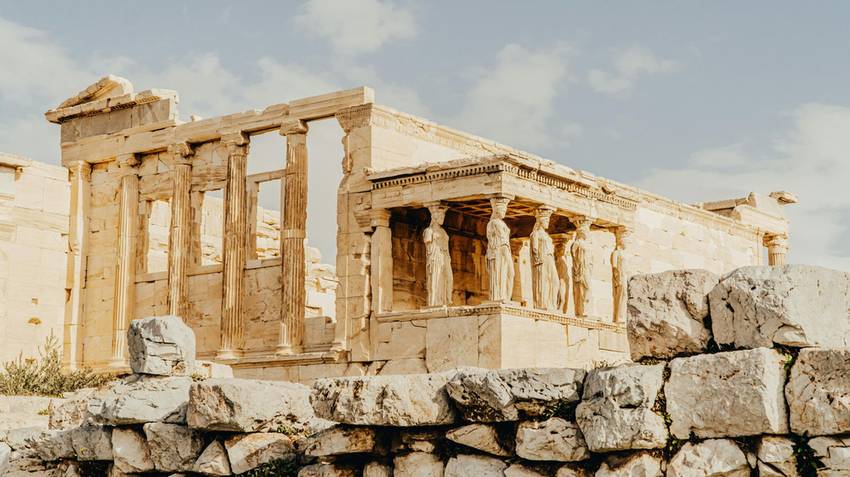
Athens is not an expensive city, but it has distinct price layers, and the gap between them is large enough to matter.
A budget travel guide to Athens is less about finding secrets and more about understanding which version of the city you are paying for at any given moment. The tourist corridor version costs roughly twice what the neighborhood version does, and they are sometimes separated by a single street.
In late spring, the city is at its most accessible: sites are fully open, the heat has not yet settled into the stone streets for the full day, and accommodation prices have not yet moved into summer territory.
Crowds are present but not at the level that compresses the main archaeological approaches into single-file queues by 10:00. That shift starts in June and is well established by July.
The practical question for most budget travelers is not whether Athens is affordable, because it generally is, but how to avoid consistently paying the higher rate without realizing it.
What the city actually costs across a normal day
The most reliable budget indicator in Athens is where you eat. A meal at a taverna two or three streets back from the main tourist arteries, the kind with laminated menus and a few plastic chairs outside, costs roughly a third of what the same dish costs in the restaurants immediately beside the Acropolis Museum or facing Monastiraki Square.
The food is not different in any meaningful way. The price is entirely about address.
Metro fares are low and fixed regardless of distance, which makes the transit cost across the city predictable. A single journey costs under two euros, and a five-day pass brings the daily cost down further if you plan to move around rather than concentrate in one area.
The airport line costs more and is priced separately, which catches some travelers on arrival.
Accommodation follows a similar pattern. Hostels and budget guesthouses in Exarchia, Metaxourgeio, or the quieter parts of Koukaki run notably cheaper than anything marketed toward the Acropolis-view bracket.
The difference in value is real: the cheaper neighborhoods are walkable to the main sites and have better local food options than the tourist-facing streets around Plaka.
The Acropolis combined ticket covers several archaeological sites and is valid for five days, which spreads the cost across a stay and represents the single clearest value decision for visitors.
Several museums have free admission windows on specific days of the week or month, worth checking before paying full price on a Tuesday afternoon.
How the walking load affects the budget math
Athens is a walking-heavy city, and the terrain is uneven in ways that matter for how you structure the day. The approach to the Acropolis involves a sustained climb over uneven stone, and the surrounding Plaka and Monastiraki lanes run on similar surfaces.
By the second day, most travelers have learned to plan the hill-heavy sections for the morning before the heat builds, and to save the flatter districts, the National Garden, the streets around Syntagma or Gazi, for later in the day.
This is relevant for budget planning because fatigue drives spontaneous spending. A long uphill morning without shade ends with someone sitting down at the nearest café, which in the tourist zones means paying considerably more than the coffee costs elsewhere.
The Filopappou hill viewpoints are free, but the walk back down on cobbles when it is 32 degrees is where many people end up at a terrace they had not planned to visit.
Planning walking routes around shade availability and surface quality is not just a comfort consideration; it is a practical cost-management strategy in a city where the hot-and-tired response is heavily monetized around the main attractions.
Travelers arriving in Athens for the first time often underestimate how much the city’s rhythm affects daily spending decisions.
The Athens first-time traveler guide breaks down how the city actually feels operationally once you are moving between neighborhoods, archaeological sites, late dinners, and the walking-heavy central districts — context that becomes surprisingly useful when trying to keep both energy and budget under control.
Which neighborhoods keep the budget intact
Exarchia sits north of the main tourist area and has a visible local life that operates largely independently of the visitor economy. Cafés here serve coffee at prices closer to what Athenians pay.
The square and the streets around it are active in the evening, filling with students, regulars, and the kind of social density that comes from people who actually live in the neighborhood.
It is louder at night than Koukaki, and the surrounding streets carry a specific political and cultural identity that some travelers find interesting and others find slightly disorienting. Either way, it is consistently cheaper.
Metaxourgeio is further west and has been changing in character over several years, with a mix of older local businesses and newer restaurants that sit in a price range between the tourist zone and the cheaper neighborhood cafés.
It suits travelers who want to be away from the main tourist pressure without fully leaving the central city.
Koukaki, immediately south of the Acropolis, is the other commonly cited budget-friendly option, though accommodation here runs slightly higher than the two neighborhoods above given its proximity to the main site.
The trade-off is a ten-minute walk to the Acropolis approach versus a metro ride from Exarchia. For a short stay focused on the main archaeological sites, Koukaki makes sense. For a longer stay or a slow-travel rhythm, the savings from Exarchia or Metaxourgeio compound quickly.
Travelers who find themselves weighing Athens against a longer Greece circuit, where the city is one stop among several, will find the Greece multi-city circuit read useful for thinking through how many nights Athens actually needs versus how many it tends to absorb by default.
When Athens fits a budget rhythm and when it pushes back
Late spring is the clearest window. May offers full site access, weather that allows morning archaeological visits without planning around midday heat, and accommodation prices that have not yet moved into the summer bracket.
The city’s rhythm in May still belongs partly to Athenians, who become less visible as summer tourism fully takes hold.
July and August work for travelers who want the full summer social energy, the busy squares, the outdoor cinemas, the evening promenade culture around the harbor neighborhoods.
But accommodation costs rise substantially, the walking-heavy tourist sections become genuinely demanding by 11:00, and the version of Athens available at budget prices in May is simply less accessible in peak summer. It is not impossible, but the margins narrow and the effort required to stay within them increases.
September partially recovers the shoulder-season balance, with lower prices than August, manageable heat, and sites that remain fully open. The shift from summer to autumn happens quickly in Athens; by late September the evenings are noticeably cooler and the outdoor dining culture that defines the summer months starts to thin.
For travelers considering whether Athens fits alongside a slower, more coastal stay, the rhythm comparison shifts considerably once you move to the islands.
The Thessaloniki first-visit read sits on a different register entirely, slower by default and cheaper than Athens across most categories, which makes it a natural pairing for a longer Greece trip with a more varied pace.
The tourist pricing layer and how to move around it
The price differential in Athens is spatial and predictable. Within roughly 200 to 300 meters of the Acropolis Museum, the Agora, and Monastiraki Square, most food and drink prices are calibrated for visitors rather than residents.
The restaurants are not necessarily worse, but the value proposition changes. A Greek salad and a carafe of wine at 19:00 two streets into a residential lane behind Monastiraki will cost less than the same order at a terrace with a view of the flea market.
The flea market itself, which runs daily around Monastiraki but peaks on Sunday mornings, is one of the few contexts in the tourist zone where the pricing is genuinely inconsistent, with vendors at different price points operating within meters of each other. It rewards patience and a willingness to walk the full length before committing to anything.
Street food around Monastiraki, specifically the souvlaki counters that have operated in the same spots for years, represents one of the clearest value points in the entire tourist corridor. The lines at lunch confirm it. A souvlaki wrap from one of the established counters costs a fraction of a sit-down meal nearby and is what many Athenians eat for the same meal.
Budget travelers who want a benchmark for another Southern European city with a different urban scale might find the Naples first-time guide a useful reference point, since both cities share a similar price structure where address drives cost more than category.
Who this version of Athens suits
Athens on a budget works best for travelers who are comfortable navigating a dense urban environment with some planning effort. The city does not require expensive choices, but it does reward knowing where the price layers shift.
Travelers who arrive without that orientation and eat three meals a day in the Monastiraki-Plaka zone will spend significantly more than someone who takes thirty minutes to locate a neighborhood taverna and a local coffee spot.
It suits slow travelers who are willing to stay five to seven days and learn the city’s geography by walking rather than taking taxis between highlights. The return on investment from that kind of stay is high: once the neighborhood rhythm is established, daily costs drop and the city becomes easier to navigate without constantly checking maps or defaulting to the nearest obvious option.
Solo travelers and couples manage the budget calculus more cleanly than groups, since restaurant portions and shared dishes are designed for two and the taverna culture rewards staying at a table longer rather than turning over quickly.
Families with young children will find the city manageable but tiring given the terrain load, and the afternoon heat in summer changes the calculus considerably when factoring in how much walking is actually required.
Athens as a budget destination: the fit logic
A budget travel guide to Athens ultimately describes a city where the gap between the expensive version and the affordable version is entirely navigable, but requires a small amount of spatial awareness.
The infrastructure for low-cost travel is there, from the metro pricing to the neighborhood tavernas to the combined archaeological ticket, and it works reliably for travelers who engage with it.
The city fits best in spring and early autumn, when the walking demand is manageable and accommodation prices sit below their summer ceiling. In those windows, Athens is genuinely accessible for travelers on careful budgets without requiring the kind of aggressive optimization that drains the pleasure from a trip.
The archaeology, the food, the evening street life that starts properly after 20:00, and the views from the free hill paths all sit within reach. The version of Athens that costs significantly more is mostly optional and mostly geographically concentrated around the main tourist approaches.
For travelers whose budget instinct runs toward slower, lower-density destinations after Athens, a few days in a place like Thessaloniki or a northern Greece base changes the rhythm considerably without requiring a different country.
Budget travel in Athens: common questions
1. How much does a day in Athens cost on a budget?
A realistic budget day in Athens runs roughly 50 to 70 euros for one person, covering accommodation in a mid-range hostel or budget guesthouse, meals at tavernas away from the main tourist streets, metro transport, and one paid site. The Acropolis combined ticket covers several major sites and spreads the cost across two or three days of exploration.
2. Which Athens neighborhoods are cheapest to stay in?
Exarchia and Metaxourgeio consistently offer lower accommodation prices than Monastiraki or Plaka. Both sit within walking distance of the metro and have their own food scene, which reduces the pressure to eat near the tourist corridors where prices are noticeably higher.
3. Is Athens expensive compared to other Southern European cities?
Athens sits below Lisbon, Barcelona, and Rome on most budget traveler comparisons. Food at neighborhood tavernas, metro fares, and accommodation in non-central areas remain accessible. The main cost escalation comes from eating and drinking in the immediate vicinity of the Acropolis and Monastiraki Square.
4. When is the best time to visit Athens on a budget?
May and early June offer the strongest balance of weather, open sites, and manageable prices before peak summer rates take hold. September is a strong second window. July and August push accommodation costs up considerably, and the heat makes the walking-heavy parts of the city significantly more demanding.
5. Can you visit the main Athens sites for free or cheap?
The combined Acropolis ticket covers the main archaeological sites and is valid for five days, which makes it reasonable value spread across a stay. Several museums offer free admission on specific days, and the Roman Agora, Kerameikos, and the hill viewpoints accessible from Filopappou require either a low fee or nothing at all.