
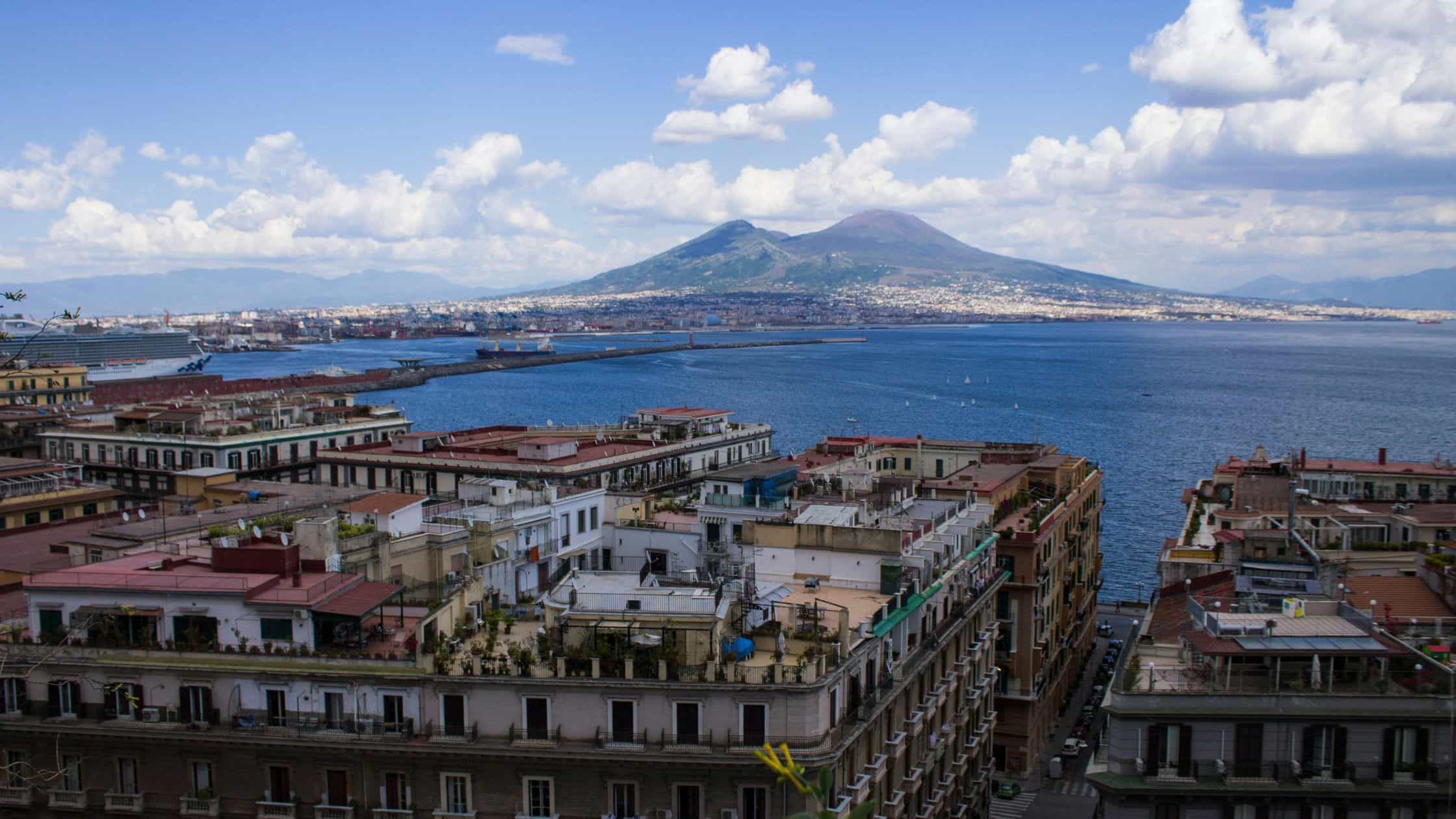
Naples is one of those cities that people talk about in superlatives before they arrive, and then find completely different once they are actually standing in it. The chaos is real, so is the pleasure.
A first-time traveler guide to Naples is useful precisely because the city does not meet expectations – it replaces them with something harder to describe and easier to feel.
It is loud in a specific way: not the noise of traffic management failure, but the noise of a city that still conducts large portions of daily life in public. Arguments, laughter, scooters, conversations between balconies. The streets in the historic centre narrow enough that sound bounces. You notice this within the first hour.
Spring is a good time to arrive for the first time. The light is generous, the evenings are warm enough to sit outside past nine, and the city has not yet shifted into its high-summer mode, where temperatures climb past thirty-five and the Amalfi Coast day-trip coaches start backing up on the waterfront.
What Naples is like for first-time visitors
The train station drops you into Piazza Garibaldi, which is not a flattering introduction. It is busy, somewhat disorienting, and has the particular energy of a transport hub that has been under intermittent renovation for longer than anyone can clearly remember. Most first-time visitors find their bearings quickly enough once they move two or three streets north or west into the Decumani, the ancient grid of the historic centre.
The transition happens fast. Within ten minutes of leaving the station district, you are likely standing in front of a church that nobody is making a fuss about, next to a bar where an espresso costs less than a euro, in a street that smells of pastry and exhaust in roughly equal measure. That is the baseline.
The centro storico is a UNESCO World Heritage site, which matters slightly less here than it might elsewhere, because the city does not perform its own history for visitors. The ancient street plan is simply where people live and work.
The Greek foundations of the city sit beneath it. The narrow streets – Spaccanapoli being the most famous, running straight across the entire lower centre – were not designed for tourism but for a city that has been continuously inhabited for nearly three thousand years. They function accordingly.
Accommodation near the centre puts you within walking distance of most things that matter. The Quartieri Spagnoli, on the western side of the historic grid, is denser and quieter at street level once you step one block off the main routes. Chiaia, further south toward the seafront, is considerably calmer and slightly more expensive, with a neighbourhood feeling that suits travelers who want something less stimulating at the end of the day.
Is Naples right for your travel style?
Naples works well for travelers who do not require a managed experience. If you are comfortable navigating by feel rather than by itinerary, and if you find pleasure in a city that is operating at full volume regardless of whether you are watching, Naples delivers something that more orderly destinations cannot.
It also works for travelers who eat seriously. The food here is not a tourism product, it is a daily civic institution. Pizza is cheaper, better, and more seriously regarded than almost anywhere else in Europe. The fried food at street level (frittatine di pasta, cuoppo di mare, zeppole) follows the same logic.
Markets are functioning markets, not styled-for-photographs ones. The city is harder for travelers who need visual coherence, low ambient stimulation, or a clear separation between tourist infrastructure and everyday life. Those things do not really exist here.
The historic centre has a density and a sensory load that some people find energising and others find genuinely exhausting by day three. If the second category sounds like you, Naples still works – it just works better as a three-day stop than as a week-long base. Solo female travelers often find Naples more manageable than the reputation suggests. Attention on the street exists, as it does in most southern Italian cities, but it is rarely aggressive.
Staying near Chiaia or the Quartieri Spagnoli gives better options after dark than areas closer to the station. Travelers comparing this with other Mediterranean cities of a similar reputation – Palermo, Thessaloniki, parts of Athens – often find Naples in the middle range of that comparison, not at the extreme end.
How to get around Naples and plan day trips
Mornings in Naples start late by northern European standards. Bars open early, but the city does not really fill up until nine or ten. If you are somewhere close to the centre, the first espresso and sfogliatella at a bar counter sets the tone for the day in a way that sitting down for breakfast never quite does.
Pastry consumption is a social act here, brief and counter-standing. The metro system has two functioning lines for most visitor purposes. Line 1 connects the station area through the centre toward Vomero and Chiaia. It is reasonably reliable and the stations are notable in themselves – several of them are designed by major architects and worth the stop. Line 2 handles the coast toward Pozzuoli and the Campi Flegrei.
Taxis exist but traffic in the centre makes them useful mainly for airport runs and late-night returns. Walking is the primary mode for anything within the historic centre. The distance from Spaccanapoli to the seafront at Castel dell’Ovo is around twenty-five minutes on foot, more if you stop, which you will.
The Quartieri Spagnoli is about ten minutes west of the cathedral. Vomero, the quieter residential hill above the centre, is reachable by funicular in five minutes and feels like a different city in terms of pace and sound level. Day trips to Pompeii leave from Circumvesuviana trains at Piazza Garibaldi. The journey takes around thirty-five minutes and the trains run frequently in the morning.
<div data-gyg-href=”https://widget.getyourguide.com/default/availability.frame” data-gyg-tour-id=”937692″ data-gyg-locale-code=”en-US” data-gyg-currency=”EUR” data-gyg-widget=”availability” data-gyg-variant=”horizontal” data-gyg-partner-id=”YPWSEKK”><span>Powered by <a target=”_blank” rel=”sponsored” href=”https://www.getyourguide.com/naples-l162/”>GetYourGuide</a></span></div>
Going early is not optional in summer, the site becomes crowded and very hot by midday, and kitchens at the nearby restaurants close before most northern European travelers consider eating lunch. Spring timing is more forgiving but the same principle applies.
The Amalfi Coast is reachable by ferry from the Molo Beverello dock near the waterfront. This is a better option than the coastal road, which is narrow, slow, and shared with every coach in the region during peak season. Ferries run to Positano and Amalfi directly in spring and summer, with morning departures and afternoon returns. The crossing takes around an hour to ninety minutes depending on the stop.
Where to eat and go out in Naples
Lunch is more important here than dinner in terms of food quality per euro spent. Most locals eat their main meal between one and three, and restaurants operating inside that window are cooking for regulars, not tourists.
A three-course lunch with house wine in a trattoria in the Quartieri Spagnoli or near Piazza Bellini tends to cost less than twenty euros. Dinner service starts around seven-thirty but the tables fill properly after eight-thirty. Restaurants near the tourist corridors on Spaccanapoli will turn earlier, but those are not the ones worth sitting in for a meal.
The better options are usually a street or two removed from the obvious walking routes, and they tend not to display laminated menus with photographs. The city’s evening social life concentrates in a few areas depending on the crowd: Piazza Bellini and the surrounding streets for a younger, louder mix; Chiaia and Piazza dei Martiri for something calmer and less student-oriented.
The waterfront at Mergellina gets busy on summer evenings with people eating gelato and not particularly doing anything else, which is its own legitimate use of time. Bars close when they close, which in the centro storico means somewhere between midnight and considerably later. This is not a city with uniform closing times.
If quiet evenings matter more than access to the historic centre, the neighborhood-level read for an alternative base is worth considering, travelers who found Rome’s Trastevere too loud after two nights sometimes look for a Naples equivalent in Chiaia or Vomero and are not disappointed.
Naples vs other cities in southern Italy
The natural circuit from Naples runs south and east: the Amalfi Coast and the Cilento for coastal slowdown, Matera for something almost entirely different in terms of pace and landscape, Sicily if the trip extends further. Naples is not a city you pass through, it takes at least a couple of days before it starts to make sense, but it is also not the logical ending point of a longer Italian trip for everyone.
Travelers coming from Rome often find Naples requires a recalibration. Rome is chaotic in its own way, but it has a tourist infrastructure that absorbs visitors cleanly. Naples does not absorb in the same way – it simply continues doing what it does and leaves the visitor to find their position within that. For some travelers, that is exactly the appeal. For others, three days here before heading back north to Rome’s slightly more managed atmosphere is a useful decompression structure.
If you are weighing Naples against a slower southern alternative, the first-time guide to Malaga covers a city with a similar Mediterranean rhythm but significantly lower ambient intensity – useful if you are trying to calibrate how much stimulation your current trip can absorb.
For travelers considering a comparable multi-city southern loop on a different coast, the Greece circuit read works through a similar logic of sequencing dense and quieter stops.
Naples travel costs and daily budget
Budget structure in Naples is relatively forgiving by Italian standards. Accommodation in the centro storico ranges considerably depending on how close you want to be to the action and how much quiet you need at night and food is genuinely cheap if you eat where locals eat. The main cost inflations come from ferry tickets to the coast in peak season and from any accommodation with a view, which commands a premium that the view may or may not justify.
If you are still deciding how Naples fits into a broader Italy trip, the Florence budget travel read lays out a useful counterpoint, a city with a slower intake curve and a more contained historic centre, which some first-time Italy travelers find easier to sequence before or after Naples.
Naples first-time visitor FAQ
1. Is Naples a good destination for first-time visitors to Italy?
Naples works well for first-time visitors who want something less polished and more immediate than Rome or Florence. The city has a steep learning curve, especially around navigation and neighbourhood orientation, but most travelers adjust within a day or two. If you are arriving directly from a northern Italian city, the shift in pace and atmosphere is significant.
2. How many days do you need in Naples as a first-time visitor?
Three to four days is a reasonable base. The first day is largely orientation. By day two most travelers have found their rhythm around meals, the historic centre, and basic movement. A fourth day lets you reach Pompeii or the Campi Flegrei without feeling rushed. Anything shorter tends to feel incomplete.
3. Is Naples safe for solo travelers?
Naples has a reputation that outpaces its current reality. The historic centre and Chiaia are generally fine for solo travel, including solo women, provided standard city caution applies: keep your phone in a pocket rather than in your hand, stay aware on the quieter side streets at night, and avoid the area immediately around Piazza Garibaldi after dark if you are unfamiliar with it.
4. What is the best time of year to visit Naples for the first time?
April through June and September through October offer the most manageable conditions. Summer is very hot, the city fills with Italian domestic tourists and international visitors, and the Amalfi day trips become crowded and slow. Spring gives you warm evenings, lighter crowds, and a city that feels properly in motion without the high-season pressure.
5. Do you need to speak Italian to get around Naples?
Not fluently, but a few phrases help more than in Rome or Milan. English is less widely spoken, particularly outside restaurants and hotels that cater to tourists. A translation app covers most practical situations, but locals tend to respond warmly when you try even a phrase or two in Italian rather than defaulting immediately to English.