
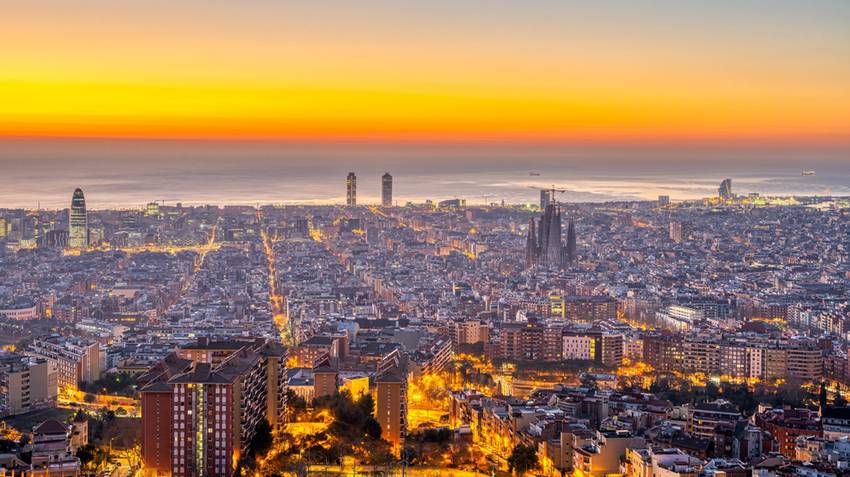
Barcelona is the city most people picture when they think about Spain for the first time, and the expectation is rarely wrong in the way that expectations usually are. The architecture exists, the seafront exists, the food and the late evenings exist and what surprises most first-time visitors is the scale of it, and how much the city rewards slowing down rather than covering ground.
This is a large, physically complex city with several distinct rhythms running in parallel. Understanding which one you are actually entering and when changes the experience considerably.
What Barcelona actually feels like to arrive in
The Aerobus drops you at Plaça Catalunya in around 35 minutes from El Prat, fare flat and reliable, and the first thing most people notice is that the city does not start gently. The square is large and open, the streets immediately around it are wide, and the noise level is already significant by mid-morning. That is not a warning – it is just the register Barcelona operates in.
The Eixample grid, which covers much of the central city, is genuinely easier to navigate than it looks. Blocks are consistent, corners are chamfered (those cut diagonal edges are Cerdà’s doing, not decoration), and addresses follow a logical pattern once you orient yourself to the sea.
Walking distances feel manageable on a map and are manageable in practice, at least for the first few days. By day three or four, most people have quietly added up 14 or 15 kilometers without realizing it.
The old city – the Gothic Quarter and El Born operates differently. Streets narrow to the point where two people with bags struggle to pass, the ground is uneven stone, and navigation by phone becomes unreliable in the deeper alleys. The orientation logic there is essentially: downhill means sea, uphill means the cathedral. Everything else is approximate.
Who Barcelona fits and who it does not
The city suits people who want density of experience without having to manufacture it. Things happen here without much effort on the traveler’s part: a market you wander into, a terrace that extends an hour into the evening, a neighborhood that shifts character between afternoon and night. That kind of passive richness is the city’s strongest quality.
It works particularly well for travelers who are comfortable with a moderate amount of sensory load – street noise, terrace crowds, uneven pavements, the Metro at rush hour. The city is not aggressive, but it is consistently active, and that does not let up much even in residential areas like Gràcia, where the main squares fill up most evenings from around 20:00 onward.
It is a harder fit for people who need quietness as a baseline, or who travel better in cities where the tourist layer and the residential layer are more separated. In the Gothic Quarter and along Las Ramblas, those two layers are fully merged, and there is no period of the day when the visitor economy is not the dominant presence. Two streets back from the Ramblas, the ratio shifts quickly, but that proximity is always there.
Slow travelers and remote workers who have been to the city before often find a week or two in the Eixample or Poble Sec surprisingly workable good cafés, consistent transit, a neighborhood structure that makes ordinary days feel coherent. For a first visit, though, five days is probably the right duration before the city starts feeling like it is asking something of you rather than giving something to you.
How movement works across the city
The Metro is the backbone of most itineraries. Eight lines, clear colour coding, consistent signage in Catalan and Spanish (and usually English at major stations). The main orientation nodes are Passeig de Gràcia – where Lines 2, 3, and 4 cross and Diagonal, which handles transfers between the upper and lower halves of the Eixample. For first-time visitors, those two stations remove most of the confusion from the network.
The T-Casual card (10 trips, intermodal) covers Metro, bus, and the FGC suburban trains toward Tibidabo or Montserrat, and is worth buying on arrival rather than single-faring it. Line 3 (green) runs the spine of the tourist axis from Zona Universitària down through the Eixample to the Old City and Barceloneta, so many first-time visitors end up using it heavily by default.
Walking is viable between most central points, though the map consistently lies about effort. The distance from the Gothic Quarter to Sagrada Família is around 25 minutes on foot across flat grid streets, which is accurate.
The distance from Barceloneta up to Parc Güell is also only around 4 kilometers, but involves a sustained uphill gradient through Gràcia that most people underestimate until they are halfway through it. The bus (line 116 from Alfons X Metro station) solves that climb entirely.
Montjuïc deserves its own note: the hill is accessible by cable car from Paral·lel Metro, by funicular from the same station, or on foot via a long stair-heavy route from the port. The walk back down, especially in summer heat, costs more than most people budget for it. Taking the funicular up and cable car across to the port, or reversing that sequence, is a more manageable approach.
The tradeoffs worth knowing before you commit
Summer in Barcelona is loud, warm, and very full. July and August bring the highest visitor volumes, and the beach at Barceloneta shifts from pleasant to genuinely crowded by mid-morning on any clear day. The sand fills methodically from the access points outward, so arriving before 10:00 or shifting toward an evening swim (the water stays warm and the beach thins considerably after 19:00) both work as adjustments.
The evening beach promenade in summer – Barceloneta to the Fòrum, or even just the stretch toward Port Olímpic – is one of the city’s better experiences precisely because the crowd changes character at that hour: fewer day-trippers, more locals, the city’s own rhythm reasserting itself.
Las Ramblas is worth one deliberate walk, preferably in the morning before 10:00 when the light is better and the pedestrian density is still manageable. As a place to linger or eat, it has long since been absorbed entirely by the visitor economy. The cafés either side of it charge a premium for mediocre food in a setting designed for throughput. Nobody eats on the Ramblas more than once.
Pickpocketing is consistent enough to be mentioned plainly rather than as a footnote. The Metro (particularly Line 3 at Liceu and Drassanes stops), Las Ramblas, and the area around La Boqueria market are the main vectors. A crossbody bag worn in front and a phone kept in a front pocket rather than used openly while walking are sufficient precautions for most travelers.
The noise in the Old City at night is a genuine consideration for accommodation. Streets that look quiet on a map are often directly above bar terraces or on routes between nightlife areas, and stone buildings carry sound well. The Eixample is calmer by midnight, which is one reason it tends to work better as a base for travelers who are not primarily in the city for nightlife.
Where you stay changes Barcelona more than many first-time visitors expect. The difference between the Gothic Quarter, Eixample, Gràcia, or Poblenou is not just aesthetic but physical and behavioral: noise levels, walking load, late-evening density, and even how quickly the city becomes tiring all shift noticeably by neighborhood. The Barcelona neighborhood guide breaks down which areas actually fit different pacing styles and traveler types.
Travelers weighing Barcelona against a slower coastal option or wondering whether a week in Spain works better split between two cities often find the Madrid vs. Barcelona traveler-fit read useful at that decision point, since the two cities differ more in rhythm and character than their geographic proximity suggests.
Seasonal timing and what it changes
Spring is the sharpest entry point for a first visit. May in Barcelona means warm afternoons (typically 20-24°C), outdoor terraces operating at full capacity, and the city’s architectural density at its most walkable long evenings, light until past 21:00, no requirement to plan around midday heat. The crowds are present but not at their July peak, and venues are fully open without the reduced-hours unpredictability of early spring.
September recovers the same quality after the summer peak passes. The sea temperature is at its annual high, the city returns slightly to its own rhythm after August, and the light in late afternoon has a different character than summer longer shadows, more contrast, a noticeable shift in the city’s social energy toward something slightly more local in composition.
Winter is underused and has genuine advantages for a certain kind of visit. December through February is quiet by Barcelona standards, with temperatures that rarely drop below 8-10°C at night and daytime windows that are frequently clear and mild. Museums, markets, and the architecture operate without crowds.
The seafront is cold and empty, which is either an advantage or a dealbreaker depending on why you came. For anyone whose Spain trip is primarily about the city rather than the beach, the winter version of Barcelona is considerably more accessible and significantly less expensive.
If the coastal rhythm is part of what draws you to the region, the Spain city beach access read breaks down how Barceloneta sits relative to other urban beach options along the coast useful context if you are deciding whether to anchor in the city or position differently.
How Barcelona sits within a broader Spain itinerary
Barcelona is a logical entry point for Spain precisely because it is not representative of the country. It has its own language (Catalan), its own architectural tradition, its own relationship to the sea, and a civic identity that resists being flattened into a generic “Spanish city” experience. Understanding that at the outset helps calibrate what follows.
From Barcelona, the natural continuations within Spain split cleanly. Madrid is 2.5 hours by AVE high-speed rail and offers a genuinely different urban register landlocked, denser in its nightlife structure, less visually coherent but arguably more socially open.
Valencia is 1.5 hours south and provides a lower-intensity coastal alternative that tends to suit people who find Barcelona slightly too activated. Seville sits further out but anchors a very different part of Spain’s character more architecturally Moorish, more extreme in summer heat, and with a slower social metabolism than either coastal city.
For first-time visitors building an itinerary around Spain rather than just Barcelona, the Seville first-visit read covers the pacing and traveler-fit logic for the south, which requires a different set of expectations than the northeast.
Barcelona as a first experience of Spain
For most travelers arriving in Spain for the first time, Barcelona delivers on the expectation in the ways that matter: the architecture is genuinely singular, the food culture rewards engagement at almost any budget, and the city’s physical layout sea on one side, hills behind, a grid in between gives it a legibility that larger cities often lack. The complications are real but mostly manageable with timing and modest preparation.
It is not a city that requires experience to enjoy; it rewards experience to enjoy more deeply. A first visit that moves at a sustainable pace, stays alert to the neighborhood-level texture beyond the main corridors, and does not try to do everything will leave most travelers with the specific kind of satisfaction that comes from having understood a place rather than simply covered it.
Spain as a first destination makes sense here precisely because Barcelona’s density of offer is high enough to justify the trip on its own, while its transport connections keep the rest of the country accessible when the impulse to continue arrives.
Frequently asked questions about visiting Barcelona for the first time
1. When is the best time to visit Barcelona for the first time?
Late April through June and September through October tend to work best for first-time visitors. The city is fully operational, temperatures are comfortable for walking, and crowd pressure is lower than July and August. Summer remains popular and energetic, but the heat and visitor volume require more deliberate pacing.
2. How many days do you need in Barcelona on a first visit?
Four to five days gives enough time to cover the main architecture, settle into the neighborhood rhythm, and take at least one slower day without feeling rushed. Three days is workable but leaves little room for the kind of unhurried afternoon that makes the city feel real rather than ticked off.
3. Is Barcelona safe for solo travelers?
Barcelona is generally safe, but pickpocketing is a consistent issue on Las Ramblas, on the Metro (particularly lines 3 and 5 at busy transfer points), and near major monuments. A crossbody bag kept in front, phone awareness on crowded streets, and avoiding the Ramblas late at night cover most of the practical risk.
4. What neighborhood should first-time visitors stay in?
The Eixample works well for most first-time visitors: central, flat, well-connected by metro, and close to the Modernista architecture without the noise concentration of the Gothic Quarter. Gràcia suits travelers who want a quieter residential feel with good transport links back into the center.
5. Is Barcelona worth visiting if you have already been to Madrid?
The two cities have distinct rhythms and very different physical characters. Madrid is denser, more nocturnal, and landlocked; Barcelona is more horizontal, has the seafront as a genuine part of daily life, and its architecture gives the city a visual coherence that Madrid does not. Travelers who have done Madrid and want a different energy profile in Spain will find Barcelona genuinely different rather than redundant.