
The question of Florence vs Venice comes up early in most Italy trips, often because travelers sense they are genuinely different experiences rather than interchangeable stops on the same route.
They are. The choice is less about which city is better and more about which one fits the kind of trip you are actually planning. Both are dense with art, history, and narrow stone streets. Both get genuinely crowded from June onwards. But the rhythm of each city, how they wear on the body over several days, and who feels at ease in them differs in ways that matter before you book anything.
What Florence is like for visitors
Florence is a city you can read. The center is compact, the grid is roughly logical, and most of what you came to see sits within a 30-minute walk from almost anywhere inside the historic core. That legibility is part of its appeal, and also part of why it fills quickly.
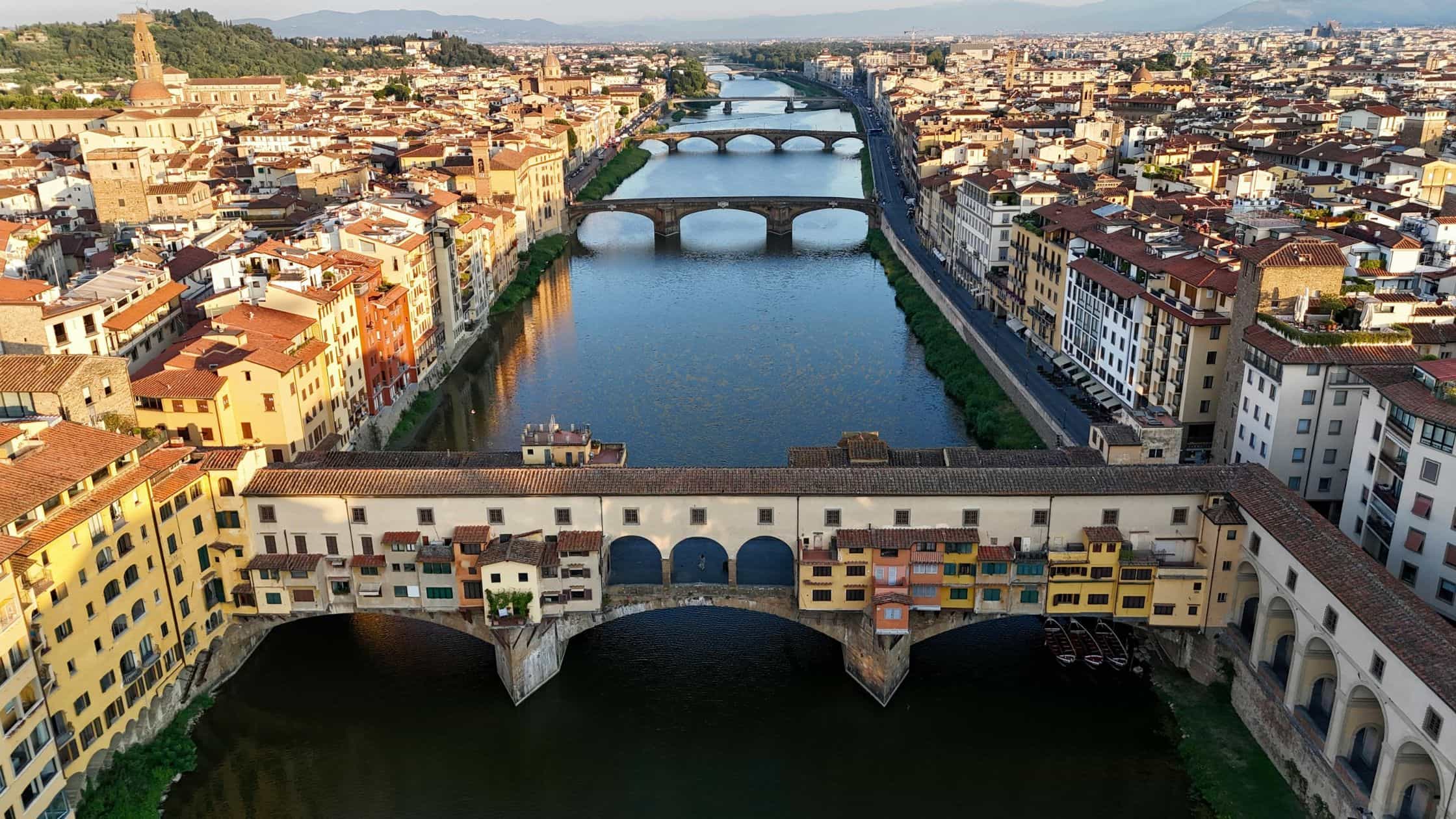
The main corridors, around the Duomo, along Via dei Calzaiuoli, and across Ponte Vecchio, are fully occupied by mid-morning in late spring and summer. Ponte Vecchio itself narrows to a single shuffling lane in both directions by 11:00 on a clear morning.
If you plan to cross it, you cross it before 09:30 or after 19:00, when the jewellery shops are shuttered and the foot traffic thins to something manageable.
Away from those corridors, though, the city changes register quickly. The Oltrarno neighborhood, south of the Arno, runs at a noticeably lower pitch even in high season.
Piazza Santo Spirito stays local in a way that Piazza della Repubblica never quite does. Two streets off the main tourist axis in most directions, Florence starts to feel like a city where people actually live, which is not something you can say about as much of the historic center as you might hope.
The walking load accumulates. The streets are flat by Italian standards, but the stone surfaces are uneven, the pavements are narrow, and a full day of sightseeing in Florence leaves most people tired in a way that a 20,000-step count on a softer surface would not.
By day two, slower mornings and a longer lunch stop start making more sense than they did on arrival.
What Venice is like for visitors
Venice operates on a logic that has no equivalent in other Italian cities. There are no cars, no taxis, no trams. Movement is either on foot or by water, and the walking routes require constant micro-decisions at canal crossings.
After a day or two, most people develop a rough instinct for the layout, but the city consistently surprises even returning visitors with dead ends and bridges that are not where you expect them to be.
The physical effort in Venice is specific. It is not about distance but about verticality, repeated in small doses. Every canal crossing involves steps up and over a bridge, usually with a slight camber on the descent.
This is fine for a morning, unremarkable for an afternoon, and genuinely tiring by the end of day three if you are pulling luggage or have any issue with knees.
Suitcases with wheels become a liability rather than a convenience; the standard advice to use a soft bag is practical, not aesthetic.
The reward for accepting that friction is an atmosphere that has no real comparison. Early mornings in the smaller sestieri, before the vaporetti start running at full frequency and before the day-trippers arrive from the mainland, feel different from anywhere else in Italy. The sound carries differently on water.
The quality of light in the hours after sunrise is one of those things that photographs try to capture and mostly fail at. Arriving the evening before and staying overnight, rather than doing Venice as a long day-trip, is the difference between experiencing the city and auditing it.
The route from Santa Lucia station to Piazza San Marco through the Rialto is Venice’s equivalent of Florence’s central corridor: fully occupied by 10:00 in summer, moving slowly by 11:30.
The key difference is that in Venice there are very few obvious alternatives to that route, while in Florence there are several. Travelers who find crowded corridors draining tend to find Venice harder to manage than Florence, even if they find it more memorable.
Florence or Venice: which city suits your travel style?
Florence works well for travelers who want to move through a lot of art and architecture across several days without logistical complexity.
It suits first visits to Italy, couples who want a base with good dining and neighborhood variety, and anyone who needs a city that functions predictably.
The apartment rental market is wide, neighborhoods like San Niccolò or Santa Croce offer quieter evenings than the center, and a week here rarely feels like a week in the same place.
It also suits remote workers more naturally than Venice does. Cafés with working conditions exist, the rhythm supports a longer stay without constant movement, and the city does not demand the same physical output from you every day.
The Florence budget travel read covers what that longer stay actually costs, which matters more over five nights than over two.
Venice suits travelers who are willing to trade comfort and predictability for an experience that is genuinely unlike anything else.
It works for people who can pack light, accept higher prices without resentment, and find the physical complexity of the city interesting rather than frustrating.
Short stays of two or three nights tend to work better than longer ones for most travelers, not because Venice loses its appeal but because the logistics of daily life, doing laundry, buying groceries, finding a quiet place to sit in the afternoon, add up in ways that a shorter stay simply absorbs.
Travelers weighing Venice against other northern Italian cities sometimes find the Venice vs. Milan comparison clarifies a different kind of tradeoff, particularly around livability and urban rhythm over multiple days.
Best time to visit Florence and Venice
Both cities in June through August are operating at full capacity, with the main difference being that Venice has less physical room to absorb the volume.
The route through the Rialto on a July morning is one of the more uncomfortable experiences in Italian tourism, not because it is dangerous but because narrow calli with no shade and slow-moving foot traffic in 32-degree heat accumulate into something genuinely draining.
Florence in the same conditions is also busy, but its squares are larger and some relief exists.
May is currently one of the better windows for both cities. Days are long, temperatures are comfortable for walking, and the main corridors have not yet reached their summer peak.
The light in late afternoon is particularly good in Florence from April through June, when the sun angles across the Arno from the west and the city’s particular colour palette shows itself at its clearest.
September holds well, though it stays warm into mid-month in both cities, and the tourist volume does not drop sharply until after the Italian school year begins in mid-September.
October is quieter but brings shorter days and unpredictable rain; by late October, Venice occasionally experiences acqua alta, the tidal flooding that temporarily raises water levels across parts of the city.
Passarelle, the raised walkways, go out quickly and the system is manageable, but it is worth knowing before you pack only leather-soled shoes.
Can you combine Florence and Venice in one trip?
The high-speed train between Florence and Venice runs in roughly two hours, which makes a split itinerary straightforward. The most common structure is three nights in one city and two in the other, with Florence usually taking the longer portion because it supports a slower pace more easily.
Arriving in Venice by train rather than by road removes one layer of logistical friction. The station at Santa Lucia deposits you directly onto the Grand Canal, and from there the vaporetto takes you toward your accommodation without any need for car hire, parking, or the
Piazzale Roma chaos, it is one of the better arrival experiences in European train travel, which is a reasonable thing to factor into planning.
For travelers who find themselves drawn to adding Rome to the same trip, the Rome neighborhood selection read covers the question of where to base yourself, which becomes more consequential the shorter your stay is.
A circuit of three Italian cities in ten days is common, though it compresses each place in a way that suits some travelers and exhausts others.
Florence vs Venice: key travel
The core question when choosing between Florence and Venice is not which city is more worth seeing. It is which version of difficulty you prefer. Florence asks you to navigate crowds on its main corridors and accept that its most famous spaces rarely feel uncrowded.
Venice asks you to accept physical effort, higher costs, and a layout that requires constant re-orientation.
Florence rewards travelers who want to move efficiently through a dense cultural program and still find pockets of local life within easy reach.
Travelers who find themselves wanting something less controlled and more physically alive than either Florence or Venice often respond strongly to Naples instead. The contrast is immediate once you arrive: Florence organizes itself around art and walkability, Venice around atmosphere and spatial disorientation, while Naples operates through street energy, noise, and a much heavier public-life intensity. The Naples first-time traveler guide maps that southern shift clearly.
Venice rewards travelers who slow down enough to let the city’s logic come to them, who stay overnight rather than arriving on a morning train, and who treat the physical complexity as part of the experience rather than an inconvenience to manage.
Neither city is wrong. The Florence vs Venice decision usually resolves itself once you are honest about which kind of friction you find interesting and which kind you find tiring.
How to choose between Florence and Venice
Florence vs Venice as a choice tends to simplify once you apply a few honest filters. If you are traveling with a lot of luggage, have limited mobility, or find disorientation in unfamiliar cities stressful rather than interesting, Florence is the more straightforward choice.
If you have traveled in Italy before, can pack light, and are specifically curious about Venice’s particular urban form rather than treating it as one more Italian stop, then Venice earns its own trip.
If the honest answer is that you want to see both, the two-hour train connection makes that possible without requiring any compromise on the quality of time in either city.
Three nights in Florence followed by two in Venice, or the reverse, gives each place enough time to show something beyond its first impression, which is when both of them become genuinely rewarding.
Florence vs Venice: questions travelers ask
1. Which is better for a first visit, Florence or Venice?
Florence tends to be more legible for first-time visitors. The street grid is easier to navigate, accommodation options are wider, and you can build a base in a neighborhood that suits your pace. Venice rewards a first visit too, but it requires accepting more physical effort, higher costs, and a more disorienting layout from the start.
2. Is Venice worth visiting if you only have two days?
Yes, though two days in Venice works best if you treat it as an immersive stay rather than a checklist. Arrive in the evening, stay overnight so the crowds thin, and explore early morning before the main routes fill. A day-trip version of Venice is the least rewarding way to experience it.
3. Is Florence or Venice better in summer?
Both cities reach peak pressure in July and August. Venice can feel particularly enclosed in summer heat, with narrow alleys trapping warmth and the main route from the station to San Marco becoming very busy by mid-morning. Florence has more open squares and slightly more breathing room, though its museum queues are longer. May and September are significantly more comfortable in both.
4. Which city is easier for slow travelers or remote workers?
Florence fits slow travel and remote work more readily. It has a wider range of apartment rentals, more neighborhood variety, and a rhythm that supports a longer stay without constant movement. Venice can work for slow travel too, but the logistics of daily life, groceries, getting around, noise, add friction that suits shorter stays better.
5. Can you combine Florence and Venice in one trip?
Yes, and many travelers do. The high-speed train between the two cities takes around two hours, making a split itinerary practical. A common structure is three nights in Florence and two nights in Venice, or vice versa depending on your priorities. Avoid trying to day-trip between them; the journey is comfortable but a same-day return leaves too little time in Venice to justify the effort.