
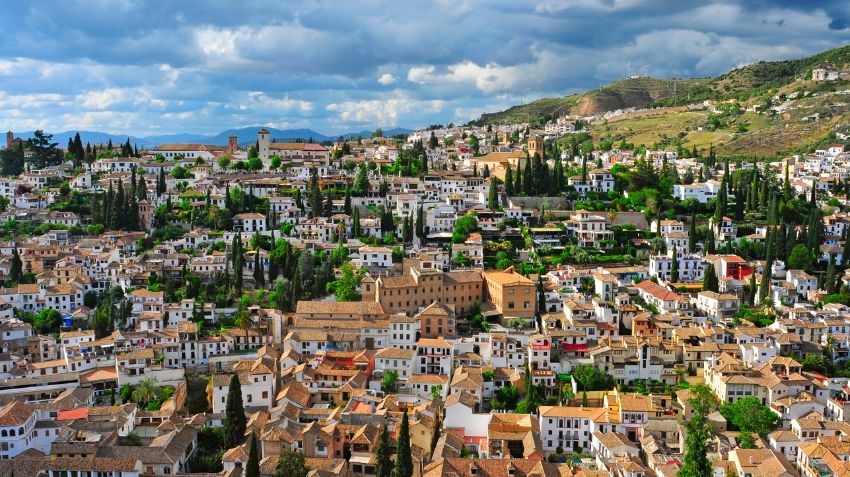
The best areas to stay in Granada are few enough to understand quickly, and different enough that getting the choice wrong changes the whole experience. This is a city where the neighborhood you pick sets the tone of every morning – whether you wake up above the rooftops with the Alhambra in view, or step out into a street that already smells of coffee and fresh bread.
Granada in July runs at two speeds: a slow, heat-aware afternoon rhythm and a late evening that comes alive after 21:00 when the stone cools and the tapas bars fill up. The city is compact but layered. Walking between neighborhoods takes minutes on the flat, longer on the hills. Where you sleep shapes when you move, how much you climb, and what you hear at midnight – details that matter across three or four nights.
What Granada’s neighborhoods feel like for visitors in summer
Granada has a specific quality in summer that most travelers do not fully anticipate: the afternoon silence. Between roughly 14:30 and 19:30, the historic core quiets considerably. Shutters close, the lanes in the Albaicín go still, and the cathedral square empties to a fraction of its morning crowd. It is not the city slowing down – it is the city reorganizing around the heat.
By 21:00 something shifts. The tapas culture here is genuine and generous – a free tapa with every drink, still, in most of the traditional bars around Navas and Pescadería. The outdoor tables fill, conversations carry across the square, and the evening continues well past midnight in the livelier streets. The light on the Alhambra at dusk, visible from several points across the Albaicín, goes from gold to copper to a dusty rose that the city almost seems to wait for.
Each neighborhood has its own acoustic signature. Centro hums at a social frequency – traffic, voices, trams. The Albaicín is quieter above a certain elevation, interrupted by the occasional tour group between 10:00 and 13:00. Sacromonte barely registers as urban at all once you are above the main cave road.
Granada neighborhood guide: Albaicín, Centro, Realejo and Sacromonte compared
Centro and Bib-Rambla
Centro sits around the cathedral and the main square of Bib-Rambla, and it is the most immediately legible part of Granada for someone arriving without much local knowledge. The streets are flat, the tapas bars are dense, and the Alhambra bus (the C3) departs from Gran Vía a short walk away. There is no particular climb required to reach anything in the first day or two.
If you’re still deciding whether Granada itself fits your trip before choosing a neighborhood, the Granada travel guide explains how the city feels beyond the accommodation decision.
The trade-off is noise. The streets around Navas and the cathedral are busy until late, and some of the accommodation sits above bars or in buildings that face the main pedestrian flow. Travelers who sleep lightly may notice the difference between a room that faces the interior courtyard and one that does not. That aside, Centro is the right base for a first visit – walkable, socially immediate, and easy to read from the first evening.
Albaicín
The Albaicín is the neighborhood most people picture when they think of Granada: white lanes, Moorish arches, tea houses that fill slowly through the morning, and miradores where the view across to the Alhambra stops conversations mid-sentence. Staying here rather than just visiting changes the texture of the whole trip.
The practical consideration is the climb. From Centro, the Albaicín starts gently and then steepens quickly; from some hotels near the top, you are 15 to 20 minutes uphill from the flat city, on cobbled lanes that are beautiful underfoot but less straightforward with luggage. The C31 bus runs from Gran Vía up into the neighborhood and is the practical solution for the first arrival and for anyone who wants to descend in the evening without the walk back up.
The atmosphere in the early morning – before 9:30 – is the reason most people choose this neighborhood. The lanes are nearly empty, the light is low and clear, and the tea houses near Plaza Nueva begin opening with a quiet deliberateness that feels separate from the tourist rhythm below. Travelers who want to sit at a mirador with a coffee and watch the Alhambra’s towers catch the first direct sunlight will not get that from Centro.
Travelers who realize the Albaicín is the neighborhood they want – not just a morning excursion – will find a fuller read of how to use it in the Granada first-time visit guidewhich covers the Alhambra timing alongside the neighborhood structure in more detail.
Realejo
Realejo sits south of the cathedral, quieter than Centro without requiring a climb. It was historically Granada’s Jewish quarter and still has a residential character that the main tourist areas have mostly lost – small squares, local bars, streets that go quiet after 23:00 rather than filling up. The walk to the Alhambra from Realejo is actually shorter than from the Albaicín by some routes, following the hill up through Campo del Príncipe.
This neighborhood works particularly well for travelers staying four or five nights who want a base with more of an everyday feeling. The concentration of tourist infrastructure is lower; the restaurants around Campo del Príncipe are used by local residents as much as by visitors. The pace in the evenings there is noticeably different from Navas – longer meals, less turnover, conversations that drift.
Sacromonte
Sacromonte is Granada’s cave neighborhood, built into the hillside east of the Albaicín across the Darro valley. Cave houses, flamenco tablaos, and a kind of wild quietness at night that no other neighborhood in the city shares. The approach is steep from every direction. Most accommodation here is in actual cave rooms cut into the hillside, which stay notably cool even in the height of summer – the thermal mass of the rock keeps interiors comfortable through the afternoon when the rest of the city is at its warmest.
It is a less practical base for general Granada sightseeing but a distinctive one for travelers who specifically want that experience. Evenings in Sacromonte run on a different clock: the flamenco shows draw visitors up from Centro from around 21:00, and the neighborhood has a particular energy between 22:00 and midnight that is unlike anywhere else in the city.
Granada in photos
How summer pacing works across Granada’s neighborhoods
July in Granada means planning around the afternoon. The Alhambra is best approached on a morning ticket, arriving before 10:00 to move through the Nasrid Palaces before the heat accumulates in the interior spaces. The walk back down from the Alhambra hill in the early afternoon is fully exposed; the alternative route through the gardens and the Generalife provides slightly more shade.
Afternoons belong to the interior: the Carmen de los Mártires gardens, a covered café near the cathedral, or the Albaicín tea houses where mint tea and shade occupy two hours without any particular effort. The city’s rhythm accommodates this naturally. Kitchens that open for dinner do so around 20:30 to 21:00, which means there is no texture in spending the mid-afternoon in a cool room and returning to the city in the early evening.
The mirador of San Nicolás in the Albaicín – the main viewpoint facing the Alhambra – fills quickly from around 19:30 in summer as the light changes on the walls. Going at 20:30 or 21:00 rather than at peak tends to mean more space and a view that is arguably better as the warm tones settle in.
Travelers comparing Andalusia’s two most visited historic cities may also find the Seville travel guide useful before deciding where to spend more time.
For travelers considering how Granada compares to other Andalusian cities on a longer trip, the Seville or Valencia comparison covers both urban energy and seasonal pacing in a way that maps well onto the same kind of decision.
Is Granada the right base for a summer Andalusia trip?
Granada works as a base for two to four nights, depending on pacing. The city itself is compact enough that the main areas feel familiar by day two, and slow enough in its midday rhythm that there is genuine time to sit with it. Longer stays suit travelers who want to use it as a hub for day trips – the Sierra Nevada is accessible year-round, and the coast at Almuñécar or Nerja is around an hour away by bus through the mountains.
If you’re planning to combine several cities, the Spain itinerary guide shows how Granada fits naturally into a wider Spain route.
The city is less suited as a base for travelers whose primary interest is nightlife and a continuous social scene. Granada has terraces, bars, and a genuine late-night culture, but it is a small city by Spanish standards and the circuit is knowable within a few evenings. Travelers who want that kind of density over a longer stay tend to gravitate toward Seville or Malaga instead.
Granada sits well in a broader Spain trip for travelers who want to move between cities with different registers – the Madrid or Malaga comparison covers two contrasting Spanish moods that often bracket a Granada stay naturally, one before and one after.
Is Granada worth staying in for more than two nights?
For the right traveler, yes. The question is less about the Alhambra – which anchors day one regardless – and more about whether the city’s pace and texture justify the additional nights. Travelers who want to settle into a neighborhood, walk the Albaicín without a schedule, eat at the bars around Realejo twice, and reach the Sierra Nevada viewpoint at dawn will find three or four nights sit comfortably. Travelers moving through Andalusia on a tight itinerary will find that two nights cover the primary visit well and leave space for a longer stop elsewhere.
The best areas to stay in Granada ultimately depend on one question: do you want to be inside the atmosphere, in the Albaicín or Sacromonte, or do you want easy access to everything, in Centro or Realejo? Both choices lead to a recognisably Granada experience. The city is too compact to get it badly wrong.
If you are mapping a wider Andalusia or Spain route alongside this decision, the Bilbao neighborhood guide offers a useful contrast – a very different Spanish city rhythm that pairs well with the Granada read for travelers planning a longer circuit through the north and south.
Granada neighborhoods FAQ: best area, Albaicín vs Centro, summer timing, Alhambra tickets and Sacromonte stay
1. Which area of Granada is best for a first visit?
Centro, around the cathedral and Bib-Rambla square, gives first-time visitors the most accessible base – flat streets, tapas bars within a short walk in every direction, and easy access to the Alhambra bus. The rhythm there is sociable and easy to drop into from the first evening.
2. Is the Albaicín worth staying in, or just visiting?
Staying in the Albaicín makes most sense for travelers who want the early morning atmosphere to themselves – narrow lanes before the day crowds arrive, tea houses opening around 10:00, views across to the Alhambra that feel genuinely still. The climb from Centro takes around 15 minutes on foot, which shapes the rhythm of every day.
3. How far in advance should I book Alhambra tickets?
In July and August, three to four weeks ahead is a realistic minimum; tickets for the Nasrid Palaces sell out faster than the rest of the complex. The Generalife gardens and the Alcazaba have more availability, but the full visit needs the timed Nasrid slot to feel complete.
4. Is Sacromonte a practical base for visitors?
Sacromonte works best as a short stay for travelers who specifically want the cave-house atmosphere and the flamenco evening culture. The approach is steep and the neighborhood is quiet after midnight; it is less practical as a general base but gives Granada a side that no other area quite replicates.
5. When does Granada feel least crowded?
September and October offer the clearest window – warm enough for evenings on the terraces, cool enough for comfortable afternoon walking, and noticeably calmer in the Alhambra queues and the Albaicín lanes. The city keeps its full character but at a more relaxed pace.