
Istanbul doesn’t resolve into a single neighborhood logic. The Bosphorus cuts through it, hills compress the streets into unexpected gradients, and the city keeps running several parallel versions of itself at once – the historic peninsula with its mosques and grand bazaars, the European side climbing toward Beyoglu, the quieter residential slopes of Cihangir, and the Asian shore that most visitors never cross. Understanding the neighborhoods of Istanbul before you choose where to sleep is the difference between a trip shaped by the city and one spent navigating away from the wrong part of it.
Travelers still deciding whether Istanbul belongs at the center of their Turkey itinerary can continue with the Istanbul first-time guide before narrowing the neighborhood decision.
The city wakes slowly. Mornings belong to the bakers, the tea houses, and the ferry commuters. By mid-morning the main corridors have filled, and by early afternoon Sultanahmet’s lanes are running at their loudest. But after 19:00 the energy redistributes – away from the tourist axis and into the fish restaurants of Karakoy, the rooftop bars around Beyoglu, the evening promenade along the Bosphorus in Besiktas. Istanbul’s real social rhythm is nocturnal, and choosing the right base matters more than in most cities because the parts that stay lively after dark are not always the parts that sit next to the major monuments.
Is Sultanahmet a good area to stay in Istanbul, Turkey?
The case for staying in Sultanahmet is simple: the Hagia Sophia, the Blue Mosque, the Topkapi Palace and the Grand Bazaar are all within ten minutes on foot. For a two-night stay with a dense sightseeing agenda, there is no better location.
The trade-off is just as clear. The streets immediately around the main monuments are built almost entirely around visitor turnover – overpriced menus on laminated cards, carpet shop conversations that begin as directions, and hotels that occupy restored Ottoman buildings without much of the daily city life that makes Istanbul itself interesting. By 16:00 the lanes between the Blue Mosque and Topkapi are running at full summer tempo. The quiet that settles over the district after the day-tripper coaches leave is real, but it is the quiet of a neighborhood that doesn’t have much to offer past 21:00.
Sultanahmet works as a base for people who want proximity, efficiency, and a first-contact experience with Istanbul’s monuments without needing the city to feel inhabited around them in the evenings. For anything longer than three nights, most travelers find themselves drifting toward Beyoglu or Karakoy for dinner regardless of where they sleep, which starts to raise the question of whether the hotel’s location is actually serving them.
Is Beyoglu a good neighborhood to stay in Istanbul, Turkey?
Beyoglu sits above Karakoy on a long, populated hill, and Istiklal Avenue is its spine – a pedestrian street about 1.4 kilometers long that runs from Taksim Square down toward the Galata Tower. The avenue itself is dense during the day, with the heritage tram running through it and the side streets feeding off it in every direction. The real texture of Beyoglu is in those side streets: the meyhanes (traditional taverns) of Nevizade, the independent music venues on the backstreets toward Cihangir, the bookshops and small galleries that persist between the chain stores.
After dark, Beyoglu’s energy accelerates. The neighborhood draws a mixed crowd of students, local professionals, and visitors who have figured out that the dining and nightlife here are significantly better than anything near Sultanahmet. Tables fill around 21:00 and the music-bar stretch off Istiklal stays active past midnight on weekends. Some streets quiet down after 23:00; others don’t.
The walking profile here is worth noting: the streets running off Istiklal drop steeply toward both Karakoy and the residential area of Cihangir, and the cobblestones are uneven in places. Luggage on wheels and those gradients are not a natural combination. But for travelers who want to be inside the city’s evening energy rather than observing it from a quieter base, Beyoglu is the most consistently interesting place to sleep.
Is Karakoy a good area to stay in Istanbul, Turkey?
Karakoy sits at the foot of the Galata hill, where the Bosphorus ferries dock and the bridge connects the European side to the historic peninsula. It operates at a calmer frequency than either Beyoglu above it or Sultanahmet across the water – a working port neighborhood that has accumulated independent coffee shops, small restaurants, and a few well-considered hotels without losing the city-logistics atmosphere of a district where real things happen.
The Bosphorus light arrives early here. On clear mornings the ferry terminal smells of diesel and salt water, bread from the nearby simitsellers, and occasionally fish from the boats moored along the quay. It is not a quiet neighborhood – the tram runs through, and the bridge pedestrian walkway brings constant foot traffic – but the acoustic register is the city working rather than the city performing for visitors.
For travelers arriving by ferry from the Asian side or by cruise into the main port, Karakoy offers a natural first base. The Galata Tower is a five-minute walk uphill; the Grand Bazaar is across the bridge and a tram stop away. The neighborhood also connects directly to Beyoglu via the Tunel funicular, which makes the evening options significantly wider without requiring a long walk up the hill.
Is Cihangir a good neighborhood for a quieter stay in Istanbul, Turkey?
Cihangir occupies a hillside position above Karakoy, slightly west of the main Istiklal corridor. It is recognisably residential – the kind of neighborhood where people collect their dry cleaning on Tuesday evenings, where the corner meyhane has been running under the same family for three decades, and where the view of the Bosphorus from the upper streets appears without warning as you turn a corner.
The pace here is slower, and that slowness is the point. Cafes run on a laptop-and-long-lunch rhythm. The bookshops stay open late. Weekend mornings bring a particular quality of light on the facades – the pale yellow and terracotta of the older apartment buildings catching the low angle before the streets below have fully woken up.
Cihangir suits travelers who want to feel embedded in the city rather than adjacent to its monuments. It is not a base for maximum sightseeing efficiency – the main sites require a descent to Karakoy and a tram connection – but for stays of five nights or more, or for anyone who wants to understand Istanbul’s residential character rather than just its museum circuit, it tends to be the neighborhood that stays with people longest after they leave.
Is Besiktas a good area to stay in Istanbul, Turkey?
Besiktas is about four kilometers northeast of Sultanahmet along the European Bosphorus shoreline – far enough from the historic peninsula to have a genuinely local character, close enough to reach by tram in under 25 minutes. The neighborhood centers on a ferry terminal, a fish market that runs into the early afternoon, and a cluster of tea houses and meyhanes where locals outnumber visitors by a ratio that feels increasingly unusual the closer you stay to the tourist corridor.
The Dolmabahce Palace is within walking distance, but Besiktas’s real draw is functional rather than monumental: it sits on the Bosphorus ferry network, which means the Asian side (Kadikoy, Uskudar) is a 20-minute crossing rather than a 40-minute transit journey. For travelers who want to cross to the Asian shore – and it is worth doing at least once, if only for the experience of the crossing itself – Besiktas is a natural starting point.
The evening energy here concentrates around the fish restaurants near the market and the bars on the side streets toward Arnavutkoy. It runs later than Sultanahmet and earlier than Beyoglu – a rhythm suited to travelers who want a lively dinner without committing to a late night, or who are simply done with the tourist axis and want to see who actually eats out in Istanbul on a Wednesday.
Is Kadikoy or Uskudar better for staying in Istanbul, Turkey?
Most first-time visitors stay on the European side and cross to Asia by ferry as a half-day excursion. That is a reasonable approach, but it means missing the character of a city that many Istanbul residents consider more genuinely theirs.
The contrast between Istanbul’s different districts becomes even clearer after exploring the Turkey market districts guide, which looks at how timing changes the experience across some of the country’s busiest urban spaces.
Kadikoy is the Asian neighborhood that visitors most frequently land in – a lively commercial and social district built around a covered market, a street food corridor, and a promenade running along the Marmara shore. The crowds here are almost entirely local, the restaurants are cheaper and less self-conscious than their equivalents in Beyoglu, and the ferry crossing from Eminonu or Besiktas to Kadikoy is one of the better free views the city offers, with the minarets of the European skyline appearing as you pull away from the dock.
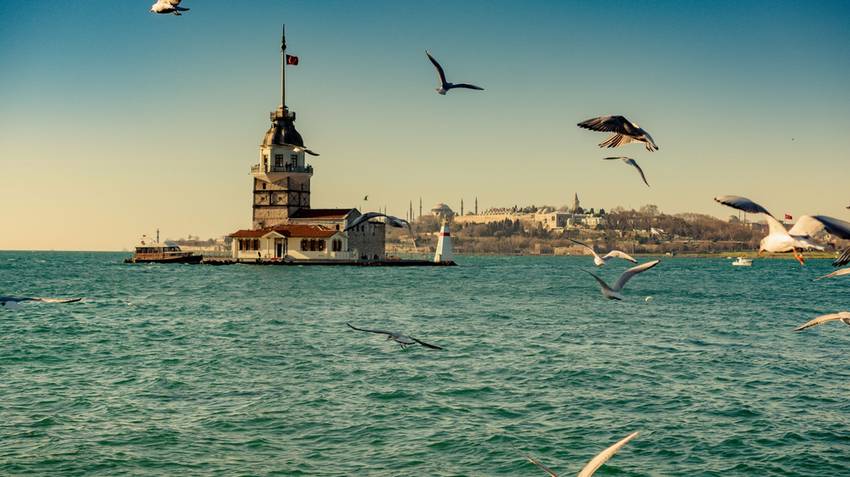
Uskudar, slightly north of Kadikoy, is quieter and more residential. The view back across the Bosphorus toward the European hills, with the Maiden’s Tower in the foreground, is particularly clear in the early morning before the ferry traffic thickens. Staying on the Asian side suits travelers who want a calmer base and are willing to factor the daily ferry crossing into their routine – it takes 20 minutes and runs frequently, but it does add a physical structure to every day that some find pleasant and others find limiting.
For a parallel on what it means to choose the quieter, less-visited side of a city versus the more concentrated tourist core – and how that choice reshapes a trip’s atmosphere – the Turkey market districts timing read covers the rhythm shifts that apply across Istanbul’s bazaar network as well.
How to get around Istanbul neighborhoods in Turkey
Istanbul’s internal transit is more coherent than the city’s scale suggests. The T1 tram handles the European tourist corridor reliably – Sultanahmet to Karakoy to Eminonu in a single line, running frequently from early morning until late evening. The M2 metro connects Taksim to the airport corridor. The Bosphorus ferries run a network that links both shores and several points along the European coast, and they are a genuine mode of transport, not a scenic add-on.
What does not flow easily between neighborhoods is pedestrian momentum. The hills between Karakoy and Beyoglu, and between Sultanahmet and any neighborhood to the north, mean that map distances understate walking time significantly. A kilometer in Cihangir can feel like two by the time you have navigated the gradient and the cobblestones. Travelers who stay in Sultanahmet and plan to spend evenings in Beyoglu consistently underestimate the return trip – uphill, after a long dinner, at 23:30. The tram is usually the right answer.
Timing also shapes the experience of moving between neighborhoods. The T1 tram compresses noticeably at the Sultanahmet and Eminonu stops between 14:00 and 17:00 in summer. The Bosphorus ferries are most pleasant as a transit option before 10:00 or after 19:00, when the crossings feel like the city briefly handing you a slower pace.
How to choose the best neighborhood in Istanbul, Turkey
Istanbul is a large, complex, physically demanding city in the summer, and neighborhood choice shapes not just location but daily experience in ways that matter more here than in a more compact destination. The neighborhoods of Istanbul do not all suit the same trip.
Short stays with a monument-heavy agenda sit most comfortably in Sultanahmet or Karakoy. Longer stays with evening energy and a desire for variety tend to anchor in Beyoglu or Cihangir and reach outward from there. Travelers who find themselves magnetized by local rhythm over landmark access – who want to understand how the city actually functions rather than how it presents itself to visitors – often find the Asian side or Besiktas giving them a version of Istanbul that feels more like living there than passing through.
The city’s scale is part of its character. Istanbul moves at a tempo that rewards patience and deliberate pacing, and the neighborhoods of Istanbul reflect that: each one has a distinct register, a distinct time of day when it comes alive, and a distinct type of traveler it suits. Choosing the right one is less about finding the “best” district and more about understanding which version of Istanbul you actually want to be inside.
Travelers planning to continue beyond Istanbul may find the Turkey itinerary guide useful for understanding how Istanbul connects with Cappadocia, Antalya, and the country’s western coast.
For a very different side of Turkey, the Antalya first-time guide explores a slower coastal rhythm that contrasts sharply with Istanbul’s scale and energy.
Frequently asked questions about Istanbul neighborhoods
1. Which neighborhood in Istanbul is best for first-time visitors?
Sultanahmet puts you closest to the major historic sites and works well for a short first visit, though the surrounding streets are oriented almost entirely toward tourists. Beyoglu offers a more mixed atmosphere with better restaurants and evening energy, and suits people staying more than two or three nights.
2. Is Beyoglu or Karakoy better for staying in Istanbul?
Karakoy sits at water level and has a calmer character than Beyoglu above it, with independent cafes, a working port atmosphere, and quicker access to the Bosphorus ferries. Beyoglu is livelier after dark, with Istiklal Avenue and the side streets around Cihangir pulling a mixed local and visitor crowd well past midnight.
3. Which Istanbul neighborhood is quietest for travelers who want to slow down?
Cihangir, perched on the slope above Karakoy, has the residential cadence of a city that locals actually use. The streets are quieter by 23:00, the cafes run on a slower tempo, and the Bosphorus view from the neighborhood’s upper reaches is something people tend to linger over rather than photograph and move on from.
4. How far is Besiktas from the main Istanbul sights?
Besiktas is about four to five kilometers from Sultanahmet by road, roughly 20 minutes on the T1 tram or a short ferry ride from Eminonu. It functions well as a base for travelers who want a livelier local neighborhood without committing to the dense tourist corridor around the historic peninsula.
5. When is the best time to visit Istanbul to avoid the busiest crowds?
April, May and October tend to offer the most comfortable balance: the city is active, the light is good in the late afternoons across the Bosphorus, and the main corridors haven’t yet reached their summer tempo. Late spring in particular is when Sultanahmet’s outdoor spaces feel most pleasurable, with evenings cooling just enough to stay out past 22:00 comfortably.
6. Is Istanbul walkable between neighborhoods?
Some crossings work well on foot – Karakoy to Sultanahmet via the Galata Bridge takes about 15 minutes on flat ground – but Beyoglu’s hills and the distances between the Asian and European sides mean the ferry and metro earn their keep. The T1 tram handles the main European tourist corridor reliably; the Bosphorus ferries are genuinely useful transport, and the early-morning crossing from Besiktas to Kadikoy, with the European skyline behind you and the Asian shore coming forward, is one of the better ways to begin a day in the city.