
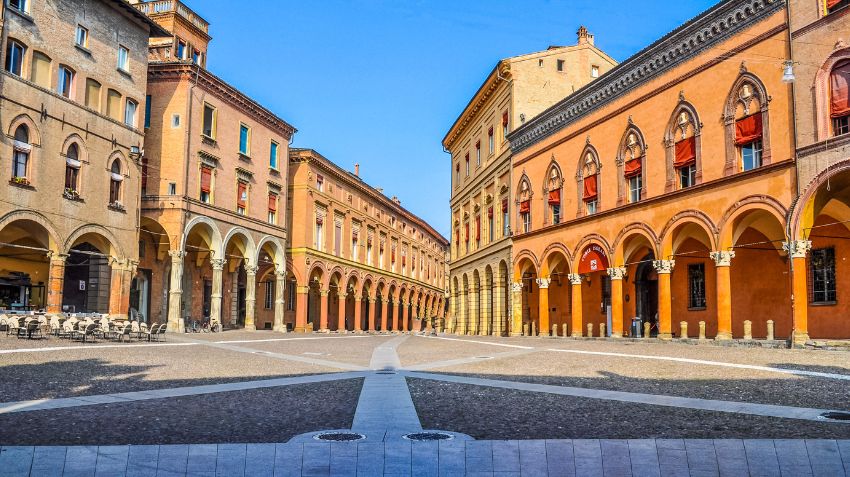
Bologna arrives differently than most Italian cities. The centre is compact, the porticoes keep the streets navigable in almost any weather, and the city’s rhythm leans closer to a working university town than a monument circuit. For a first time in Bologna, that distinction matters more than it might seem.
The food reputation is accurate and slightly undersells the reality. What the city is less known for, but just as consistently delivers, is a certain unhurried ease – long lunches that drift into afternoon coffee, evenings in Piazza Maggiore that fill gradually from around 19:30, and a general sense that the city is comfortable being itself without performing for visitors.
The streets in summer carry warmth well past sunset, and the red-brick facades take on a particular depth of tone in the late afternoon that no photograph quite captures correctly.
None of this makes Bologna effortless to navigate as a first-time visitor. The city rewards a little orientation, a sense of where to slow down, and a willingness to eat on Italian time rather than tourist time. What follows is the practical shape of that.
What Bologna feels like for visitors
Travelers deciding whether Bologna deserves a stop before Florence or Venice may also find the Florence or Venice comparison useful for understanding how each city differs in pace and atmosphere.
The porticoes are not just an architectural detail – they are the city’s operating system. Around 40 kilometres of covered walkways connect most of what a first-time visitor needs, which means the experience of moving through Bologna is fundamentally different from most Italian cities. In July, when stone streets in Florence or Rome become genuinely demanding by midday, Bologna’s covered routes stay in shade. The air still holds heat in enclosed piazzas, but the walking itself has a different quality.
The centre is organized around Piazza Maggiore, which serves as the social anchor at most hours of the day. In the morning it is relatively quiet – a few tourists, locals crossing on their way elsewhere. By early evening it fills steadily, and by 21:00 it has the kind of easy social density that makes it worth sitting in without any particular agenda. Two streets in from the main axis, the rhythm shifts noticeably – narrower lanes, fewer people, the sound of a kitchen somewhere upstairs.
The Quadrilatero, the market quarter east of the piazza, operates on its own clock. Stalls and shops open early on weekday mornings and begin winding down by early afternoon. If you arrive expecting a permanent market atmosphere, you will find it on Tuesday morning; if you arrive at 15:00 on a Saturday, considerably less so. This is worth knowing before your first full day.
Is Bologna right for your travel style?
Bologna is well-suited to travelers who eat seriously, move at a measured pace, and do not need a dense programme of headline attractions to feel a trip is worthwhile. The city’s pleasures are mostly structural – the quality of an hour in a good osteria, a walk up to San Luca in the early morning before the heat builds, the specific texture of the Archiginnasio’s anatomy theatre. None of these require planning far in advance, but all of them require a certain willingness to be present rather than to tick things off.
Travelers planning a longer stay in Tuscany can continue with the Florence travel guide to compare how the two cities reward different travel styles.
Travelers arriving from Florence or Rome with the expectation of a similarly monument-heavy experience will find Bologna quieter and, to some, thinner. The Pinacoteca Nazionale is worth a visit, the Basilica di San Petronio anchors the piazza well, and the Due Torri are genuinely atmospheric – but the city’s real character sits in its daily life rather than in its landmark count. First-time visitors who prefer a clear itinerary of named sites may find the pace too open-ended. Travelers who enjoy unstructured urban time tend to find it immediately comfortable.
How to plan your first days in Bologna
A two-night stay gives enough time to find the rhythm without rushing it. The first morning is well spent at the Quadrilatero on a weekday – arrive before 10:00 to see it at full activity. The market’s density of cured meats, cheese, fresh pasta and produce is serious, and the surrounding streets have enough small producers and specialist shops to make an hour pass easily. Lunch somewhere close, then the afternoon is better used slowly than ambitiously – the Archiginnasio, a coffee in the university quarter, an early evening aperitivo somewhere near Via del Pratello.
The second day opens more options. San Luca is a 40-minute walk uphill via the world’s longest portico – a continuous covered arcade that climbs from the city to the hilltop basilica above. The walk itself is the point; the view over Bologna from the top, particularly in summer morning light before the haze thickens, has a quality that the city’s flatter streets do not. Plan to be there before 10:00 in July or August. The afternoon can fold back into the centre without any particular structure.
Evenings in Bologna are genuinely good. Dinner rarely starts before 20:00 in local restaurants, and the kitchen rhythm reflects that – arriving at 19:30 you will often find the dining room still setting up. The canal district, the Canale di Reno area near Via Piella, has a quieter character in the evening than the main centre and is worth the 15-minute walk from Piazza Maggiore, particularly when the canal reflects the buildings above it in a way that is completely out of proportion to how little it appears on most tourist maps.
How to get around Bologna and arrive from the airport
Bologna Guglielmo Marconi airport is close – the BLQ Aerobus shuttle runs to the central station in around 30 minutes and operates frequently enough that timing your arrival around it is straightforward. Taxis from the airport run on a fixed rate to the centre. Neither option requires planning beyond knowing which one you prefer.
If Bologna is one stop within a wider northern Italy route, the Italy itinerary guide shows how the main cities connect into a practical journey.
There is no metro. The historic centre is compact enough that this is not a real limitation – most addresses a first-time visitor cares about sit within 20 minutes on foot from the central station. The main axis, Via dell’Indipendenza, runs directly from the station into Piazza Maggiore and is covered by porticoes almost continuously. Arriving by train from Florence takes around 35 minutes on the high-speed line, which makes a day trip viable, though a proper overnight stay changes the experience considerably.
Where to go after Bologna in Italy
Bologna sits well as a standalone stop of two to three nights, or as a calmer anchor between Florence and Venice. Travelers who find Florence’s summer visitor intensity at its peak in July often appreciate Bologna’s slightly lower tempo as a place to decompress and eat well before continuing north or east. Modena is 40 minutes by train and is worth the detour for its own food identity, though it functions more as a day excursion than an overnight stay for most first-time visitors.
Parma follows similar logic – close enough to visit in a day, distinct enough to offer a genuinely different character. For travelers weighing whether to include Bologna against another Italian city, the comparison that tends to be most useful is the one that accounts for what kind of day you actually want: Bologna rewards wandering, eating, and unhurried time in a way that a purely monument-focused itinerary would not fully use. If that fits the energy you are traveling with, it tends to deliver reliably.
What to expect from a first trip to Bologna
A first time in Bologna tends to leave travelers with a clearer understanding of what Italian daily life feels like outside the monument circuit – the food is as serious as its reputation suggests, the city moves at a pace that rewards attention over efficiency, and the porticoes give it a physical character that is specific and consistent regardless of season. It suits travelers who are comfortable with an open day structure, who eat on Italian time, and who find pleasure in the texture of a city rather than in the pace of covering it.
Travelers who discover they prefer quieter Italian cities often continue with the Venice travel guide, where the atmosphere shifts from university streets to canals and island neighborhoods.
Those arriving from heavier itinerary stops often find it settles the trip in a way they had not quite anticipated. Those arriving expecting the density of Rome or the art weight of Florence may find it quietly peripheral – and may also be pleasantly surprised by how much that does not matter once the first long lunch is over.
Bologna first-time visitor FAQ: days needed, walkability, summer, food and Florence comparison
1. How many days do you need in Bologna for a first visit?
Two full days covers the historic centre comfortably, with time for the main piazzas, the Archiginnasio, and a long lunch in the market quarter. Three days allows for a slower rhythm – a morning at the food market, an afternoon climb to San Luca, evenings that stretch well past 22:00 without feeling rushed.
2. Is Bologna walkable for first-time visitors?
Almost entirely. The historic centre is compact and flat, and around 40 kilometres of covered porticoes mean you can cross much of the city without sun or rain interrupting the route. Most of what a first-time visitor wants to see sits within a 20-minute walk of Piazza Maggiore.
3. What is Bologna like in summer for a first visit?
July and August run warm, with stone streets holding heat through the evening, but the porticoes soften the experience considerably – midday walks that would feel heavy in Rome or Florence are more manageable here. The city empties slightly in August as locals leave, which gives the evenings a quieter, more residential quality.
4. Is Bologna good for first-time visitors who want to eat well?
Bologna’s food identity is not a marketing claim – it is built into the daily structure of the city. The Quadrilatero market operates on weekday mornings with a density of produce, cured meats and cheese that makes most other Italian food markets feel curated by comparison. Restaurants open late, portions are serious, and the wine list rarely needs much deliberation.
5. How does Bologna compare to Florence for a first Italy trip?
Florence carries more instantly recognisable weight and a higher visitor intensity; Bologna runs quieter, more lived-in, with fewer must-tick attractions and more of a city that rewards slow movement. Travelers who find Florence’s summer crowds relentless often find Bologna settles at a more comfortable pace – the architecture is still significant, but the streets have more room to breathe.