
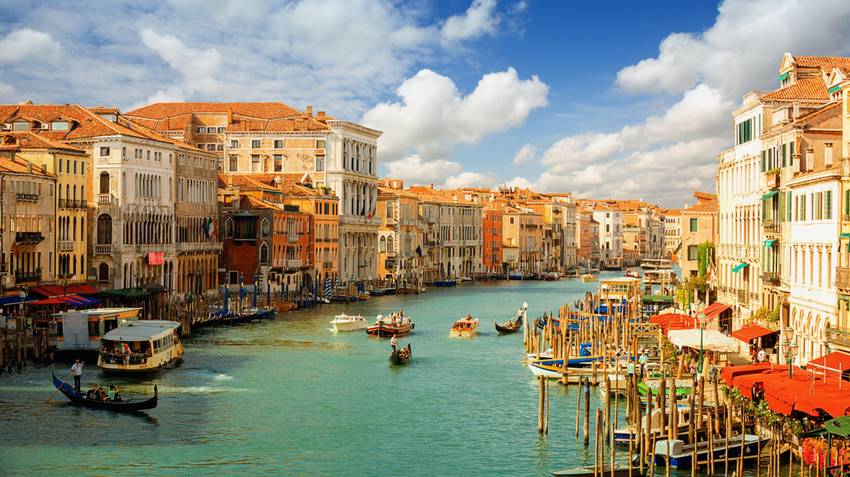
Venice in summer is at its most intense. The crowds are real, the heat lingers in the stone well past sunset, and the most famous corridors near the Rialto and Piazza San Marco are genuinely congested at peak hours. But the city absorbs all of this in a way that still leaves room for the experience travelers come for. Evenings are when day-trippers leave and something quieter takes over. Mornings before 09:00 have a different city entirely.
This is a city that exists in a way almost no other city does. There are no cars, no scooters, no bicycles. The only way to cross it is on foot and by water. The streets dead-end into canals. You navigate by the sound of bells and the angle of the light. As a first-time traveler guide to Venice goes, no amount of practical reading fully prepares you for the physical strangeness of that — but understanding what to expect from the pace, the layout, and the season gets you most of the way there.
Venice arrives differently depending on what time of day you get there. Early morning, with the boats moving quietly and the stone still cool underfoot, the city is almost uncrowded. By mid-morning in summer, the main routes fill with people moving in slow, steady streams toward the same landmarks. The city hasn’t changed — the light on the water, the impossible narrowness of the alleys, the way a canal appears exactly where you didn’t expect one — but the experience of moving through it shifts dramatically depending on the hour. For anyone approaching Venice as a first-time traveler, that timing awareness is probably the most useful thing to understand before you arrive.
What Venice actually feels like to move through
The map is a small, dense oval. The reality is a three-dimensional maze of narrow passages, sudden dead ends, small arched bridges over dark green water, and open campos where children are playing football and locals are buying coffee. You rarely walk in a straight line. The distance between two points on a map usually takes longer than it suggests, because the route bends, climbs over a bridge, dips under an archway, and doubles back.
By the second day, most visitors stop consulting the map constantly and start navigating by intuition. That shift is part of how the city works on you. You stop expecting urban logic and start accepting the city’s own spatial grammar.
The Grand Canal cuts the city in half and is best understood not as a road to walk alongside but as the main artery of movement. The vaporetto — Venice’s water bus system — runs along it constantly, and lines 1 and 2 are how most visitors and residents get from the train station to the Rialto or San Marco. In summer, both lines are crowded, particularly from mid-morning onward. Boarding at a less central stop early in the day is calmer. Evening crossings after 19:00 are noticeably quieter.
Walking is the actual experience of Venice. The heat in summer is real — the narrow calli trap warmth and there is rarely a breeze unless you are near the water or on the wider fondamente alongside a canal. Stone holds heat well past dark, so the difference between an 18:00 walk and a 21:00 walk in July is mostly about ambient air temperature, not light. Both are possible. One is more comfortable.
Who the city suits, and who finds it harder
Venice works well for travelers who are comfortable with slow, exploratory movement, who don’t need a plan to feel at ease, and who find the experience of being genuinely lost (in a bounded, navigable way) pleasurable rather than stressful. The city has a strong pull for people who respond to place — to old materials, to water light, to the specific acoustics of a city with no engine noise.
It’s less straightforward for travelers who prefer a predictable schedule or who have specific physical constraints. There are stairs everywhere — not imposing ones, but constant ones. Every bridge is a stepped arch. Suitcases on cobblestones are audible from two streets away and a genuine effort across longer distances. Families with very young children and strollers can navigate it, but it takes more planning and patience than most European cities. Mobility limitations are worth checking against specific routes before arrival rather than assuming adaptability.
Solo travelers and couples who are comfortable pacing a city on their own terms tend to find Venice deeply rewarding. The city has a particular quality for people who want to inhabit a place rather than just photograph it — the feeling that if you turn down one more alley, you’ll find something that isn’t in any guide. That instinct is usually right. Travelers already weighing a similar first-visit energy in Florence will recognize the same pull — the Florence first-time visitor guide covers a city with a comparable exploratory draw and a different spatial register.
How to pace the first two or three days
Venice rewards an early start more than almost any other city in Europe. Before 09:00, the main corridors near the Rialto are close to empty. The fish market at Rialto operates from around 07:30 and is gone by noon. The light on the water in early morning is a different light from anything that comes later. These are not abstract recommendations — they are the conditions under which the city feels like itself rather than like a crowded attraction.
Midday in summer is when the heat and the crowd pressure peak simultaneously. Many experienced Venice visitors build in a long lunch break or a quieter neighborhood drift during those two hours, then return to the main landmarks in the late afternoon when the day-trippers are heading back to the Piazzale Roma or the train station. By 18:00, the population shift is noticeable. By 20:00, the city has changed character entirely.
Evenings on the Zattere — the wide fondamenta along the southern edge of Dorsoduro — are one of the better ways to experience the city at rest. It faces south across the Giudecca Canal, catches the evening light, and is several degrees quieter than the Rialto-side of the city. Locals eat late here, cafés stay open, and there is a long, easy promenade quality that doesn’t feel tourist-facing.
Three days is a reasonable window for a first visit if you want to see the main landmarks without feeling rushed and still have time to drift into quieter sestieri. Cannaregio in the north, away from the train station end, has a residential calm that contrasts sharply with the San Marco corridor. The Jewish Ghetto area is genuinely off the main tourist axis and worth a morning. Castello, east of San Marco, empties faster than the western neighborhoods as the day progresses.
The neighborhoods that shape where you stay
Where you sleep in Venice is largely determined by budget and by how much you want to walk before you reach the city proper. The area immediately around San Marco has the highest concentration of hotels and the highest prices, along with the highest foot traffic. It’s convenient and expensive, and you’ll hear tourist noise from the campo most evenings.
Travelers who find themselves deciding between Florence and Venice rather than simply visiting both may find the Florence or Venice comparison useful for understanding how the two cities reward very different styles of exploration.
Dorsoduro and Cannaregio are consistently better for first-time visitors who want a residential feel with reasonable access to the main sights. Dorsoduro sits close to the Accademia and the Zattere; Cannaregio is near the train station and opens up into quiet streets within a short walk. Both areas have working bars and small alimentari that don’t price-adjust for tourists.
Staying on the Lido or Giudecca is an option for some travelers, but it adds a vaporetto crossing to every trip into the city center — which in summer means queuing and timing the boats around crowd peaks. For a first visit, proximity to the core usually works better.
The rhythm of getting in and getting out
Arriving at Santa Lucia train station is the most common entry point, and the view from the station steps directly onto the Grand Canal is one of those arrival moments that doesn’t require preparation. It is immediately clear you are somewhere that operates by different rules. Water, boats, no cars, the bridge to the left, the vaporetto stop immediately to the right.
From the station, Line 1 runs the full length of the Grand Canal and stops at every landing, taking around 35–40 minutes to reach San Marco. Line 2 is faster — roughly 20–25 minutes — with fewer stops. In summer, both lines at the station stop are crowded mid-morning and in the early afternoon. Early evening departures from the station are calmer.
Leaving Venice with luggage on cobblestones is where a lot of first-time visitors encounter the physical reality of the city in a concentrated way. The route from almost any accommodation to the train station or Piazzale Roma involves bridge crossings and uneven paving. Wheeled suitcases work, but they’re slow and loud. Many experienced Venice travelers pack a smaller bag specifically for this reason. It’s worth thinking about before you arrive rather than after.
Travelers who find themselves weighing this kind of compact city rhythm against something larger and more metropolitan may find the Milan first-time traveler guide sits at the opposite end of that spectrum — a city that operates on a completely different urban logic, fast and legible in ways Venice deliberately is not.
What sits near Venice and what connects naturally
The Veneto region gives Venice several useful extensions. Verona is an hour by train and offers a city that operates at a different pace — more functional, easier to navigate, with a Roman amphitheatre in the center of the old town and a rhythm that feels more like a normal Italian city. It’s a reasonable one-day addition or a useful alternative base if Venice accommodation feels prohibitively expensive.
Many travelers eventually compare Venice with Milan because both sit naturally within the same northern Italy route. The Venice versus Milan guide explores how the two cities differ in pace, layout, and traveler expectations.
Padua is even closer, around 30 minutes by regional train. The Scrovegni Chapel requires advance booking but is one of the more genuinely extraordinary spaces in northern Italy. The city itself has a university-town energy with lower prices and a functioning local life that is less tourist-oriented than Venice. Some travelers use it as a base and day-trip into Venice, though this reverses the immersion logic of staying in the city itself.
The Venetian lagoon islands — Murano, Burano, Torcello — are frequently recommended and genuinely different from the main island. Burano in particular, with its color-coded facades and quieter streets, rewards an early afternoon visit on a day when the light is clear. These are short vaporetto trips, and they fill with tour groups mid-morning, so the same early-start logic applies here as everywhere in the Venetian system.
For travelers drawn to southern Italy and a completely different register of energy, the Naples neighborhood guide covers a city that is almost the philosophical opposite of Venice — loud, vertical, unapologetically present, and rewarding in an entirely different way.
Who Venice fits as a first visit, and when it works best
As a first-time traveler guide to Venice, the honest synthesis is this: the city suits people who are willing to let it set the pace rather than imposing one of their own. It’s best in the shoulder months — late September, October, April, May — when the crowd pressure drops and the movement through the calli feels less managed and more open. Summer is entirely workable if you build your days around the city’s natural rhythm: early mornings, a slow midday, active evenings.
It doesn’t suit travelers who need a lot of physical ease, who want the kind of variety that comes from a large, multi-district city, or who find crowd management a significant source of stress. The city’s small footprint means you encounter the same pressure points repeatedly. That compression is part of what makes Venice itself, and it works for some travelers far better than others.
The city’s appeal isn’t abstract. It comes through in specific moments — the silence at 06:30 in a residential campo, the way the canal light moves across a wall in the late afternoon, the particular echo of footsteps in an alley with no street noise underneath. Those moments are the actual experience, and they’re available to anyone who adjusts their timing to find them.
Travelers building a broader northern Italy trip may also find the Italy itinerary guide useful for understanding how Venice fits within the Rome–Florence–Milan rail corridor.
Venice first visit: common questions
1. How many days do you need in Venice as a first-time visitor?
Two to three days is the practical window for a first visit. One day covers the main landmarks but leaves little time to drift into quieter sestieri; three days lets you slow down, absorb the water city’s rhythm, and have an evening or two that doesn’t feel rushed. More than four days without a specific plan tends to exhaust rather than deepen the experience.
2. When is the best time to visit Venice for the first time?
Late September and October offer a noticeably different city to the one visitors encounter in July or August. Crowds thin considerably, the canal light shifts to a lower, softer angle in the afternoons, and the cooler air makes the walking genuinely pleasant. Spring from mid-April into May works similarly well. Summer is entirely liveable if you adjust your schedule to match the city’s pace rather than fight it.
3. Is Venice walkable for first-time visitors?
Venice is entirely pedestrian, but walkable doesn’t mean easy. The city’s footprint is small on a map and much larger on your legs — bridges, stair crossings, detours around dead-end calli, and the sheer repetition of uneven stone add up. Most first-time visitors underestimate the daily distance. Comfortable shoes matter more here than in almost any other European city.
4. What neighborhoods should a first-time visitor to Venice stay in?
Dorsoduro and Cannaregio are the two areas that consistently work best for first visits. Dorsoduro sits close to the main sights without being in the thickest part of the tourist corridor, and its evening rhythm along the Zattere is one of the city’s quieter pleasures. Cannaregio gives you residential Venice within ten minutes of the train station — useful for early arrivals and late departures.
5. Is Venice worth visiting despite the crowds?
The crowds are real, but so is what draws people here. A canal at 07:00 with fog still sitting on the water, or the moment you turn a corner from a busy street into a silent campo with a single café opening its shutters — those are not experiences you find elsewhere. The city rewards travelers who adjust their hours to it rather than treating it as a conventional sightseeing circuit.