
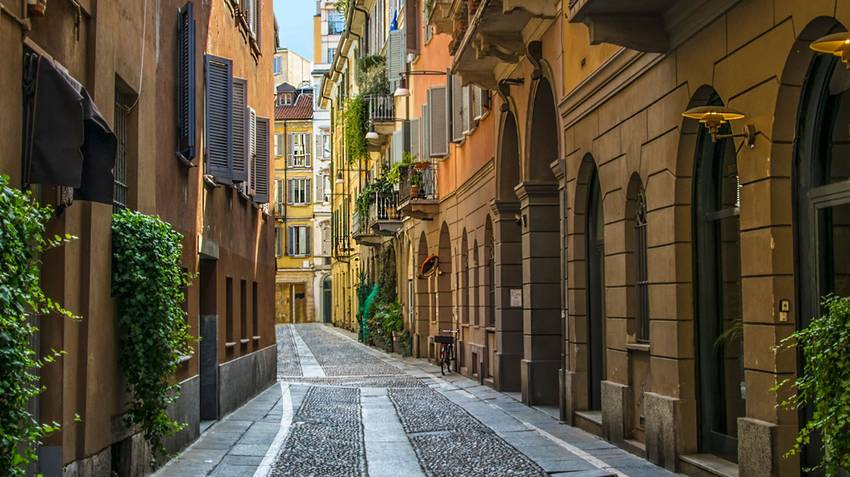
Before the cafés open their shutters and before the first organized tour group appears on Via Brera, there is a version of this neighborhood that belongs entirely to itself. The stone lanes are still cool underfoot, the light comes in at an angle low enough to catch the upper floors of the older buildings, and the only sound is the occasional rolling shutter going up in the far distance. These are the Milano Brera district quiet morning spaces – and finding them is mostly a question of timing rather than effort.
Brera sits between the Pinacoteca and Corso Garibaldi, a compact residential-gallery quarter that transitions from almost entirely local at 8:00 to noticeably tourist-facing by 11:00. That three-hour window is the operative frame. The neighborhood doesn’t hide its quiet – it just requires arriving before the gallery visitors and the aperitivo crowd organise themselves into the same lanes.
This node approaches Brera from an atmospheric and pacing angle, specifically for travelers trying to understand how the morning version of the neighborhood actually functions, which spaces hold their calm the longest, and when the visit makes sense in the context of a longer Milan stay.
What the neighborhood feels like before the city fully wakes
The core of Brera is small enough to walk in twenty minutes without rushing, but the irregular stone paving encourages a slower pace almost involuntarily. Soft soles help. The lanes around Via Madonnina and the short corridor of Via Formentini are narrow enough that two people walking side by side fill the width, and at 8:30 those lanes are essentially pedestrian in the quietest sense – no market setup, no delivery traffic in the main core, no sound bouncing between the walls.
The courtyards are the most underused part of this. Several of the older buildings along Via Brera and the streets radiating off it have internal courtyards that are visible from the street – some with potted plants that have survived multiple owners, some with worn stone arches that frame nothing in particular except the quiet. They are not tourist points. They are just architectural residue from when the neighborhood was more domestic than commercial, and in the early morning they carry that feeling still.
The smell in the morning is coffee and, faintly, stone that hasn’t fully dried from overnight. By 10:30 that shifts to the cooking smells from the few trattorias setting up lunch, and the sensory register of the neighborhood changes entirely.
The specific lanes and courtyards worth arriving early for
Via Madonnina is the most reliable. It runs parallel to the main Via Brera and catches morning light on the eastern facades earlier than the adjacent streets. The stretch between Via Fiori Chiari and Via Formentini stays walkable and calm until well after 9:00, when the small gallery that anchors the corner begins receiving its first visitors.
Via Fiori Chiari has two registers. The southern section toward Corso Garibaldi picks up noise and foot traffic earlier because it functions as a through-route from the M2 stops at Lanza and Moscova. The northern section, closer to the Pinacoteca approach, is slower to fill and the buildings on the western side throw useful shade by mid-morning.
The courtyard of the Palazzo di Brera itself – the one visible through the main entrance arch on Via Brera – is technically accessible during Pinacoteca opening hours. The Pinacoteca opens at 8:30 on most days Tuesday through Sunday, which means arriving close to that time puts you in the courtyard before it serves as a waiting space for groups. The courtyard is a working university campus as much as a gallery approach, which gives it a different social texture from a purely tourist space: students crossing it on the way to the Accademia di Belle Arti, the occasional librarian-adjacent figure moving without urgency. That domestic-academic atmosphere lasts until around 10:00.
A few blocks east, the lanes connecting Via Pontaccio to Via della Moscova pass through a quieter residential fringe where the neighborhood’s gallery identity fades quickly. There are no shops designed for visitors in this zone, the awnings are for locals, and the morning pace there is unhurried in a structural rather than curated way.
Who this morning window actually works for
Travelers who appreciate a destination most in its low-stimulation register will find Brera mornings genuinely rewarding. The quietness isn’t forced or contrived – it’s a product of what the neighborhood is before commerce activates it. That appeals to a certain kind of traveler: someone on a longer Milan stay who has already done the main axes, who wants the gallery experience without the group-tour choreography around it, or who simply functions better in the first half of the day and wants to use that energy on atmosphere rather than crowds.
It works less well for travelers whose primary interest is the aperitivo and restaurant culture that Brera is arguably more famous for. That version of the neighborhood runs from 18:00 onward and has a completely different energy – louder, more social, more performative in the way that Milan’s bar culture tends to be. Both versions are real. They just require different arrival times and different expectations.
For solo travelers or couples who want a two-hour walk that doesn’t require planning beyond “be there early,” Brera in the morning is low-friction. The Pinacoteca can anchor the visit if the galleries are on the itinerary, or the walk can stay entirely outside if the objective is the neighborhood’s spatial quality rather than the art.
How the timing actually works across the morning
8:00 to 8:30 is the emptiest window. Most cafés are either not yet open or just pulling back their shutters. The neighborhood belongs to people walking to work and the occasional early runner cutting through toward Corso Garibaldi.
8:30 to 10:00 is the optimal window for the combination of quiet and some operational life – a coffee at one of the smaller bars on Via Madonnina or Via Pontaccio, the Pinacoteca opening, the courtyards accessible without navigating groups. The light at this hour in summer hits the stone at an angle that makes the texture of the older facades read clearly, which is the kind of detail that disappears entirely by midday when the sun flattens everything.
By 10:30 the dynamic shifts. Foot traffic increases on the main Via Brera and the approach to the Pinacoteca. The quieter lanes retain more of the morning feel for another thirty minutes, but the general atmosphere of the neighborhood has already started its transition toward the midday version. By 11:30, Brera is recognisably a tourist-facing gallery quarter again, and the morning window has closed.
In summer specifically, there is another consideration: the stone surfaces absorb heat efficiently, and by 12:30 the narrower lanes hold warmth in a way that changes the comfort of walking through them significantly. The morning window is partly a quiet window and partly a temperature window, and both close at roughly the same hour.
What to accept and what to skip
The main Via Brera itself – the named street running from the Pinacoteca toward Corso Garibaldi – is not particularly special in the morning. It’s the commercial spine of the neighborhood and the first surface to lose its early-morning quality. The appeal of a Brera morning walk is in the parallel lanes, not the central artery.
The Pinacoteca is worth the early start if Mantegna’s Lamentation or the Raphael rooms are on the list. Early in the week, before 10:30, the rooms are calm enough to look at specific paintings without the social pressure of a slow-moving group behind you. Weekends shift that window significantly – Saturday mornings in high summer bring organized tours that arrive at the opening bell.
Travelers weighing a Brera morning against other Milan options should know that this is a contained experience, not an all-morning program. Two hours, maximum three, is the natural length. After that, the neighborhood has given what it has at that hour and the next logical move is either the Pinacoteca interior or a drift north toward Isola, which has its own slower rhythm extending further into the morning before it transitions to the lunch crowd.
For travelers exploring Milan district by district rather than landmark by landmark, the Milan neighborhood guide provides a broader look at how Brera compares with Navigli, Porta Venezia, Isola, and the city’s other distinct areas.
For travelers building a first visit to Milan around neighborhoods rather than monuments, the Milan first-time guide covers how Brera fits into a broader neighborhood logic across the city – useful if you’re deciding which mornings to spend where before the itinerary solidifies.
Brera mornings inside a longer Italy trip
Brera’s morning atmosphere sits in an interesting relationship to other northern Italian cities. Florence’s equivalent – the streets around Santa Croce or the Oltrarno before 9:00 – has a similar domestic-before-tourist quality, though the surface texture there (rougher stone, steeper lanes in some zones) is more physically demanding to walk. If that comparison is relevant to where you’re navigating next, the Florence first-time visitor guide covers the atmospheric and pacing logic of that city in similar terms.
Travelers on a northern Italy circuit who want to understand how Milan, Florence, and the other main stops connect in terms of rhythm and energy will find the Italy classic rail loop read useful for the sequencing logic – specifically how to order the stops so that the pacing of each city doesn’t flatten the next one.
What kind of traveler Brera mornings actually suit
Brera in the morning is not a compromise version of Brera. It’s a specific experience with its own logic – quieter, more spatially legible, less socially dense than the aperitivo hours that tend to define the neighborhood’s reputation. It suits travelers who find that their best moments in a city happen before the place has fully organised itself around visitors: the walk where the street is actually empty, the gallery room where you can stand still, the coffee where no one is performing anything.
It also suits travelers who are already in Milan for several days and have moved past the first-day orientation phase. On a first day, Brera’s morning quiet can feel a little underwhelming without context – there’s less there than the hype suggests at that hour. By the second or third morning, when the city’s rhythm has become familiar, the early walk through those lanes reads differently: less as a tourist checkpoint and more as the version of the neighborhood that residents actually live alongside.
The Milano Brera district quiet morning spaces reward the traveler who arrives with time rather than a checklist, who is willing to walk slowly on uneven stone without a specific destination in the first thirty minutes, and who finds that the absence of crowds is itself a form of access to a place.
If that’s the register you’re working in, the 8:30 arrival at Via Madonnina is the practical starting point. The neighborhood will do the rest.
Brera quiet mornings: questions travelers ask
1. What time is Brera actually quiet in the morning?
Before 9:00 is the reliable window. The lanes around Via Madonnina and the smaller courtyards off Via Formentini stay nearly empty until the cafés pull back their shutters and the first gallery visitors appear around 10:00. By 11:00 the dynamic has changed noticeably.
2. Which specific streets in Brera are quietest in the morning?
Via Madonnina, Via Formentini, and the lanes immediately surrounding the Pinacoteca di Brera tend to hold their quiet the longest. The stretch of Via Fiori Chiari closest to the gallery is calmer than the southern end, which connects to the louder Corso Garibaldi axis and fills first.
3. Is Brera worth visiting in summer mornings specifically?
Summer mornings in Brera have a particular quality: the stone stays cool from overnight, the light is already bright but not yet harsh, and the neighborhood feels more like a residential quarter than a gallery district. The Pinacoteca itself opens at 8:30 on most days, so arriving close to opening puts you ahead of the organized tour groups.
4. How does Brera compare to other quiet Milan neighborhoods for a morning walk?
Brera is more compact and visually concentrated than, say, the Isola quarter further north, which has a longer, looser morning rhythm. Brera rewards a slower, two-hour circuit rather than a full morning; the courtyards and gallery approach do the work without needing much distance covered.
5. Does the Pinacoteca di Brera get crowded early in the day?
Early in the week and before 10:30, the Pinacoteca tends to be genuinely calm inside – the kind of calm where you can stand in front of Mantegna’s Lamentation for several minutes without anyone stepping in front of you. Weekends shift that window significantly, so a Tuesday or Wednesday arrival rewards the effort of an early start.