
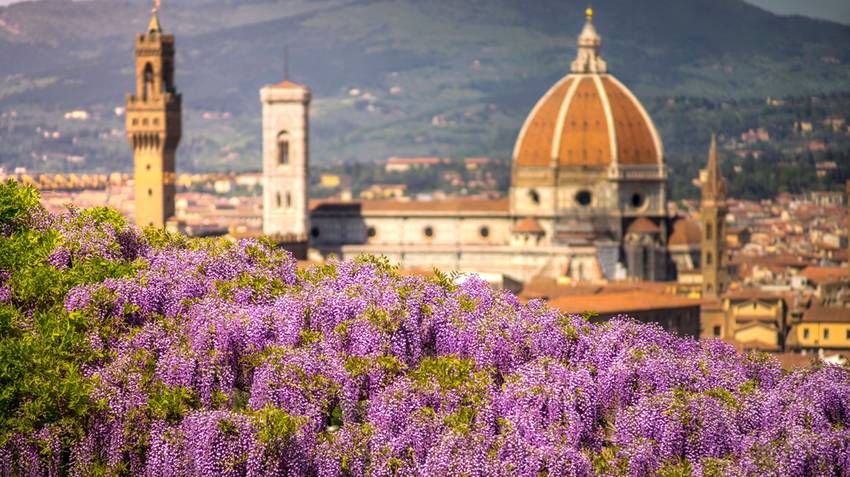
Florence in late spring has a particular quality in the early evening, when the light thins over the Arno and the last day-trip buses pull out from the Piazzale. The city doesn’t empty so much as it exhales. The streets around Santa Croce fill with a different kind of movement – dinner-bound, slower, less directed – and the Italy that people imagine before they arrive starts to look more like what’s actually in front of them.
What the neighborhood guides rarely say clearly is that Florence is not one city to stay in. It’s four or five distinct rhythms compressed into a walkable centre, and which one you land in shapes almost everything: how loud the mornings feel, how much local life you encounter, whether the city seems to operate around you or past you. The choice matters more here than in most Italian destinations of comparable size.
This guide covers the feel of each district, who tends to do well where, and the small practical realities that don’t appear on the hotel booking page.
The historic centre: proximity at a cost
The corridor running from the Duomo south to the Uffizi and west along Via dei Calzaiuoli is Florence at its most concentrated. Everything is close. The Baptistery is outside the door. The Accademia is a 12-minute walk. On the surface it’s the obvious place to be.
The cost is environmental. By 10:00 in late spring the streets around the Duomo are moving at a pace that leaves little room for the kind of slow morning that most people are actually trying to have in Italy. The cathedral square echoes. Gelato shops have lines before lunch. It’s not unpleasant, but it is relentless in a way that accumulates over several days.
Travelers who stay here for two or three nights and move on tend to find it works well. Those who settle for a week often start eating dinner in the opposite direction, toward quieter streets, without quite knowing why. The proximity to monuments is real; the livability for longer stays is more conditional.
Santa Croce: the neighbourhood that performs best in the evening
A few streets east of the Palazzo Vecchio, Santa Croce sits just outside the peak tourist corridor without losing easy access to it. The piazza itself is large enough that it doesn’t feel compressed even with people in it, and by evening it becomes one of the more pleasant open spaces in central Florence – students, locals returning home, a few travelers who figured out that sitting here is better than standing in a queue.
The streets immediately around the basilica fill with restaurants and wine bars that cater to a mixed clientele, somewhere between visitor-facing and neighbourhood-serving. Not all of them are worth the bill, but the overall energy of the area after 19:00 is genuinely good. It has the rare quality of feeling like a real place while still being central enough that nothing requires planning.
For solo travelers and couples on a 4-6 night stay, Santa Croce tends to be the most consistent choice in the city. Not the most atmospheric, not the most “authentic” in the way that word gets overused, but functionally the best balance between access and livability.
Oltrarno: south of the river, different city
Cross the Ponte Vecchio and turn left or right before looking at any map and you’ll notice the shift almost immediately. The scale changes. The pavement widens. The shops are different.
Oltrarno – broadly the left bank of the Arno – runs from the Ponte Vecchio westward through Palazzo Pitti and into San Frediano, which is the neighbourhood that makes the most converts among travelers who’ve been to Florence before and wanted something different the second time. There are workshops that have been in the same family for decades. There are coffee bars where the morning clientele are overwhelmingly Florentine. The tourist layer exists, but it’s thinner, and you can step out of it with about two minutes of walking.
The tradeoff is small and worth naming: Ponte Vecchio is one of the more compressed pedestrian points in the city at almost any hour during high season, and it’s your primary crossing to get anywhere north. Once you’ve crossed, it’s fine. But if you’re moving back and forth several times a day, that bridge bottleneck is something you feel. The alternative bridges – Ponte alle Grazie, Ponte Santa Trinita – add a few minutes but are significantly more pleasant to use.
For slow travelers, remote workers doing a 10-plus day stay, or anyone who has already seen the main monuments and wants the city’s daily rhythm more than its highlights, Oltrarno is the clear call. It’s also where evenings tend to run longer and later in a way that feels earned rather than performed.
Travelers weighing a Florence base against a different Italian pacing entirely will find the Rome first-time orientation read useful for calibrating what kind of city energy they’re actually after before committing to either.
San Lorenzo and the area north of the Duomo
The neighbourhood north and west of the cathedral, around the Mercato Centrale and San Lorenzo market, has a working texture that the streets immediately around the Duomo lack. It’s noisier, more functional, and considerably less curated. The market itself runs through the morning and is worth spending time in – not for the leather stalls outside, which are tourist-facing, but for the covered food market upstairs, where the clientele is Florentine and the quality is straightforward.
Accommodation here tends to be slightly cheaper for similar quality to the Duomo-adjacent options. The streets aren’t as polished, which is either a reason to choose it or a reason to look elsewhere, depending entirely on what you’re after. As a base for first-time visitors it works; as an atmospheric neighbourhood experience it’s limited. The area functions best as a place to sleep affordably close to everything rather than as a place to inhabit.
Piazzale Michelangelo and the hillside: views, but effort
Most travelers visit Piazzale Michelangelo as a viewpoint rather than a base, which is the correct instinct. The climb from the Arno is real – around 15-20 minutes on foot over staircases and ramps – and doing it daily with luggage or after a long day of walking doesn’t suit everyone. The views across the city are as good as advertised. The piazzale itself is crowded at sunset in a way that requires patience.
San Miniato al Monte, just above, is quieter and genuinely worth the additional few minutes. The church is Romanesque, understated, and usually less crowded than the viewpoint below. It’s the kind of place that rewards arriving a few minutes before closing, when most of the other visitors have already turned back down.
Staying up here is a niche choice. If you have a car and prefer quiet over proximity, it can work. For everyone else, it’s a half-day excursion from a base closer to the centre.
Who Florence works for, and where the fit breaks
Florence is a compact city with a high density of major art institutions, good food infrastructure, and a walkable layout that makes it one of the more forgiving Italian destinations for first-timers. The scale is manageable. Nothing requires a metro or a complicated bus. Most of what people come for is within 30 minutes on foot of wherever they’re staying.
Where it works less well: travelers who want a slow, spacious daily rhythm without putting in deliberate effort to find it. The tourist axis is tight, and the city’s popularity means that peak hours in the centre produce a sensory load that some travelers find tiring by day three. That’s not a reason to avoid Florence; it’s a reason to stay in Oltrarno, plan mornings early, and let the afternoon heat and crowds run their course while you’re somewhere else.
For travelers comparing the city against other Italian options before deciding, the Rome vs Florence first-timer breakdown works through the experience tradeoffs at the same decision stage.
It suits couples doing 4-7 nights as part of a broader Italy trip, solo travelers interested in art at a pace they control, and anyone who does well in a city that rewards early mornings and late evenings more than midday. It suits less well travelers who want the kind of deep neighbourhood immersion that requires weeks and linguistic patience, or those who find high tourist density actively unpleasant regardless of neighbourhood choice.
How the days actually unfold here
Florence mornings in late spring are worth protecting. By 08:30 the city is moving, coffee bars are full, and the light on the stone facades is at its best. The Uffizi queue, if you haven’t pre-booked, forms early. The Accademia fills by 10:00. If those are on the list, the morning is the slot.
Midday slows for a reason. The heat builds, the tourist corridors reach peak activity, and most of the better restaurants start filling from 12:30 onward. This is the window to eat well and move slowly rather than chase a second monument. Afternoons in Florence work better as drift time – a specific street, a specific church that’s free and usually quiet, a coffee somewhere off the main axis.
After 18:00 the city changes register. Day-trippers leave. The piazzas decompress. Dinner doesn’t really start until 19:30 or 20:00, and the restaurants worth going to don’t take kindly to being treated as fast-service options. The evening rhythm, in Oltrarno especially, can run until midnight without feeling forced. That arc from late afternoon through dinner is where Florence tends to make the strongest impression on people.
Where to settle: a practical summary by traveler type
For a first visit to Italy focused on art and monuments, the Santa Croce area or the streets immediately east of the Duomo give you proximity without the worst of the corridor intensity. Two nights is enough to orient; four to six nights covers the main institutions at a pace that doesn’t feel rushed.
For a longer stay or a repeat visit, Oltrarno. Specifically San Frediano if you want the most residential texture, or the streets between Piazza Pitti and Ponte Vecchio if you want slightly more restaurant options within walking distance.
For travelers who want to use Florence as a base for day trips – Siena, San Gimignano, Cinque Terre by train – the proximity to Santa Maria Novella station matters more. That puts the San Lorenzo area or the streets immediately west of the Duomo in practical range. The station is central enough that no Florence neighborhood is genuinely far from it, but shaving five minutes of walking off a 07:00 train departure is not nothing.
Travelers who find themselves drawn to the idea of a smaller-scale, quieter Italian city altogether – one where the tourist layer is thinner – may find the Lisbon first-time read a useful experiential comparison, or the Amsterdam neighborhood guide for a sense of how city scale and district character interact differently in a compact European destination.
Florence by neighborhood: what holds across the whole city
Whatever part of Florence you’re in, the city’s pace is fundamentally evening-oriented. The best of it – the dinner, the piazza, the slower street-level rhythm – happens after most of the day-visitors have left. Travelers who arrive expecting an early-morning-to-late-afternoon museum run and then some rest often miss the part of the city that justifies the stay.
The neighborhood choice mostly determines how much of the surrounding daily city life you encounter, how long the walk is to your first coffee, and whether the sound outside the window at midnight is a group of tourists or a resident pulling a shutter closed. Those are real differences. But Florence as an Italy destination rewards the same thing across all its neighborhoods: arriving with time to spare and using it slowly.
Florence neighborhood guide: frequently asked questions
1. Which Florence neighborhood is best for a first visit to Italy?
The area between Santa Croce and the Duomo puts you within walking distance of nearly everything without being directly on the most saturated tourist corridor. It works well for first-time visitors who want to orient quickly and move on foot. Oltrarno across the river is a slightly slower, more residential alternative if you prefer fewer souvenir shops outside your door.
2. Is Oltrarno actually quieter than the city centre?
Two streets south of the Arno it is noticeably different. San Frediano in particular has a neighbourhood rhythm that the Duomo area rarely achieves, with local bars, small workshops, and residents on the street rather than tour groups. The evenings there feel more like a city than a museum.
3. How walkable is Florence between neighborhoods?
Extremely walkable by the standards of Italian cities. The historic centre is compact and mostly flat, and most travelers cover the distance from Santa Croce to Oltrarno in under 20 minutes on foot. The one real exception is the climb to Piazzale Michelangelo or San Miniato, which asks for genuine uphill effort.
4. When does Florence feel least crowded during the day?
Early morning and after 18:00. By late afternoon many day-trip coaches have left, and the city shifts into its dinner rhythm. The Piazza della Signoria and the streets around the Uffizi become noticeably calmer from around 19:00 onward, which is also when they look their best.
5. Does the neighborhood you stay in change how Florence feels as a city?
Considerably. Staying inside the main tourist corridor gives you convenience but very little daily Florentine life to observe. Oltrarno, even a short walk from the tourist axis, produces a different pacing entirely, with coffee bars that fill with regulars in the morning and evenings that extend into the neighbourhood rather than ending at the hotel door.