
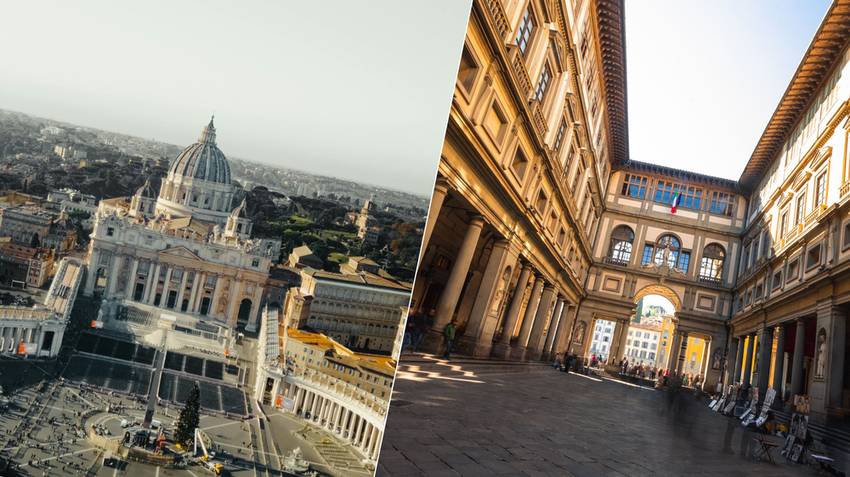
For most people planning their first trip to Italy, the choice between Rome and Florence comes up early and lingers for a while. Both cities appear on almost every itinerary.
Both carry obvious weight. But they work quite differently, and which one suits a particular traveler at a particular point in their life is not always the same answer. It’s not about which city is better in any absolute sense. It’s a matter of pace, density, and what kind of daily rhythm you want to have for a few days.
What Rome is like for first-time visitors
Rome is large in a way that surprises people who have only seen it on a map. The distance between the Colosseum and the Vatican is around 4 kilometres on a straight line, but the walking route runs through uneven stone streets, crosses plazas that funnel heat in the afternoon, and takes longer than the number suggests.
Most first-time visitors underestimate this on day one and start adjusting by day two.
The city operates at a high ambient noise level throughout the day. Scooters, outdoor terraces, tourist groups, and street vendors all contribute to a density that does not really thin until late evening, when certain residential streets around Trastevere or Prati go noticeably quiet.
That contrast, loud at the major sites, unexpectedly calm two streets off the main axis – is one of Rome’s more useful features once you learn to navigate it.
Getting between sites requires a decision every time. Rome’s metro has two main lines with limited coverage of the historic centre, so most movement happens on foot, by tram, or by taxi. A morning that involves the Roman Forum, lunch near Campo de’ Fiori, and an afternoon at the
Vatican is technically possible but involves around 8-10 kilometres of walking and a genuine caloric deficit by 16:00. Experienced Rome visitors tend to pick one zone per half-day rather than trying to cover the city as a loop.
Where you stay in Rome changes the experience more than many first-time visitors expect. Staying in Trastevere produces a very different daily rhythm than basing yourself near Termini, Prati, or the Pantheon corridor, particularly once walking load, late-evening noise, and transit friction start accumulating across several days.
The Rome neighborhood selection guide breaks down which areas actually fit different pacing styles and trip structures.
What Florence is like for first-time visitors
Florence is compact in a way that feels reassuring at first and slightly constraining by day three. The main cluster of sites – the Duomo, Uffizi, Ponte Vecchio, Accademia, sits within a 20-minute walk of itself.
There is no metro to worry about. The street layout is relatively legible. Most hotels in the historic centre put you within range of most things you came to see.
The tradeoff is that tourist pressure concentrates into a small area. The narrow lanes between Piazza della Repubblica and the river carry a lot of foot traffic between 10:00 and 16:00, and the Ponte Vecchio corridor in particular reaches a point in late morning where movement slows to a shuffle. This is not a reason to avoid Florence, it is simply the physical reality of concentrating major attractions into a medieval street plan.
Outside the core, Florence changes character considerably. The Oltrarno neighborhood on the south bank of the Arno runs at a different pace, with fewer tour groups and more of the functional street life that makes spending a long afternoon somewhere feel natural rather than performative.
The hills above the city, accessible by a 25-minute walk from Piazzale Michelangelo, offer a view that most people stop to look at longer than they planned.
Florence also operates on a narrower pricing spectrum than many travelers expect. The historic center can become expensive quickly once accommodation, museum entries, and restaurant positioning start stacking together inside a compact area.
Travelers trying to keep Florence comfortable without pushing the budget unnecessarily will find the Florence budget travel guide useful for understanding where the city remains accessible and where the tourist pricing layer becomes most visible.
Evenings in Florence wind down earlier than Rome. Kitchens tend to close by 22:00 or 22:30 in most places, and the streets thin considerably after 23:00. For travelers who prefer an early-to-bed rhythm, this is straightforwardly useful. For those who expect a city still operating at full speed at midnight, it requires an adjustment.
Rome vs Florence: pace, walking and daily rhythm
Rome asks more of your body. Four days in Rome typically means 12-15 kilometres per day if you are covering sites seriously, on surfaces that are genuinely hard on feet and knees – cobblestones, uneven marble, occasional steps with no clear warning. By the third day, most people are consciously rationing their energy in a way they were not on day one.
Florence is easier on the body in absolute distance terms, but the concentration of things to see in a small area creates a different kind of fatigue. Sensory density is high: narrow streets, close building facades, crowds in the same corridors for most of the day.
Some travelers find this stimulating. Others find it tiring by the afternoon, which is why the rhythm of lunch followed by a long slow walk across the Ponte Vecchio and into the Oltrarno works well as a mid-day reset.
One structural difference worth noting: Rome rewards longer stays in a way Florence does not necessarily. After four or five days in Rome, the city starts to feel navigable, the neighborhoods start to have distinct personalities, and the daily shape becomes something you can actually inhabit.
Florence is better absorbed in two to three focused days. Staying five days there as a first-time visitor, without venturing out to Siena, San Gimignano, or the surrounding hills, produces diminishing returns relatively quickly.
Travelers who realize they want to build a slower Tuscan rhythm around Florence – using it as a base for day trips into the countryside – often find the Florence vs Venice comparison useful for calibrating how much of their Italy trip to weight toward the north.
Who should choose Rome?
Rome works well for travelers who can carry a high stimulation level for several days without needing to decompress. It suits people who find energy in density, the feeling of a city operating at full volume around them, with something happening at every corner.
It also suits travelers who are genuinely interested in the layers of the place: the Republic over the Empire, the medieval city over the ancient one, the Counter-Reformation churches built on top of everything. That layering is what makes Rome’s scale feel rewarding rather than simply exhausting.
It is harder work for travelers who are already tired before they arrive. A couple coming off a difficult few months, or a solo traveler who needs quiet mornings and the ability to slow down without friction, may find Rome’s pace harder to manage than they expected. The city does not have much interest in operating at a slower speed for your benefit.
Travelers recovering from high-stimulation trip fatigue – or anyone who has found dense European capitals difficult in the past – sometimes drift toward Naples instead, which carries its own intensity but a different social register. The Naples first-time guide covers what that shift in energy actually looks like on the ground.
Who should choose Florence?
Florence suits travelers who want a high concentration of significant things within a small physical area, without needing to navigate a full city. It works particularly well for people visiting Italy primarily for art and architecture, where the Uffizi alone can anchor a full day and the buildings around it do the rest.
It also works for travelers who prefer the feeling of a city that they can hold in their heads after two days – where they know roughly where things are and how long it takes to get between them.
It is less satisfying for travelers who want urban texture and spontaneity across a wide area. Florence’s historic centre is well-preserved partly because it is a museum city in a meaningful sense, there are not many people actually living in those medieval streets, which is part of why it looks the way it does and part of why it can feel slightly staged by the second afternoon.
The city’s real residential life happens further out, in neighborhoods that most first-time visitors do not reach.
Couples or solo travelers who appreciate a slower pace, early dinners, and the ability to cover the main sites without a strict logistical plan tend to fit Florence well. Travelers who expect nightlife, a diverse food scene across different price points, and streets that stay animated past midnight will find it quieter than they anticipated.
How to combine Rome and Florence in one trip
Most first-time visitors to Italy do combine Rome and Florence, and the logistics support it cleanly. The high-speed train between the two takes around 90 minutes, runs frequently throughout the day, and deposits you in Florence’s Santa Maria Novella station about 10 minutes’ walk from the historic centre. There are no meaningful reasons not to do both on a single trip of a week or more.
The sequencing question is worth thinking about. Starting in Rome and finishing in Florence tends to work better than the reverse, because Rome’s scale and pace set a high-energy baseline that Florence’s quieter register then balances. Arriving in Rome after Florence sometimes makes Rome feel overwhelming by contrast, especially if the trip is already running at speed.
A reasonable first-trip structure for someone with eight days: four or five in Rome, then three in Florence, possibly with a day trip out of Florence toward Siena or the Chianti hills.
This gives Rome the time it needs and gives Florence a focused visit without the diminishing returns of overstaying.
Travelers who want to extend beyond these two cities will often find themselves weighing northern Italy next – the Venice vs Milan comparison covers that tradeoff for travelers trying to decide whether a third Italian city is worth adding to the itinerary.
Rome vs Florence by traveler type
If you are a first-time visitor to Italy whose main goal is to see the most significant things in the most concentrated way possible, Florence wins on efficiency. The density of what it offers relative to the physical and logistical effort required is higher than Rome’s.
If you want to understand what a large, functioning, historically layered city actually feels like to move through – and you can absorb that level of stimulation over four or five days – Rome is the more complete experience. It asks more of you and gives more back in proportion.
Neither city is wrong for a first trip to Italy. The error is applying the wrong pacing expectations to either one: treating Rome as a city you can cover quickly and lightly, or expecting Florence to operate with Rome’s urban energy after dark.
Which city is better for your first trip to Italy?
The real answer to the Rome vs Florence question is mostly a pacing question in disguise. Rome is a city that works when you give it time and go in with a physically calibrated plan. Florence is a city that works when you treat it as a contained, walkable visit and do not expect it to expand beyond its core.
For the majority of first-time travelers to Italy, both cities belong in the same trip. What changes is how many days you allocate to each, and which one you use to set the pace for the journey. Travelers who have found large European cities tiring in the past will likely find Florence the more comfortable anchor.
Travelers who want the full weight of being somewhere historically overwhelming and are willing to walk a lot to get it, will find Rome delivers exactly that.
Italy as a country rewards travelers who understand that different cities run at genuinely different speeds. Rome and Florence are not variations on the same theme. They are two distinct rhythms, and the trip works best when you treat them that way.
Rome vs Florence FAQ
1. Is Rome or Florence better for a first visit to Italy?
It depends on the pace you want. Rome is larger, denser, and requires more stamina over several days, but rewards travelers who want historical scale and a city that functions at full urban speed. Florence is more contained and walkable, which makes it easier to absorb in two or three days, but it runs at a quieter register than most first-time visitors expect.
2. How many days do you need in Rome versus Florence?
Rome generally needs at least four days to cover the major sites without feeling rushed, and five or six is more comfortable if you want breathing room. Florence works well in two to three full days for most first-time travelers; staying longer is possible but requires actively seeking out the quieter residential areas beyond the historic core.
3. Is Florence or Rome more crowded for tourists?
Both are very busy in spring and summer, but the crowd experience differs in structure. Rome spreads visitors across a large city, so you cycle between crowded zones and relatively calm streets. Florence concentrates almost all tourist movement into a compact area, so the pressure feels more constant even though the total visitor numbers may be lower.
4. Which city is easier to navigate as a first-time visitor to Italy?
Florence is easier to navigate on foot because the main sites are within a 20-25 minute walk of each other and the street layout is relatively legible. Rome requires more planning around transit and distance; the two metro lines help but leave significant gaps, and walking between major sites often involves 40 minutes or more on uneven stone surfaces.
5. Can you combine Rome and Florence on one first trip to Italy?
Yes, and most first-time travelers do. The high-speed train between the two cities takes around 90 minutes, which makes a combined trip logistically clean. The more useful question is sequencing: starting in Rome and ending in Florence tends to work well because Rome’s scale sets a high-stimulation baseline that Florence’s quieter pace then balances.