
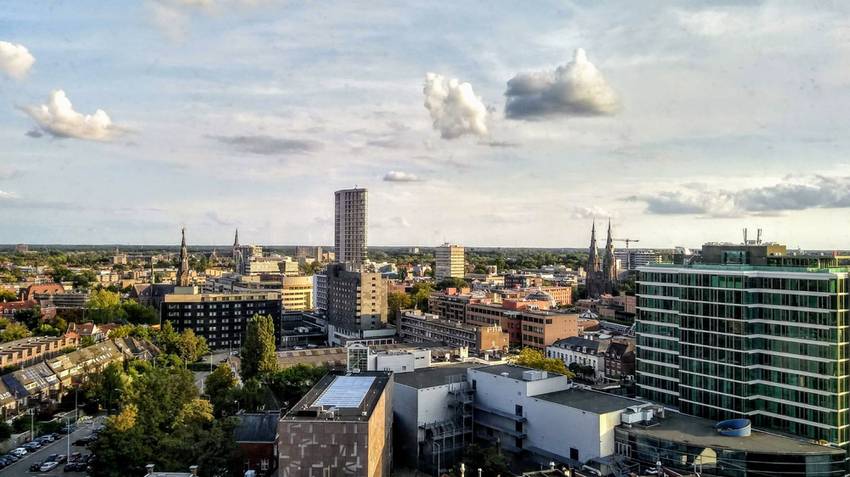
Eindhoven does not really announce itself. You arrive at a functional station, step out into a flat, orderly Dutch city, and the first question is usually a simple one: where do I actually stay? The neighborhoods of Eindhoven are distinct enough to matter, especially with summer approaching and the city filling up with design and tech visitors who have very different ideas of what a good base looks like.
This is not a large city, the core is walkable, the terrain is entirely flat, and most of what travelers want is reachable on foot or by a single bus. But the character of a stay shifts considerably depending on which neighborhood you land in, and that shift is worth understanding before you book.
What Eindhoven actually feels like to move through
The center is dense in a Dutch way, which is to say functional and relatively quiet compared to southern European equivalents. Wide pedestrian streets, cyclists moving through at speed, and a flat grid that makes orientation easy within the first hour. Most of the retail and café activity concentrates around the Markt and along the shopping streets radiating from it.
By late afternoon on a weekday, foot traffic thins noticeably. The city runs on a working-week rhythm, and the evenings pick up again mainly on Thursday through Saturday. If you arrive on a Sunday morning expecting animated streets, the center will feel quieter than most travelers anticipate, with fewer open options until mid-morning.
Walking distances between neighborhoods are short on a map but feel slightly longer because the streets are wide and the scale is generous. The distance from the Markt to Strijp-S is around twenty minutes on foot, mostly along straight corridors. On a bike, which most locals use, it takes eight minutes.
The center and the Markt area
This is the default base for most travelers and it earns its position straightforwardly. Accommodation here puts you within five minutes of the main transport hub, the evening bar and restaurant options, and the Saturday market that runs around the square. The streets are flat, well-lit, and easy to navigate after dark.
The character of the Markt shifts through the day. In the morning it is quiet and slightly empty-feeling, partly because Dutch cities do not do a long breakfast culture in the southern European sense. By early afternoon it picks up, and by evening it becomes genuinely lively, particularly on the terraces that face the square when the weather holds. Late spring evenings here, with the temperature mild and the daylight extending past 21:00, are when the center feels at its best.
The practical limitation is noise. The area immediately around the square and the adjacent bar streets carries sound into the early hours on weekends. Street-facing rooms in busy sections are a real consideration for anyone who needs quiet sleep before midnight.
Stratumseind and the nightlife corridor
Stratumseind runs for roughly 300 meters and contains a high concentration of bars operating until late. The street becomes genuinely busy on Thursday, Friday, and Saturday evenings, which is part of the point for travelers who want to be in the center of that energy without planning around it.
Staying directly on or adjacent to this street works for a specific kind of trip. Two or three nights of social weekend energy, proximity to the action, and no transit to think about. The street noise after midnight is substantial and consistent. For anything longer than a short stay, or for travelers with early starts, the appeal drops quickly, and moving a few streets back makes a significant difference.
The surrounding blocks blend into the general center, so location here is mostly about how much buffer you want between your room and the Friday evening crowd.
Strijp-S: the converted factory district
Strijp-S is where Philips used to manufacture radios and televisions, and the former industrial complex has been converted over the past two decades into studios, ateliers, design showrooms, cafés, and co-working spaces. The architecture is large-scale red brick, the streets are wide, and the atmosphere during the day is calm and working rather than tourist-oriented.
It sits roughly 1.5 kilometers west of the center, which is a 20-minute walk or a short bus ride. During Dutch Design Week in October it becomes the busiest part of the city. In late spring and summer the energy is quieter but consistent, with a stable population of designers and creative-sector workers moving through cafés and spaces that feel built for actual use rather than visitor consumption.
For remote workers or slow travelers who want a functional base with a defined daytime rhythm, Strijp-S tends to work better than the center. The cafés have working hours and working attitudes. The noise floor at night is low. The tradeoff is that the evening food and social options are more limited, and getting to the main restaurant clusters involves a bus or a walk back toward the center.
Travelers comparing this kind of lower-density creative neighborhood against their experience in other Dutch cities sometimes find themselves looking at the Amsterdam neighborhood stay read as a reference point for how Strijp-S fits relative to something like Amsterdam’s Westerpark or De Pijp.
Woensel and the northern neighborhoods
Woensel is the residential northern zone, primarily local in character and not oriented toward visitors. The Woensel market, one of the larger outdoor markets in the Netherlands, draws locals on Thursday and Saturday mornings, which gives the neighborhood a brief burst of activity. The rest of the time it runs on a quiet residential schedule.
Staying here makes practical sense mainly if accommodation in the center or Strijp-S is unavailable, or if you are visiting residents. Transit connections to the center are reliable, with buses running frequently enough to avoid a meaningful daily friction. But the walking option is around 25 minutes to the Markt, which is manageable but adds up over a longer stay.
The neighborhood rewards a slow pace and local observation rather than tourist programming. For anyone whose travel style runs toward markets, neighborhood bakeries, and watching a Dutch city function at a workday pace, Woensel has a calm that the center simply does not offer.
Around the station
The station area is undergoing ongoing redevelopment and currently has a transitional quality. Some accommodation sits close enough to Centraal to be genuinely convenient for early trains toward Den Bosch, Tilburg, or connections toward Antwerp. The station is about ten to twelve minutes on foot from the Markt.
The surrounding streets are partly commercial and partly construction-adjacent, which is not a dealbreaker but shapes the immediate environment. Travelers who have an early departure the following morning, or who are using Eindhoven primarily as a transit node, sometimes base here for practical reasons rather than atmosphere. The evening social options require a walk; the transit convenience is real.
If the rhythm of moving between Dutch cities is part of the trip’s logic, the Malaga neighborhood fit read is a useful contrast for understanding how differently a southern European equivalent handles the same question of neighborhood character versus transit proximity.
How to think about the neighborhoods as a whole
The realistic choice for most first-time visitors is between the center and Strijp-S, with the decision turning mostly on evening priorities. The center gives you more evening options within walking distance and puts you closer to what the city generates socially on weekends. Strijp-S gives you a slower, more working atmosphere during the day and quieter nights, with the center accessible by bus when you want it.
Neither choice involves a difficult transit commitment. Eindhoven is small enough that a wrong choice does not trap you, and the flat terrain means walking between neighborhoods is genuinely low-effort. The city does not punish base decisions the way a large, hilly, or highly polarized city might.
What does matter is timing within the week. Arriving Thursday through Saturday versus Sunday through Wednesday lands you in noticeably different cities. The center on a Wednesday evening is a different proposition from the same streets on a Friday. For travelers whose schedule is flexible, this has more practical effect on the experience than the specific neighborhood choice.
Travelers who find themselves weighing Eindhoven’s scale and creative character against other mid-size European cities often end up on the Florence neighborhood guide as a reference for how neighborhood character maps differently in a denser, older urban fabric.
Who the neighborhoods of Eindhoven suit
The neighborhoods of Eindhoven as a whole suit travelers who want a functional, low-friction Dutch base that runs at a working pace rather than a tourist pace. The center works for short visits, weekend social energy, and people who want proximity to everything without planning. Strijp-S works for longer stays, remote work routines, and travelers who prefer a quieter day structure with deliberate evening choices. Woensel and the station area work mainly for specific practical reasons.
The city does not suit travelers looking for a dense cultural itinerary that fills multiple days with programmed activity. Outside of Dutch Design Week in October, the cultural offering is real but not saturating. What Eindhoven does consistently well is provide a calm, navigable, low-friction city that does not demand much from you while still having a defined character, particularly in Strijp-S and around the Saturday Markt.
Late spring is a good time to be here. The terraces open reliably, the evenings are long, and the summer design and tech crowd has not yet arrived in full. If your interest is in how the city actually operates week to week, May and June give you that without the event-season compression that follows.
For travelers who like to understand how neighborhood character varies across European cities before committing to one, the Malaga neighborhood read covers a very different set of tradeoffs that sometimes clarifies what matters most in the choice.
Neighborhoods of Eindhoven: frequently asked questions
1. Which neighborhood in Eindhoven is best for first-time visitors?
The city center around the Markt is the most practical base for a first visit. It puts you within walking distance of the main streets, transport links, and most of the evening activity without needing to think about buses.
2. Is Strijp-S worth staying in or just visiting for a day?
Strijp-S works well as a day destination from a central base. Staying there suits travelers who specifically want a quieter, design-oriented atmosphere and do not mind the short bus ride into the center in the evening.
3. What is Stratumseind and should I stay near it?
Stratumseind is the main bar and nightlife strip, reportedly one of the longest in the Netherlands. Staying nearby makes sense if you plan to use it regularly; otherwise the noise after midnight is a real consideration.
4. How are the neighborhoods of Eindhoven different from each other in terms of atmosphere?
The center is commercial and practical, Stratumseind is social and loud in the evenings, Strijp-S is slower and design-focused, and areas like Woensel and the station surroundings are workday residential with fewer traveler amenities. The differences are noticeable within a ten-minute walk.
5. Is Eindhoven a good base for day trips in the region?
It connects well by train to Den Bosch and Tilburg, and within reasonable range of Antwerp and Maastricht. Centraal station is about a ten-minute walk from most central accommodation, which makes early departures straightforward.
6. What is the best neighborhood in Eindhoven for remote workers?
Strijp-S has the highest concentration of design studios, co-working spaces, and cafés with a working atmosphere. The center also has options, but Strijp-S tends to have a more productive, focused energy during the day.