
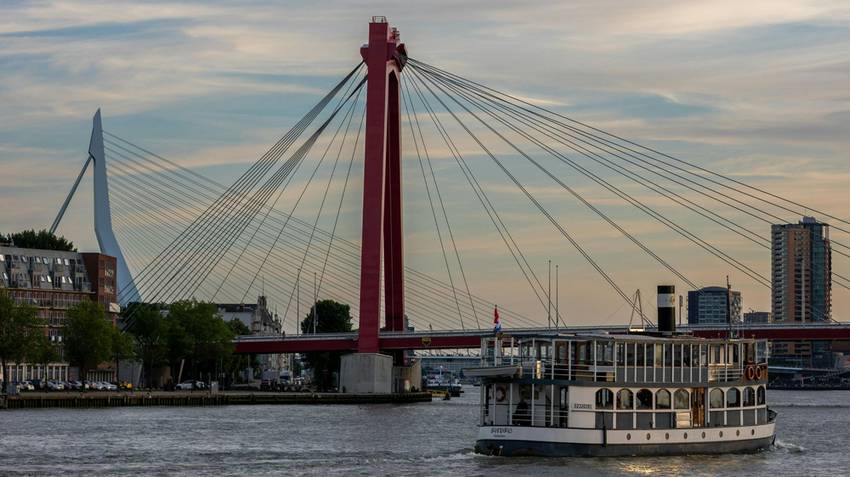
Rotterdam does not soften its edges for visitors. The skyline is deliberate, the waterfront is wide and open, and the architecture reads as a city that rebuilt itself from a near-complete post-war erasure and took the project seriously. Walking across the Erasmus Bridge in the evening, with the river carrying barge traffic and the south bank lit behind you, gives a sense of urban scale that the Netherlands rarely delivers anywhere else.
What makes the neighborhood question genuinely interesting here is that Rotterdam’s districts feel unlike each other in ways that go beyond atmosphere. Delfshaven survived the 1940 bombing; the rest of the city largely did not, and the reconstruction produced clusters of architectural ambition separated by fast arterials and open water. The result is a city that rewards moving between zones rather than settling into one area and calling it done.
For travelers coming from Amsterdam or about to continue there, Rotterdam often recalibrates expectations about what a major Dutch city can feel like. Tourist concentration is lower, the pace is slightly different, and the spatial logic – wider streets, fewer narrow canal corridors, more sky – takes a day or two to fully click.
The districts that actually define the city
The central waterfront belt, running from Blaak east toward Wilhelminapier, is where Rotterdam’s architectural identity is most legible. The Markthal, the Cube Houses, Hotel New York across the river in the former Holland-America Line terminal – this stretch is where the city concentrates its most-visited infrastructure and where first-time visitors tend to orientate themselves. It is not quiet, particularly on weekends, but the scale of the waterfront means it rarely feels compressed in the way a narrow historic centre would.
Witte de Withstraat and the streets immediately around it form the cultural and social core of the city. Galleries, restaurants, bars with tables on the pavement from May through September – this is where Rotterdam’s evening life runs most consistently. The street is a 15-minute walk from Blaak and functions as a genuine local corridor rather than a tourist strip, though by midsummer that distinction blurs slightly around the larger terraces.
Delfshaven, west of the centre, is the neighborhood that reads entirely differently from the rest. The historic harbour is intact – narrow buildings, boats in the water, a scale that feels closer to Delft than to the city you just came from. It takes about 20 minutes by tram from Central Station and the walk through the in-between districts is itself informative, passing through residential streets that most guides do not cover. The neighborhood is busier in summer but absorbs visitors without losing its texture.
Kralingen, east of centre, is residential and largely off the tourist map. A large park with a lake, good cafe density along the main streets, quiet in the evenings. It requires a tram ride to reach anything central, which some travelers find inconvenient and others find exactly right.
Who Rotterdam fits, and who might find it lacking
Rotterdam suits travelers whose primary interest is architecture, urban form, or port culture. The city is layered with decisions about how to build a modern city on a cleared site, and those decisions are visible everywhere from the waterfront to the side streets. Travelers who arrive with that lens leave with considerably more to think about than they expected.
It also works well for people who found Amsterdam too dense with visitors to move comfortably through. The tourist infrastructure here is real but lighter, and the city’s residential neighborhoods have a daily rhythm that is easier to access without planning around crowds. Remote workers and slower travelers tend to settle more comfortably in Rotterdam than the city’s reputation as a quick day trip might suggest.
Travelers whose primary interest is historic streetscape – canal houses, medieval cores, preserved old-town atmosphere – will find Rotterdam limited. Outside Delfshaven, the city does not offer that register. This is not a flaw; it is the honest shape of the place. The Eindhoven neighborhood read covers a similar post-industrial Dutch city energy, though at a smaller scale and with different architectural logic.
Pacing and movement across the city
Rotterdam’s flat terrain and wide pavements make it physically easier than most European cities of comparable size. The main friction is not gradient but distance – the districts that matter are spread across a larger footprint than a map suggests, and several areas that look walkable from the centre require 30-40 minutes on foot to reach properly. The tram and metro network covers most of it cleanly, with Central Station as the obvious transfer hub.
A two-day visit can cover the central waterfront, Witte de Withstraat, and Delfshaven without rushing. Three days allows Kralingen and a day trip to Delft or The Hague, which are 12 and 25 minutes by train respectively. The city’s position in the Netherlands makes it a natural base for moving around the region, and the train connections from Central Station are frequent enough that day-trip logistics are uncomplicated.
The waterfront along the Maas is wide and exposed. In spring the wind coming off the river can be strong on the southern bank near Wilhelminapier, which matters less for a short walk and more if you are sitting on a terrace for an hour. From late afternoon onward the light on the water is worth the exposure.
Evenings in Rotterdam tend to develop slowly. The Witte de Withstraat area picks up from around 18:00 and stays active well past midnight on weekends. The waterfront shifts toward a more ambient pace after 21:00, with people walking rather than sitting, which gives it a different quality from the restaurant district further inland.
Staying in Rotterdam: where the fit varies by traveler type
The area around Blaak and the waterfront is the most practical base for a first visit – everything central is walkable, the market and the main architectural landmarks are within a few minutes, and the metro and tram connections are direct. Hotels and apartments here are priced at a premium by Rotterdam standards, though still noticeably below Amsterdam.
Witte de Withstraat and the surrounding blocks work well for travelers who want to be inside the evening rhythm from the start. Noise on weekend nights carries past midnight on the main street itself, but one block back it drops significantly. The trade-off is a slightly longer walk to the waterfront landmarks.
Kralingen is the right choice for travelers who want longer stays, quieter mornings, and a neighbourhood that functions on its own terms. The park is genuinely good in late spring and early summer. The tram journey to the centre runs around 15-20 minutes, which is only inconvenient if you were planning to move between districts several times a day.
Rotterdam in the context of the Netherlands
Amsterdam gets the visitors, The Hague gets the institutions, and Rotterdam is the port city that built itself into something else without being entirely sure what. That ambiguity is part of what makes it interesting. The architecture is not settled into a consensus style; the neighborhoods have not finished negotiating with each other; the waterfront is still working rather than purely scenic.
For travelers moving through the Netherlands with more than a week, Rotterdam works as a two or three-night anchor that resets the tempo after Amsterdam’s density. It does not try to compete on the same terms and does not need to. The city has a confidence in its own form that makes it easier to read once you stop expecting it to look like the other Dutch cities in the itinerary.
Those building a first-time Netherlands itinerary and trying to decide how to distribute time between cities will find the Amsterdam neighborhood stays read useful for understanding how the two cities differ at the district level, which makes the choice of where to spend more time considerably clearer.
What Rotterdam actually suits in May and into summer
Late spring is a good entry point. The terraces open fully in May, the waterfront walks are comfortable without summer heat pressure, and the city has not yet absorbed the peak-season visitor volume that July and August bring to the Markthal and the Cube Houses area. Weekend mornings at Blaak market in May are still predominantly local in feel.
Summer extends the day considerably – northern light keeps the riverfront walkable past 21:00, which suits Rotterdam’s outdoor evening rhythm well. The city’s design is built around movement and open space rather than enclosed squares, so the long days give the waterfront and the park areas their best version of themselves. Kralingen lake in June is the kind of place you do not plan to spend three hours and then do.
The city does not have a low season that meaningfully degrades the experience. Autumn and winter shift activity inward – the covered Markthal absorbs visitors who would otherwise be on the waterfront, the cafe culture becomes more interior-focused, and the architectural qualities of the city arguably read better in grey light than in flat summer sun. Rotterdam is not seasonal in the way a beach destination is.
The traveler-fit verdict for Rotterdam in the Netherlands
Rotterdam works best for travelers who are comfortable with a city that prioritizes form over nostalgia. The energy is lower-key than Amsterdam without being slow, the districts are distinct enough to give a longer stay real variety, and the transport connections make it a practical base for the wider Netherlands. It fits people who want to understand how a city thinks, not just how it looks from a canal tour.
It is less suited to travelers whose Netherlands itinerary is primarily built around historic atmosphere, cycling through canal-lined streets, or the classic Dutch-city visual vocabulary. Those travelers will find what they need elsewhere and may feel Rotterdam requires more orientation than the timeline allows.
For the Netherlands as a destination, Rotterdam is the city that holds up longest under close attention. The initial read is direct and slightly austere, but the detail accumulates over days in a way that most first-time visitors do not anticipate.
Rotterdam neighborhood guide: frequently asked questions
1. Which Rotterdam neighborhood is best for first-time visitors?
The area around Blaak and the Waterfront puts you within walking distance of the Markthal, the Cube Houses, and the Erasmus Bridge. It orients quickly, has good metro and tram access, and gives a strong sense of what makes Rotterdam feel different from other Dutch cities. Most first-time visitors find this central belt the easiest base.
2. Is Rotterdam worth visiting if you have already seen Amsterdam?
Rotterdam has a different register entirely – denser architecturally, more contemporary, with a working-port atmosphere that Amsterdam no longer carries. The scale is more manageable, the tourist concentration is lower, and the waterfront moves at a pace that feels less choreographed. Travelers who found Amsterdam crowded tend to settle more comfortably here.
3. What is the quietest neighborhood to stay in Rotterdam?
Kralingen, east of the centre, is a residential district with a large park and a lake that draws locals rather than tourists. It requires a tram ride to reach the central waterfront, but evenings there are noticeably calmer than anything near Witte de Withstraat. Good fit for travelers who want the city at hand but not directly underfoot.
4. How do Rotterdam’s neighborhoods change in summer?
Summer shifts the city’s energy outward – the Maas riverbanks fill in the evenings, rooftop bars open, and the waterfront around Hotel New York becomes a genuine gathering point. Delfshaven gets busier but never feels overloaded. The long northern light means the city stays animated well past 21:00, which suits the outdoor rhythm most Rotterdam neighborhoods are built around.
5. What kind of traveler does Rotterdam suit best?
Rotterdam tends to work well for people interested in architecture, port history, or contemporary urban form – and less well for travelers whose primary lens is historic streetscapes or conventional old-city atmosphere. The city rewards curiosity and direct observation over curated sightseeing, and its low tourist-to-resident ratio in most neighborhoods gives it a texture that feels closer to how the city actually lives.
Continue exploring through the Lisbon first-time guide if your travel thinking is moving toward other western European port cities with strong architectural character and a distinct sense of daily rhythm – the comparison in pace and urban texture is instructive.
Travelers who are already calibrated to Dutch urban rhythm and want to weigh Rotterdam against a slower coastal register might find the Malaga neighborhood fit read a useful contrast – not as a direct alternative, but as a different European waterfront logic that clarifies what Rotterdam is and is not.