
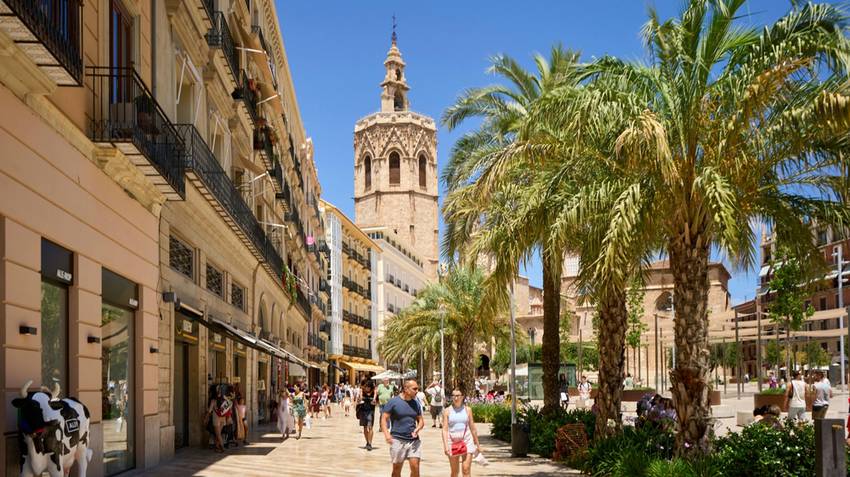
Valencia in early summer has a particular quality in the morning: the old town still holds the cool of the night, the first cafés are setting out chairs, and the streets are genuinely walkable before the day warms up. By early afternoon the light is sharp and the pace slows down. The city adjusts, and so does everyone in it.
The neighborhoods of Valencia read very differently from each other, which is not always obvious from a map. The gap between staying in Carmen and staying in Ruzafa is not just geographic – it is a difference in daily rhythm, noise register, and the kind of evening you are likely to have. Getting that choice right tends to shape the whole trip.
Travelers who are still deciding whether Valencia belongs in their itinerary at all may find the Valencia first-time guide useful before choosing a specific district. What follows is a read of the main districts by atmosphere and fit, not by proximity to a landmark list. The question worth asking is not which neighborhood is closest to the cathedral, but which one matches how you actually want to spend your time.
Carmen and the old town: dense, central, socially active
Carmen is the historic core that most first-time visitors default to, and the logic holds. The streets are narrow, the architecture reads clearly as old Valencia, and the distance to everything significant is short. The market, the cathedral square, the central park, the port tram – all of it is close enough that the city feels navigable without planning.
The street-level experience changes significantly across the day. By mid-morning the tourist corridors are filling, the main lanes near the central market carry steady foot traffic, and the squares are in full sun. Late evening in Carmen has a different quality: the day-trippers have cleared, the residents are back at street level, and the bars around Plaça del Tossal stay lively past midnight. The social tempo here does not wind down early.
For stays of two or three nights, Carmen works well almost regardless of traveler type, because the access radius is simply efficient. For longer stays, the acoustic register of the weekend nights – which carries into the early hours on the main streets – becomes part of the calculation. The narrow geometry that gives Carmen its character also means sound travels.
Travelers who enjoy this style of compact historic center often end up comparing it with Catalonia’s largest city. The Barcelona neighborhood guide explores a very different neighborhood structure built around a much larger urban footprint.
Ruzafa: the neighborhood that rewards settling in
Ruzafa sits roughly 20 minutes south of the old town on foot, across the dry riverbed park, and it functions on a noticeably different tempo. During the day it is a working residential neighborhood with good coffee, small shops, and the kind of street life that does not perform itself for visitors.
The change happens in the evening. From around 20:00 the terraces outside the restaurants and bars along Calle Cuba and the surrounding streets begin to fill, conversation gets louder, and the neighborhood becomes one of the more socially alive parts of the city. It runs later than most visitors expect – still busy at midnight on a Thursday, restaurants turning tables at 22:30 on a Saturday.
Ruzafa tends to suit travelers who want good food and a local social atmosphere without being inside the old town tourist corridor. Remote workers doing longer stays often end up anchored here because the daytime pace is calm enough to work in, and the evening gives them something to walk toward. The walk to Carmen takes around 20 minutes and passes through some of the quieter residential streets that feel very different from either district at their most active.
El Cabanyal and the beach districts: a different kind of city
The beach neighborhoods – Malvarrosa, El Cabanyal, the stretch closest to the port – read as a separate city from the historic centre, connected by metro (line 5, roughly 15 minutes), a tram line along the seafront, and an excellent cycle path that makes the journey itself pleasant rather than just functional.
Travelers comparing urban beach access across Spain may also find the Spain city beaches guide useful for understanding how Valencia’s coastline differs from other major Spanish destinations.
El Cabanyal has been in a slow process of renovation for years, and the current result is a neighborhood in visible transition: beautifully tiled modernist facades next to buildings that have not yet been touched, a food and bar scene that started as local and is now attracting more visitors, a weekend atmosphere that tilts social and Mediterranean in the specific way that seaside neighborhoods in Spain tend to do. Mornings here smell of salt and bread from the bakeries along the main streets, and the light on the tile facades around 08:30 is one of the more quietly distinctive things about Valencia that does not appear in most travel photography.
Staying near the beach makes obvious sense if the priority is morning swims and evening promenade walks. The trade-off is distance from the historic core, which becomes noticeable over a week if the itinerary involves the old town regularly. The metro covers it well, but the rhythm of the day needs to account for it. For beach-first travelers, or anyone spending a week or more, splitting the stay between Ruzafa and the beach area is a structure that tends to work.
The City of Arts and Sciences area: clean, quiet, practical
The area immediately around the City of Arts and Sciences is residential and considerably calmer than Carmen or Ruzafa. It is not a neighborhood in the same social sense – there is no particular evening scene, no cluster of restaurants that defines the local rhythm – but it is practical, well connected, and significantly quieter than the old town.
For travelers visiting Valencia primarily to see the Calatrava complex and the science museum, staying nearby removes one layer of logistics. For everyone else, the distance from the parts of the city that give Valencia its social and culinary identity is noticeable enough that it tends to be a less suitable base unless the itinerary genuinely centers on that corner of the city.
Pacing across neighborhoods: how days actually unfold
Valencia’s flatness is one of its structural advantages. Unlike many Spanish cities, the walking profile here is genuinely easy – no significant hills, surfaces that are mostly smooth, and distances that are honest on a map. The gap between Ruzafa and the old town is 20 minutes on foot. The beach from Ruzafa is around 35 to 40 minutes walking, or 15 on the metro.
The tram along the seafront (line 4) connects the port area northward to the marina and south toward the city, and functions as one of the more pleasant transit experiences in the city – moving at surface level alongside the promenade rather than underground. Most visitors use it once or twice and then default to the metro for speed.
A typical day in the old town tends to compress toward the middle of the day and then re-expand in the evening. Mornings before 10:00 have the city mostly to local residents; the market, the streets around the cathedral, and the park are at their best in that window. Midday is the low point for pedestrian comfort in summer – the stone streets hold heat and the main corridors are at their busiest. The city comes back to life properly after 19:00, when the light shifts and the squares fill with people who have nowhere particular to be.
Travelers staying longer than four nights often find a natural split between two modes: slower mornings in their neighborhood, more active evenings in the old town or Ruzafa, and at least one full day organized around the beach. That structure maps well onto how Valencia’s rhythm actually works rather than fighting it.
Comparing Valencia’s neighborhood fit with other Spanish cities
Travelers deciding between Valencia and Seville often get stuck on a similar question: which city has the better neighborhood logic for a first visit. The Seville vs Valencia traveler fit read covers that comparison directly, including how the atmospheric differences between the two cities translate into different daily rhythms and different base choices.
For travelers who have already done Malaga and are looking at how Valencia compares in terms of neighborhood structure, the Malaga neighborhood fit read maps out a useful parallel – both cities have a distinct beach-versus-old-town split, but the distances and transit options play out differently. If Madrid is also in the sequence, the Madrid neighborhood stays read sits at the denser, more complex end of the Spanish city comparison and gives a useful sense of how Valencia’s scale and pace differ.
Who the neighborhoods of Valencia actually suit
Carmen and the historic core work best for first visits, short stays, travelers who want access without planning, and anyone for whom being inside the social fabric of the old city matters more than quiet. The density and acoustic register at night are part of the package.
Ruzafa suits longer stays, remote workers, travelers who want a local neighborhood experience alongside good evening options, and couples or solo travelers who prefer settling into a routine over maximizing sightseeing efficiency. The slower daytime pace is a feature here, not an absence of activity.
The beach districts suit beach-first travelers, families with children, people on longer stays who want a different tempo from the historic core, and anyone for whom the early morning swim or the evening promenade carries real weight in how they want the trip to feel. The metro connection is reliable enough that the old town never becomes inaccessible.
The City of Arts and Sciences area suits travelers with a specific itinerary focus on that part of the city, or those who simply want quiet and space at a distance from the tourist corridors. It is the right choice for a smaller number of travelers and tends to be a less suitable base for most first-time visitors with broader itineraries.
How Valencia’s neighborhoods sit in a longer itinerary
The neighborhoods of Valencia are legible in a way that rewards some advance thought without requiring much. Decide what you want to be close to in the evening – old town social life, a local residential scene, or the beach – and the base choice follows naturally from that. The distances between districts are honest, the metro covers the gaps that walking does not, and the city does not punish you for getting the base choice slightly wrong.
For travelers planning a broader route through the country, the Spain itinerary guide shows how Valencia connects naturally with Barcelona, Madrid, and Seville within the same trip.
Three nights in Carmen followed by two in Ruzafa, or a full week anchored in Ruzafa with day rhythms extending toward the beach and the old town, are both structures that tend to surface naturally after a day or two in the city. Valencia is flat, readable, and consistent enough in its rhythms that most travelers find their own version of it fairly quickly.
The best time to figure out where you actually want to be in Valencia is the first evening, when the neighborhoods show what they are made of after dark. Walk through Carmen at 22:00 and then walk down to Ruzafa. The difference is obvious and the choice usually makes itself.
Frequently asked questions about neighborhoods of Valencia
1. Which neighborhood in Valencia is best for first-time visitors?
The old town, specifically the area around Carmen and Barrio del Carmen, gives first-time visitors the most concentrated access to the historic fabric, main squares, and evening social life. It works especially well for shorter stays of two or three nights where proximity matters more than quiet.
2. Is Ruzafa a good area to stay in Valencia?
Ruzafa suits travelers who want a residential rhythm alongside good restaurants and a social evening scene. It runs quieter than the old town during the day, but the terraces fill from around 20:00 and the streets stay active well past midnight on weekends.
3. Where should I stay in Valencia if I want to be near the beach?
Malvarrosa and the areas closest to the port are the most practical bases for beach-first stays, though the distance from the main historic sites means spending time on the metro or renting a bike. The cycle path connecting the beach to the city centre is one of the more pleasant commutes Valencia offers.
4. How far is Ruzafa from the old town in Valencia?
On foot, Ruzafa sits roughly 15 to 20 minutes south of the historic centre depending on your exact starting point. It is a walkable gap, and the route passes through some of the calmer residential streets that feel very different from the main tourist corridors.
5. What is Valencia like to navigate for a first-time visitor?
Valencia is flat and straightforward to read once you understand how the districts sit relative to each other. The metro is simple enough for day trips to the beach or the City of Arts and Sciences, and the old town is compact enough to explore almost entirely on foot, especially in the cooler morning hours when the streets have their own particular quiet.