
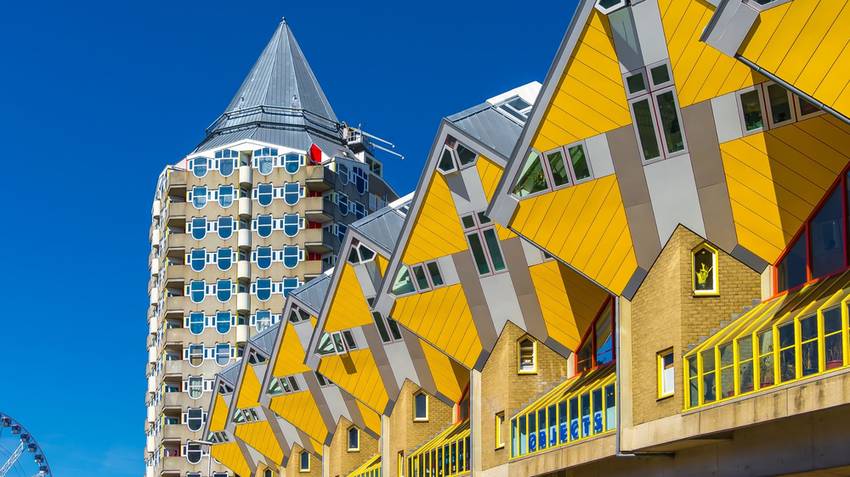
Rotterdam in June runs at a particular temperature – not just the weather, but the pace of the place. The harbour light stretches well past 21:00, the outdoor terraces along the Maas fill gradually rather than all at once, and the city has an ease to it that its architectural reputation sometimes obscures. A budget travel guide to Rotterdam is really a guide to reading the city correctly, because most of the money people spend here is optional rather than inevitable.
This is a city that can cost very little or a fair amount depending almost entirely on where you eat, which transport you use, and whether you fall for the harbour-view premium that sits on top of otherwise ordinary meals. The bones of the trip – the waterfront, the architecture, the neighbourhood walk through Delfshaven or Katendrecht – cost nothing. The spending happens at the edges, and those edges are easy to see once you know what they are.
The angle here is pacing and trade-offs: not a list of the cheapest hostels, but an honest picture of where money goes in Rotterdam, which rhythms suit a budget traveler, and what the city actually feels like when you approach it with spending awareness rather than anxiety.
Rotterdam budget travel costs in the Netherlands
Accommodation is the most significant variable. Rotterdam runs noticeably cheaper than Amsterdam for comparable options, and the central zones are compact enough that location matters less here than in larger cities. A private room in a mid-range hostel or budget hotel in the centre typically lands between 50 and 90 euros per night in summer, with some options below that if you are willing to look at Kralingen or the edges of the Lloyd Kwartier rather than the Wilhelminapier side of things.
Travelers comparing Dutch city costs more broadly may also find the Amsterdam versus Rotterdam comparison useful, particularly when weighing accommodation prices and daily spending patterns.
Food is where the city splits clearly. Market Hal – the arched indoor market near Blaak station – is one of the more honest budget eating options in any Dutch city. Vendors there run between 5 and 12 euros for a full plate, the variety is genuine, and the building itself is worth the stop even if you only have a coffee. The harbour-facing restaurants along Wilhelminapier are a different register entirely: the views command a premium that the food itself rarely justifies, and most experienced visitors treat those spots as drinks destinations rather than meals.
Transport costs almost nothing if you use the RET network intelligently. A day card or a loaded OV-chipkaart covers metro, tram, and bus access across the whole city. The metro connects Central Station to the waterfront zones, Blaak, and most of the residential neighbourhoods in under 15 minutes. Rotterdam is also flat enough that walking between districts is rarely a commitment – the distance from Central Station to Delfshaven on foot takes around 25 minutes on wide, easy pavement.
Where Rotterdam, Netherlands stays affordable and where costs rise
The architecture is free. That sounds obvious, but it matters more in Rotterdam than in most cities because the architecture IS the primary experience. The Cube Houses, the Markthal exterior, the Erasmus Bridge at dusk, the skyline view from the south bank – these cost nothing and are not diminished versions of a paid experience. A slow walk from Central Station through the Blaak area and down to the Maas riverfront is one of the more satisfying two-hour sequences in any Northern European city.
Museums are where it gets selective. The Museum Boijmans Van Beuningen building has been under renovation and the collection is currently accessible through the Depot Boijmans Van Beuningen – a mirrored-bowl building in the Museumpark that charges around 20 euros for entry but is genuinely unlike most museum experiences on the continent. It is a considered spend, not a polarising. The Maritime Museum runs significantly cheaper and is better suited to a half-day than a full one.
The Euromast observation tower is the most obvious tourist-premium item in the city, and it is also one of the more skippable ones if the budget is tight. The view from the south bank of the Maas at low cost gives you a version of the same skyline without the lift ticket.
Drinking out is where the drift happens. Rotterdam has a lively bar culture – Katendrecht in particular has a concentrated strip of craft beer venues and wine bars that are easy to spend an unplanned evening in. The prices are not unreasonable by Amsterdam or London standards, but they add up across multiple nights faster than the daytime spending does. One or two deliberate evenings there are part of the Rotterdam rhythm; every evening there is a different proposition.
Best Rotterdam neighborhoods for budget travelers
Delfshaven is the part of Rotterdam that looks most like the city’s pre-war self – narrow canal streets, an old windmill, a quieter human scale that contrasts with the glass towers visible just over the rooftops. It is also where some of the city’s smaller, neighbourhood-priced cafes and lunch spots operate without the design-district markup. A lunch there on a weekday afternoon, with the canal almost still and most of the morning visitors already gone, is one of the lower-cost and higher-atmosphere moments available in the city.
Travelers looking at the city district by district can continue with the Rotterdam neighborhood guide, which explores how Delfshaven, Katendrecht, Kralingen, and the waterfront areas differ.
Katendrecht, across the Maas on what was once the city’s port promontory, has a slightly different energy – more evening-focused, younger, with the sense that the neighbourhood is still in the middle of becoming something. The restaurants here are independent rather than chain, and several of them run lunch menus that sit between 10 and 15 euros in a way that the Wilhelminapier side of the water does not. The walk across the Rijnhaven bridge to get there is also part of the experience, with the container-crane silhouettes along the southern horizon giving the approach a particular industrial lightness that Rotterdam does better than almost any other European city.
Kralingen, further east, has a large recreational lake and a residential neighbourhood that most visitors never reach. It is not a destination in the conventional sense, but for anyone staying multiple nights, an afternoon there – coffee near the water, a slow walk around the Kralingse Plas – has the kind of decompression rhythm that keeps longer stays from feeling like a continuous march through architecture.
How to get around Rotterdam on a budget
Rotterdam Centraal is a well-signed station with a clear relationship to the metro network. The arrivals sequence from Schiphol or Amsterdam is straightforward by Intercity train – around 40 minutes from Amsterdam Centraal – and the price is manageable within the OV-chipkaart system. If you are arriving from Brussels, the Thalys-successor services stop at Rotterdam Centraal before Amsterdam, which makes it a sensible first stop in the Netherlands rather than an afterthought.
The metro’s four lines cover the key districts without requiring much interpretation. Line B and Line D are the most useful for central movement. The Erasmus metro station gives direct access to the Wilhelminapier area without a long surface walk, though the walk itself along the waterfront after 18:00 – when the evening light catches the bridge cable-stays – is the kind of thing that makes the slower option feel like the correct one.
Travelers who arrive by car or who are considering a day-trip structure from Amsterdam will find parking expensive and mostly unnecessary. The train connection is fast enough that Rotterdam works well as a base for visiting The Hague (20 minutes) or Delft (12 minutes) without needing to move accommodation. That flexibility – using Rotterdam as a regional anchor rather than just a standalone stop – is one of the arguments for spending two or three nights here rather than one.
Travelers mapping out a broader Netherlands circuit often find the Netherlands city-loop read useful at this point, particularly for understanding how Rotterdam’s pace sits relative to Utrecht and The Hague within the same trip.
Is Rotterdam, Netherlands good for budget travelers?
Rotterdam works naturally for travelers who find their energy in looking at cities rather than consuming them through a checklist. The architecture alone – and the particular quality of light that bounces off the glass and the water on a long summer evening – gives the visit a continuous visual interest that does not require tickets, reservations, or a schedule.
For travelers still deciding whether Rotterdam fits their style of trip, the Amsterdam first-time guide provides a useful contrast in density, pace, and visitor experience.
It suits solo travelers and couples who are comfortable spending significant parts of the day simply walking, orienting, and choosing spontaneously. The city’s rhythm rewards that mode: the best moments here tend to arrive when you are not trying to produce them. A side street in Delfshaven at midday, the view from the Wilhelminapier looking back at the skyline at 20:30, the Market Hal on a quiet Tuesday – these are not planned experiences. They are the texture of moving through a city that happens to be very good-looking and not yet overloaded with the volume of visitors that would change that.
It suits less well travelers who need a dense agenda to feel the trip is working. Rotterdam is not Amsterdam in terms of cultural site volume, and the city’s quieter residential scale can read as emptiness rather than atmosphere if the expectation is constant stimulation. It also sits at a slightly odd angle for very short visits – one day is enough to see the main architecture but not enough to get a real sense of the neighbourhood variation that makes the city interesting over time.
For travelers weighing Rotterdam against Amsterdam as a base, the Amsterdam or Rotterdam city comparison covers that specific trade-off in more detail, particularly on cost, density, and visitor energy.
How to plan two or three budget days in Rotterdam
Two days is the minimum that gives Rotterdam a fair hearing. A single day produces a highlight reel but misses the rhythm shifts – the way the Maas waterfront changes between 11:00 and 21:00, the difference between a Market Hal visit on a weekend afternoon and a weekday morning, the slower quality that the residential streets take on once the day-trip visitors clear out.
A practical two-day shape: the first day in the architectural centre and along the Maas, with the market visit in the morning before the afternoon build, and an evening walk across the Erasmus Bridge toward Katendrecht. The second day with a half-morning in Delfshaven and the afternoon on a regional day-trip to Delft or The Hague, returning for a late dinner back in the city. That sequence uses the city without high-tempo it and keeps the budget in a manageable range because the day-trip legs are cheap by train and Delft in particular requires almost no spending to feel like a worthwhile few hours.
Three nights changes the dynamic noticeably. By the third day, Rotterdam starts to feel familiar in the best sense – you know which coffee place opens early, you have walked the same bridge twice and noticed different things both times, and the pace of the city has settled into something close to your own. That familiarity is where the city’s atmosphere comes through most clearly, and it is harder to manufacture on a single night’s stay.
What budget travel changes in Rotterdam
Rotterdam does not require significant spending to be a genuinely rewarding trip. The architecture, the waterfront, the neighbourhood variation, and the evening rhythm along the Maas are available to anyone moving through the city with attention and reasonable timing. Where money goes in Rotterdam is mostly about elevation – upgrading from a market lunch to a harbour-terrace dinner, from a metro ride to a taxi, from a self-guided walk to a guided tour. Those upgrades are available but not necessary, and the gap between the low-cost version of the trip and the higher-cost version is mostly one of comfort rather than experience.
The city has a particular quality of being interesting at eye level – the street furniture, the building facades, the way the sky reflects in the glass towers – that does not require any entry fee. That quality is what makes Rotterdam genuinely good value in summer, even as the city’s reputation and weekend visitor numbers push some of the surface prices upward.
Is Rotterdam worth visiting on a budget?
A budget travel guide to Rotterdam arrives at a straightforward conclusion: the city is one of the more forgiving destinations in Northern Europe for travelers who want to spend thoughtfully rather than freely. The architecture is the product, and the architecture is public. The eating options divide clearly between the good-value market-hall and neighbourhood tier and the premium harbour-view tier, and that division is easy to navigate once you see it.
Travelers planning a wider route through the country often combine Rotterdam with Utrecht and Amsterdam using the Netherlands itinerary guide as a starting framework.
The traveler this works for is someone who finds stimulus in visual complexity and is comfortable with a slower daily pace – long walks, a few hours in a neighbourhood, an evening that drifts rather than a schedule that fills. Rotterdam in summer suits that mode well. The evenings are long, the waterfront is generous with its light, and the city never quite feels like it is performing for visitors the way some other Dutch destinations do.
Where the fit shifts is for travelers who need a full agenda to feel the trip is justified, or who are coming for a single day and expecting the same density of experience that a longer stay produces. For that shape of visit, the budget framing changes less than the time allocation does.
Travelers who find Rotterdam’s scale comfortable but want to understand how the wider Netherlands circuit holds together often turn to the Utrecht first-visit read next – it covers a quieter tempo and a more compact city that pairs naturally with a Rotterdam base.
Frequently asked questions about visiting Rotterdam on a budget
1. Is Rotterdam an expensive city to visit?
Rotterdam sits at a mid-range level by Dutch standards. Accommodation runs cheaper than Amsterdam, and the food scene has genuine options below 15 euros per meal if you work the market halls and local lunch spots rather than the harbour-facing terraces. The city’s design-heavy reputation can push spending upward, but the baseline costs are reasonable for Western Europe.
2. What is the cheapest way to get around Rotterdam?
The RET metro and tram network covers the city well, and a day OV-chipkaart loaded with credit gives you access to the full network without buying individual tickets. Walking is a realistic option across central zones given the flat terrain. Cycling is also widespread, and short-term bike rentals are available near Central Station for multi-hour use.
3. Where can you eat cheaply in Rotterdam?
Market Hal is the most reliable budget eating stop in the centre – vendors there typically run between 5 and 12 euros for a full plate, and the variety keeps it from feeling like a compromise. Katendrecht and Delfshaven have smaller neighbourhood spots where lunch menus tend to sit in the same range. The harbour-facing restaurants along Wilhelminapier are better treated as drinks stops than meal destinations if you are watching costs.
4. Is Rotterdam worth visiting on a short trip?
Two full days gives you a solid read on the city – enough to move through the architecture zone, the Maas waterfront, and at least one quieter neighbourhood without rushing. Rotterdam’s pace suits shorter trips well because the distances are walkable and the energy concentrates in the evening rather than spreading across a long list of sites. The city tends to reward those who slow down around the water after 18:00.
5. When is the best time to visit Rotterdam on a budget?
May and September tend to offer the most useful balance: accommodation prices ease slightly outside the summer peak, and the outdoor rhythm along the Maas and in the smaller districts still runs at full energy. Summer is the liveliest window for the waterfront and rooftop bars, but weekday visits from June to August keep costs and crowd activity more manageable than weekend arrivals.