
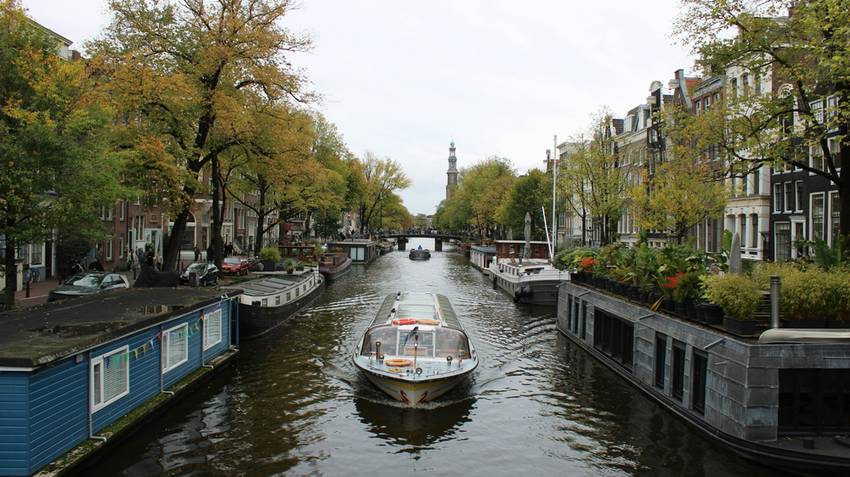
Before the city fully orients itself, the Canal Ring holds a particular kind of stillness. The water sits flat, the brick facades come back amber in the low June light, and the bridges are yours for a few minutes at a time. Amsterdam Canal Ring for a morning rhythm is one of those pairings that actually delivers what it promises, but only inside a narrow window.
The canals themselves are the same at any hour, but the experience of them is not. By 10:00 on a summer weekday, the main arteries are cycling corridors and tour routes. At 07:45, they are something closer to a neighbourhood. That shift is what makes the morning sequence worth understanding before you plan around it.
Travelers deciding whether to stay inside the canal belt or elsewhere in the city may also find the Amsterdam neighborhood guide useful before choosing a base.
This guide focuses on the atmospheric logic of the early Canal Ring: what the window actually feels like, how to move through it, who it genuinely suits, and where the fit shifts as the day progresses.
Amsterdam Canal Ring in the early morning
Herengracht carries the most composed version of Amsterdam’s canal character. The houses are taller here, the facades more consistent, and at low morning light the water picks up the reflection of gabled rooflines in a way that disappears once glare arrives. Walking the east bank between Leidsegracht and Vijzelstraat somewhere around 07:30 is about as quiet as this city gets in summer.
Prinsengracht runs a slightly different register. It is more residential on the northern stretch, with houseboats that show actual signs of life early, and the Westerkerk tower visible from several bridge crossings. The acoustic difference is noticeable too: Herengracht is stone and water, relatively hushed; Prinsengracht picks up bicycle bells, a distant radio, a dog being walked toward the Jordaan.
Keizersgracht sits between the two in mood and character. Wide enough to breathe, slightly less trafficked than Herengracht by mid-morning, and with a stretch near the Negen Straatjes where the tree canopy is dense enough that the light comes through in fragments even on clear days.
Best time to visit the Amsterdam Canal Ring
In June and July, the reliable quiet window is roughly 07:00 to 09:00. After 09:30, the volume and pace of the Ring changes perceptibly: delivery cyclists, tourist groups, the first boats of the day, and the general accumulation of a city that moves primarily on two wheels.
May is more generous. The light arrives earlier and the tourist tempo, while building, hasn’t yet reached its July compression. An 08:30 walk in mid-May still feels genuinely unhurried in most stretches. September shifts the light lower and the air cooler, which changes the character again, autumn mornings on the Ring carry a different kind of appeal, sharper edges, less haze on the water, and fewer people.
Weekend mornings in summer require earlier starts than weekday ones. Saturday in July, even at 08:00, is already catching up to what a Tuesday at 09:30 looks like. If you are planning around the quiet, mid-week is more reliable than Friday or Saturday.
Amsterdam Canal Ring walking route
The three main canals, Herengracht, Keizersgracht, and Prinsengracht, form a concentric arc. A full loop of the core section covers roughly four to five kilometres, most of it flat, with the variation coming from bridge crossings rather than gradient. Cobblestones are consistent along the canal sides, and while they add texture to the walking experience, they slow things down enough that the route takes longer than a map suggests.
A practical early sequence: start on Herengracht near Leidsegracht, walk north toward the Negen Straatjes, cross into Keizersgracht, continue to Prinsengracht and north toward Westerkerk, then loop back through the Jordaan side streets toward a coffee stop. Several cafes in the Nine Streets open by 08:00, including a few that catch the morning sun on their south-facing windows.
Cycling the route instead of walking compresses the time significantly, but it changes the register. On foot, the canal smells, the sound of water against the houseboats, and the scale of the bridges are all more present. On a bike, you move through it faster, which works better when the crowds arrive, but the early morning argument is for slower movement.
The tram network reaches the edges of the Ring well, but for the morning walk itself, arrival by foot or bike from wherever you are staying is almost always more direct than trying to optimize transit within the Ring. The network serves the city broadly; the Ring rewards proximity.
Who should experience the Canal Ring in the morning
The early Canal Ring works well for travelers who are comfortable with unstructured time and don’t need a schedule to make movement feel purposeful. It is not a timed attraction. There is no gate, no opening hour, no queue. The reward is atmospheric and observational, and it requires arriving early enough to catch the right conditions.
For a broader view of how Amsterdam works beyond the Canal Ring, the Amsterdam city guide explores the city’s different districts, rhythms, and travel styles.
Solo travelers and couples tend to get the most from it. The walking pace is personal, the pauses are easy to take, and two hours here before the city fills feels like a genuinely unhurried start rather than a sightseeing task.
For families with younger children, the morning canal walk is workable but the cobblestone surfaces and bridge stairs make it more demanding with a stroller than a map reading suggests. The pacing also tends to drift slower than children find comfortable once the novelty of the water settles.
Travelers who are based outside the Canal Ring, say in De Pijp or near Museumplein, will find the walk from their accommodation adds meaningful time to the morning before the quiet window closes. It is not impossible, but it sharpens the case for staying in or adjacent to the Ring if this kind of morning is a priority.
Negen Straatjes in the morning
The Nine Streets, the grid of smaller cross-streets connecting the three main canals between Raadhuisstraat and Leidsegracht, carry their own version of early Amsterdam. The shops are all closed until 10:00 or later, but the streets themselves are navigable and quiet in a way that the main canal sides are not.
A few cafes here open early enough to serve the pre-tourist morning: the smell of fresh bread from bakeries a few streets into the Jordaan tends to arrive before you can see the source. By 09:00, the Nine Streets start to catch foot traffic from people heading toward the Anne Frank House or crossing toward the west. By 10:00, it has a different energy entirely.
This small zone is worth treating as the hinge point of the morning: walk the canals first while the light is low and the reflections are strongest, then settle into the Nine Streets for coffee as the city begins moving around you.
Should you stay in the Amsterdam Canal Ring?
Staying inside the Canal Ring brings obvious proximity to the morning rhythm, but it comes with its own character. Accommodation here runs at a higher price point than most other Amsterdam neighborhoods, and some of the canal-side streets stay active until late, particularly near Leidsegracht and the southern stretches toward Rembrandtplein. The quiet of 07:30 is a different city from the one that exists at 23:30.
Travelers looking for a different kind of urban experience within the Netherlands may also find the Rotterdam neighborhood guide useful for comparing atmosphere, layout, and city character.
For travelers who are sensitive to late-night sound, the Jordaan, just west of the Ring, offers a similar walking access to the canals with a more residential acoustic register after dark. The streets are narrower and the distances to Herengracht are short enough that the morning walk arrives at the same point, just from a quieter starting position.
Travelers spending more than three or four days in Amsterdam sometimes find that the Canal Ring, as a base, rewards the first two days heavily and then becomes an environment to move through rather than anchor in. The character of the Ring is better experienced than lived in continuously, which is worth considering when weighing the accommodation premium.
If the comparison is between Amsterdam and a slower-tempo Dutch city, the Rotterdam or Utrecht city styles read covers how that trade-off resolves depending on what you are actually looking for in the trip.
Where the Canal Ring fits in an Amsterdam trip
The Canal Ring is one facet of Amsterdam, not the whole city. Travelers who plan their entire visit around the canal experience sometimes miss what the city does in other registers: the energy of De Pijp late on a Friday, the quiet of the eastern islands, the scale shift in Amsterdam Noord across the IJ.
Travelers building a wider route through the country can continue with the Netherlands itinerary guide to understand how Amsterdam fits alongside Rotterdam, Utrecht, and The Hague.
The morning canal walk is best understood as one sequence in a longer day, not as a full-day program. After the quiet window closes, the Ring becomes a transit corridor rather than a destination. The logical continuation is inward, toward the Nine Streets and the Jordaan for coffee and a slower morning, or outward toward Museumplein if the Rijksmuseum is in the plan for later.
For travelers deciding between Amsterdam and the Dutch alternatives, the Amsterdam or Rotterdam city comparison sits on that decision cleanly, covering what each city offers at the trip level rather than at the morning level.
Why experience the Amsterdam Canal Ring early
Amsterdam Canal Ring for a morning rhythm is a specific kind of experience: unhurried, atmospheric, dependent on timing, and genuinely different from what the same streets offer three hours later. It suits travelers who are comfortable arriving early, walking without a fixed destination, and letting the city reveal itself at a pace the city itself rarely maintains past mid-morning.
The summer window is real but narrow. May and September offer more generous versions of the same experience, with stronger light conditions in autumn and fewer people sharing the bridges. For travelers for whom this register is a priority, those shoulder months sharpen the fit considerably.
The Ring does not suit travelers who prefer to start slowly, eat a long breakfast, and begin moving around 10:00. By then, the morning character the canals carry at first light has largely been replaced by the city’s tourism tempo. Both versions of Amsterdam are genuine; they just require different rhythms to experience well. Knowing which version you are actually planning for is the most useful thing to settle before arriving.
Related Amsterdam and Netherlands guides: If the morning rhythm of a historic European waterfront is the register you’re drawn to, the seasonal pacing reads for other canal cities and slow-travel European bases in the ecosystem build naturally from here.
Travelers deciding where Amsterdam fits within a wider Netherlands trip often continue with the Netherlands itinerary guide, which connects Amsterdam with Rotterdam, Utrecht, and The Hague. Those comparing city styles rather than neighborhoods may also find the Amsterdam or Rotterdam comparison useful before choosing a base.
Amsterdam Canal Ring morning rhythm: common questions
1. What time should I walk the Amsterdam Canal Ring for the quietest experience?
Before 08:30 is the reliable window. The main canals, Herengracht in particular, stay genuinely quiet until around 09:00, when tour groups and cyclists begin arriving in volume. On summer weekends, even 08:00 can feel less empty than it does on a Tuesday in May.
2. Is the Canal Ring walkable in a single morning?
The core arc, Herengracht, Keizersgracht, and Prinsengracht, covers roughly 4 to 5 kilometres if you walk the full loop. Most people take 90 minutes to two hours at a relaxed pace, including time on bridges and a coffee stop near the Negen Straatjes. The surface is mostly flat but cobblestones slow things down.
3. Which canal is best for a morning walk in Amsterdam?
Herengracht carries the most architectural consistency and the widest water reflections at low light. Prinsengracht is slightly less polished, more residential in feel, and tends to stay quieter a few minutes longer in the morning, especially north of Westerkerk.
4. Does the Canal Ring get crowded in summer mornings?
Yes, and earlier than many visitors expect. By 10:00 in July, the main bridge crossings near Leidsegracht and the Flower Market stretch are already at a noticeably higher tempo. The quiet window compresses to roughly 07:30 to 09:00 in peak summer, and the water light at that hour makes the timing worth it.
5. What is there to do in the Canal Ring early in the morning?
Walking and cycling are the main activities, but the Negen Straatjes has a few cafes open by 08:00 for coffee and a pastry. The Jordaan side streets carry their own quieter morning character, with bakeries and local movement that belongs to the neighbourhood rather than to tourism, and the canal-side light holds well until the city properly wakes.