
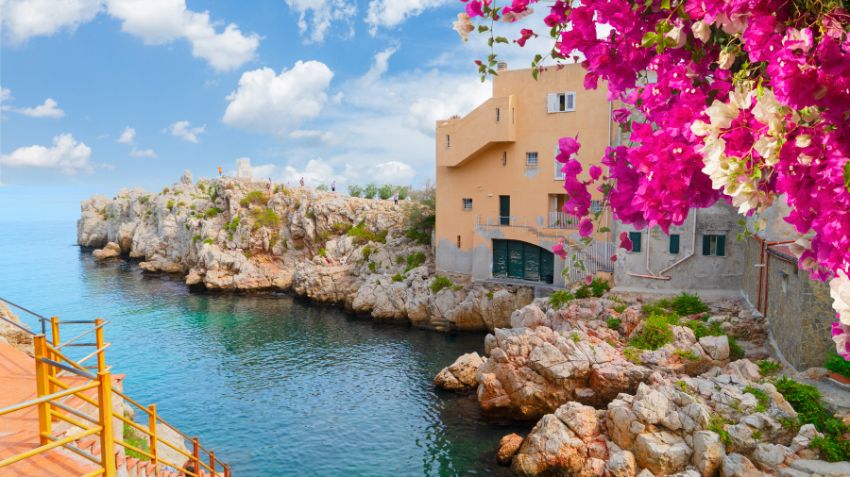
Palermo arrives before you’re ready for it. The smell of frying panelle, the sound of a vendor calling over a cart of sea urchins, a Norman tower rising above a tangle of laundry lines — the city doesn’t stage its character, it just has it. This first-time traveler guide to Palermo is written for the kind of traveler who wants to understand what the city actually feels like before they land, not just what it contains.
Sicily’s capital sits at a specific crossroads of culture and climate that you don’t fully absorb from photographs. Arab-Norman architecture, North African market energy, Baroque excess and the Mediterranean’s insistence on slow lunches all press against each other in a city that is compact enough to walk but dense enough to take time. The historic quarters cover a lot of ground for their footprint.
In summer the city runs on a rhythm that rewards late starts and long evenings. Mornings belong to the markets. Afternoons belong to shade and coffee. After 18:00 the streets fill again, dinner drifts toward 21:00 or later, and the piazzas stay active past midnight in ways that feel natural rather than performative.
What Palermo feels like for first-time visitors to Sicily
The historic centre is divided into four quarters by two crossing streets, a layout that dates to the Arab period and still shapes how you move through the city. Each quarter has a different density and character. Ballarò, in the southwest, is the most active market zone — produce vendors, street food stalls and a noise level that peaks before 13:00. The Kalsa, closer to the waterfront, is quieter, with a concentration of palaces and churches that have been partially reclaimed after decades of post-war neglect. The result is a mix of restored facades and atmospheric decay that some travelers find genuinely arresting.
Vucciria market, long famous and increasingly photographed, runs at a lower intensity than Ballarò for most of the morning but transforms at night into an outdoor social zone where locals drink and eat at plastic tables in the alleys. The shift happens around 20:00 and is worth experiencing at least once, though it runs loud.
The churches arrive at a rate that can recalibrate a day. Palermo has more Norman-Arab-Byzantine monuments per square kilometre than almost anywhere in Europe. The Palatine Chapel inside the Royal Palace and the Martorana church near the Quattro Canti are the two most direct encounters with the Arab-Norman aesthetic — gold mosaics, geometric tilework, a visual language that exists nowhere quite the same way. Early morning visits, before guided groups arrive, give you the mosaics in near-silence, which is when they register most clearly.
Is Palermo right for your travel style?
Palermo works well for travelers who can let a day unfold rather than schedule it. The city’s logic is not linear — one church leads to a street, a street to a market, a market to a courtyard that opens onto something unexpected. Travelers who move slowly and follow curiosity tend to feel the city reward them. Those who plan tight itineraries often find the rhythm resistant.
Travelers who enjoy slower Italian cities with a strong food culture often continue with the Rome travel guide to compare how the capital differs in rhythm and scale.
The city also suits travelers who eat adventurously at street level. Much of Palermo’s best food is sold from carts or small counters: arancine, sfincione, panelle in sesame rolls, stigghiola grilled over charcoal. If that register doesn’t interest you, or if you need restaurant consistency, Palermo still has options, but some of its most distinctive character will remain at a distance.
First-time visitors who are sensitive to urban density may find the central quarters a lot to absorb in the first day. The Kalsa tends to offer a natural decompression — wider streets, fewer vendors, more chance to sit in a courtyard. Starting mornings in Ballarò and spending afternoons in the Kalsa or near the waterfront is a rhythm that tends to work better than staying in one zone all day.
How to get around Palermo as a first-time visitor
Arriving from the airport by train is the most practical option for the majority of first-time visitors. The Trinacria Express runs to Palermo Centrale in roughly 50 minutes, with a consistent schedule and reasonable cost. From the central station, most accommodation in the historic centre is within a 15- to 20-minute walk, though dragging luggage across certain cobbled stretches in summer heat is worth factoring into the decision to take a taxi for the final stretch.
If Sicily is only one stop in a wider Italy journey, the Italy itinerary guide explains how Palermo fits alongside the country’s classic city route.
The historic centre itself is walkable across most of a day. The main quarters sit close together, and the distances that look significant on a map are often 10 minutes on foot. The metro is limited in scope — two lines that cover the central corridor and connect to some residential areas — but for most of what a first-time visitor wants to see, it operates as a supplement rather than the main system. Buses fill the gaps to areas further from the centre.
Taxis are available at main ranks and bookable by phone, though ride-app coverage is less consistent than in northern Italian cities. For arrivals late at night or with significant luggage, having a pre-arranged transfer from the airport removes uncertainty. Within the city, the combination of walking and occasional buses covers the range of most first visits.
The Quattro Canti intersection works as a useful anchor point for orientation. From there, every major quarter is within a short walk in a different direction, which makes returning to it a natural reset when a route becomes unclear.
Day trips from Palermo worth taking
Monreale sits about 8 kilometres southwest of the city centre and is the most direct extension of the Arab-Norman circuit. The cathedral there contains one of the largest intact Byzantine mosaic programmes in the world, covering the interior in gold-ground scenes that take time to read properly. Local buses run from central Palermo regularly, and the journey takes around 30 minutes. Most visitors go in the morning and return for lunch, though the town itself warrants a slower walk if the afternoon light is good.
Travelers comparing Sicily with mainland Italy for a future trip may also find the Naples travel guide useful, as both cities share a strong street-food culture and an energetic urban character.
Cefalù, about 70 kilometres east along the coast, is reachable by train in under an hour and offers a different register entirely — a smaller Norman cathedral, a compact historic centre on a promontory, and a beach that is considerably quieter than anything near Palermo in peak summer.
It works as a natural cooling-down day if the city’s intensity has been continuous. Travelers weighing a longer stay in Sicily sometimes use Cefalù as a quieter counterpoint to Palermo’s pace, in the same way that some Italian city visitors move between a dense urban base and a slower coastal stop — a logic the first-time Venice guide explores for a different kind of itinerary.
The fishing village of Scopello, further west, and the salt flats near Marsala are both worth considering for travelers staying four or more days, though they require more planning and either a rental car or a tour connection.
If you’re building a broader Italian context for a first Palermo trip, the Bologna travel guide covers a northern Italian city whose food culture and compact historic centre create an interesting counterpoint to the southern Mediterranean register Palermo operates in.
Explore slow-travel and long-stay-compatible destinations across the Mediterranean
Is Palermo worth visiting for a first trip to Sicily?
For a first-time traveler guide to Palermo, the honest answer is that the city is one of the more layered entry points into Italian travel precisely because it doesn’t behave like the rest of Italy. The cultural register is its own — part North African, part Norman, part Baroque, with a food culture that operates almost entirely at street level and a social pace that follows the sun rather than a schedule.
Travelers deciding between Sicily and northern Italy often continue with the Florence travel guide to compare two very different Italian travel experiences.
It suits travelers who can absorb ambiguity alongside beauty, who don’t need every surface polished, and who eat well from a paper napkin. It suits the traveler who finds a city more interesting when it has clearly lived in itself rather than arranged itself for visitors.
The summer rhythm — slow afternoons, active evenings, markets at dawn — is not a limitation but a structure that produces some of the most pleasant hours Palermo offers. Travelers who arrive expecting a conventionally curated Italian city experience will need to recalibrate quickly. Travelers who arrive curious about what makes a place itself tend to find Palermo more than they expected.
Palermo first-time visitor FAQ: days needed, best time, airport transfer, neighbourhoods and street food
1. How many days do you need in Palermo for a first visit?
Three full days gives you enough time to move through the main historic quarters, eat at the street markets, and follow the city’s natural rhythm without rushing. Four days allows a day trip to Monreale or the coast and a slower pace overall.
2. What is the best time to visit Palermo?
May, June and September offer the clearest balance of warm weather, functioning markets and manageable visitor activity. July and August are significantly hotter and busier, but Palermo’s evening culture — long dinners, late piazza life, sea breezes after dark — means the city still works well for travelers who adapt to a later-starting day.
3. Is Palermo good for first-time visitors to Sicily?
Palermo is a strong first entry point into Sicily because it concentrates the island’s contrasts in one place — Arab-Norman architecture, North African market culture, Baroque churches and seafood you eat standing up. The city is denser and more layered than other Sicilian stops, which suits travelers who prefer to read a place slowly rather than move between attractions.
4. How do you get from Palermo airport to the city centre?
The Trinacria Express train runs between the airport and Palermo Centrale in around 50 minutes and is the most straightforward option for most arrivals. Buses also connect to the waterfront area near the port, which is useful if your accommodation sits north of the central station.
5. What neighbourhoods should first-time visitors to Palermo stay in?
The area around the Quattro Canti and the Kalsa quarter puts you within walking distance of the main markets and churches, with a slightly quieter character than the Ballarò corridor. Staying near the waterfront works well for travelers who want to start mornings with a coffee by the port before the city properly wakes up.